The strongest family costume ideas do not come from buying the same thing four times. They come from deciding which visual signal carries the story – a color, a shape, a print, or one memorable prop – and then letting every person interpret it at a comfort level that makes sense for them. That approach leaves more room for personality, especially when ages and movement needs differ.
For Halloween costume planning, start by choosing the detail that must read from a few steps away, then make everything else support it. A repeated color can do more work than identical fabric, while one oversized silhouette can give a whole group a center of gravity. The practical goal is a look that still feels clear after jackets, snack breaks, and a long walk.
1. Pierrot Sisters With Pumpkin Buckets
The two clown costumes read as Halloween Pierrots, with their pointed hats, oversized pom-poms, and pumpkin trick-or-treat buckets naming the character idea. These cream Pierrot-style outfits share the same tall hats, ruffled collars, pom-poms, and loose jumpsuit proportions, so the pair reads as connected before the details even register. Pink ruffles soften one look, while blue stripes sharpen the other and keep the cream base from feeling too precious. That split is a smart answer when two children want to coordinate without disappearing into a single matching costume.
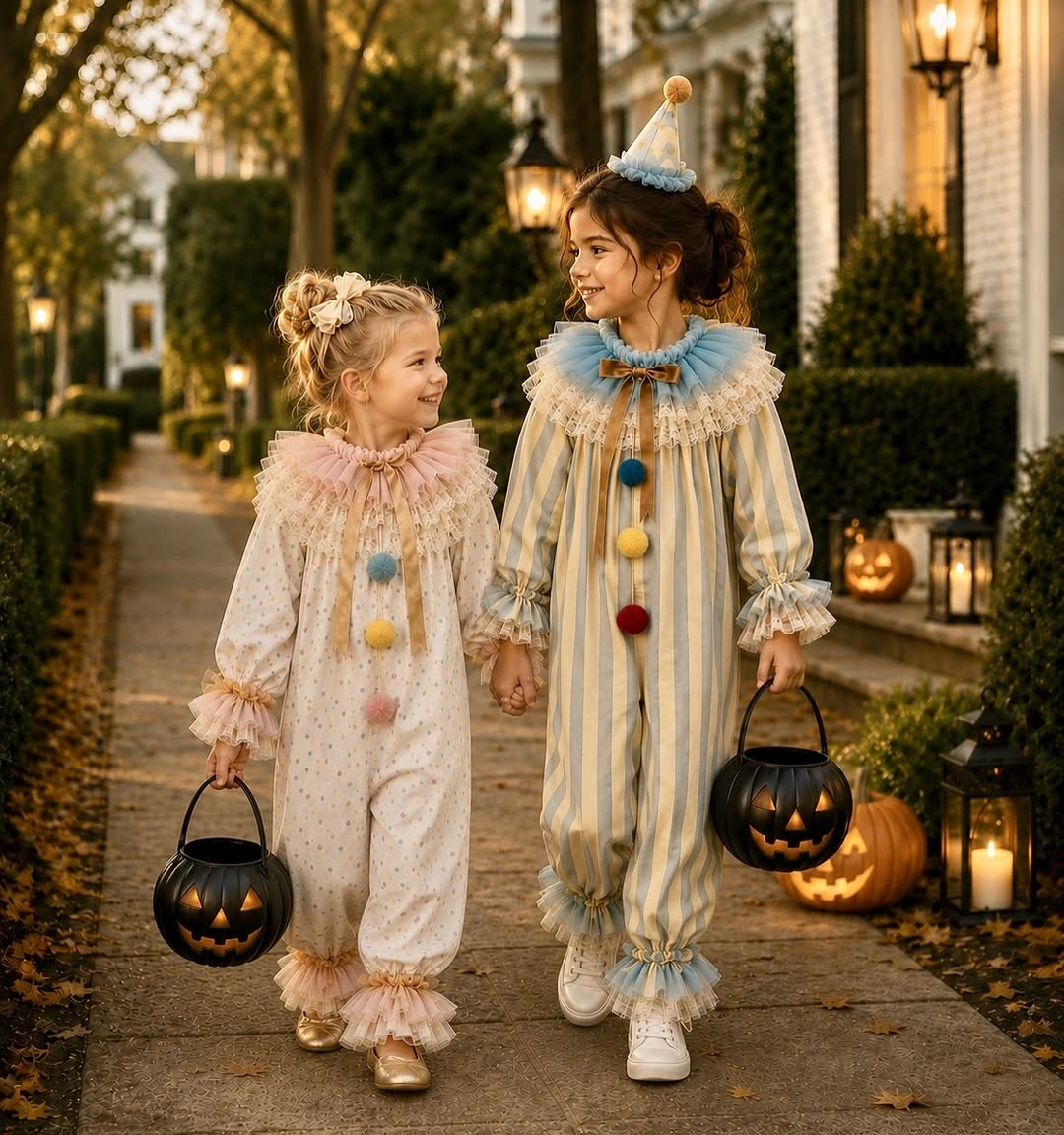
The large pom-poms give each costume a vertical rhythm, and the pumpkin buckets echo the rounded shapes without adding another color direction. If the hats feel too dramatic for part of the evening, the ruffled collars and wide silhouettes would still preserve the costume idea on their own. Keep shoes light and simple here so the two color stories remain the focus.
For a similar family pairing, choose one shared costume pattern and assign each child a separate accent shade rather than changing every component. A warm blush and a cool blue work because both remain gentle against cream, but orange and green or red and black could create a more graphic version. The color decision is what keeps the idea coherent.
2. Fantasy King, Queen, and Young Royal Court
The white beard, crown, gold dress, and long draped layers establish a storybook royal family rather than an ordinary dress-up palette. A white beard, crown, gilded dress, draped lavender skirt, and dark tunic create different fantasy roles without breaking the group’s visual logic. Pale ivory and metallic gold appear across the adults, while lavender gives the younger figure a softer point of contrast. The result feels more organized than a costume group built from unrelated character colors, even though the silhouettes are all doing different jobs.
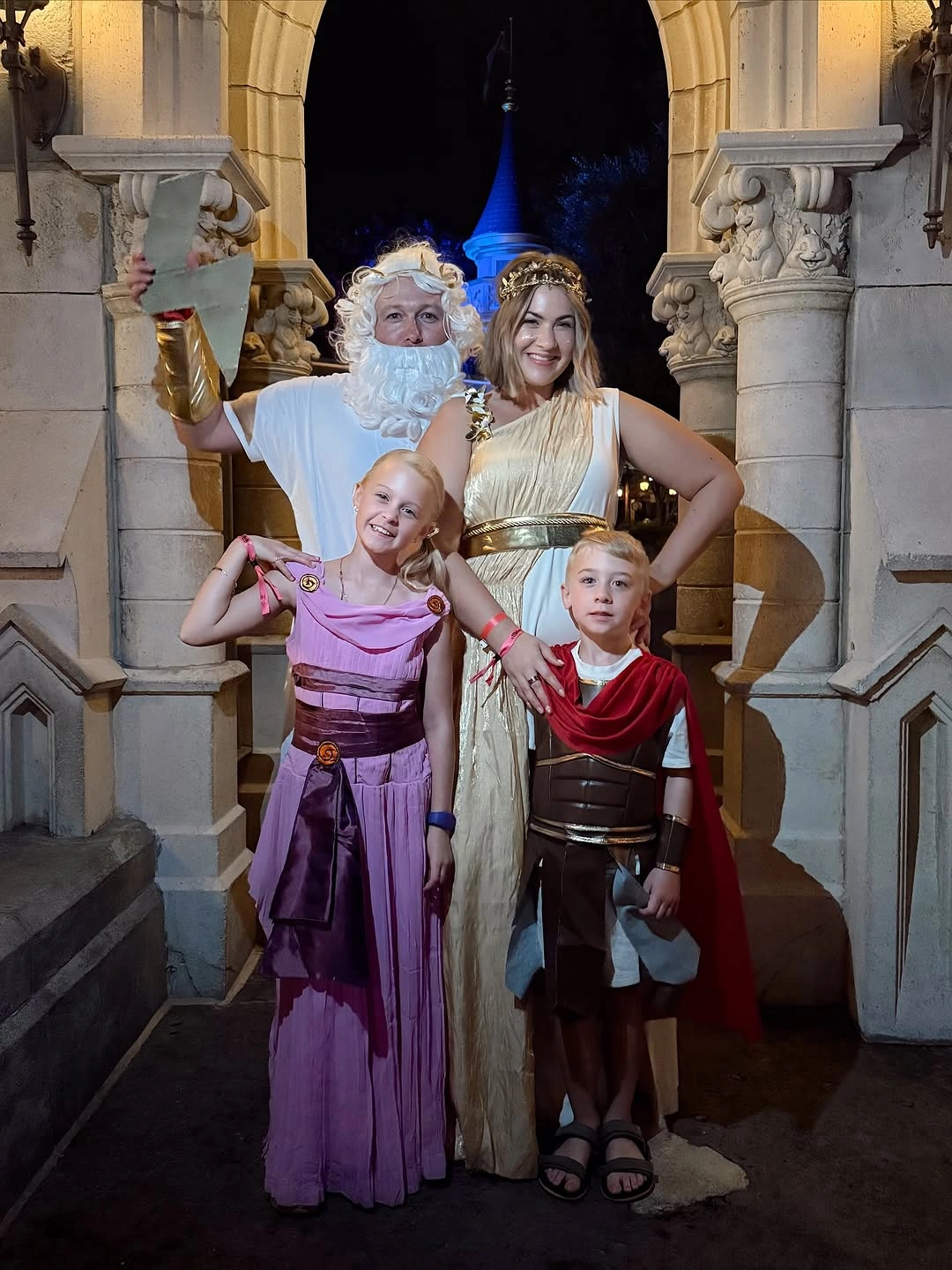
Long robes and dresses add height, so the shorter tunic and child-scale outfit prevent the group from becoming one tall column of fabric. Gold accessories are useful here because they repeat the warm highlight without demanding another full garment. For a cold evening, a plain cream layer underneath would keep the palette intact far better than a random dark coat.
Families who prefer a less literal theme can borrow the palette rather than the exact roles: ivory tops, soft purple skirts, and one gold accessory per person would make the same point. The trick is limiting the group to two main neutrals and one accent color. That restraint lets varied costume shapes feel like deliberate casting rather than last-minute substitutions.
3. Colorful Cartoon Animal Character Family
The hooded animal faces and saturated yellow, blue, and orange outfits make this a playful cartoon-character group, while the adult outfit supports their color world. The children’s yellow, blue, and orange hooded outfits provide the immediate color hit, while the purple graphic top and plaid skirt give the adult a recognizable but more flexible costume route. Saturated color is doing most of the storytelling, not complicated tailoring or layers. That matters for a family costume because one adult can stay comfortable and still look visually connected to the brighter pieces.
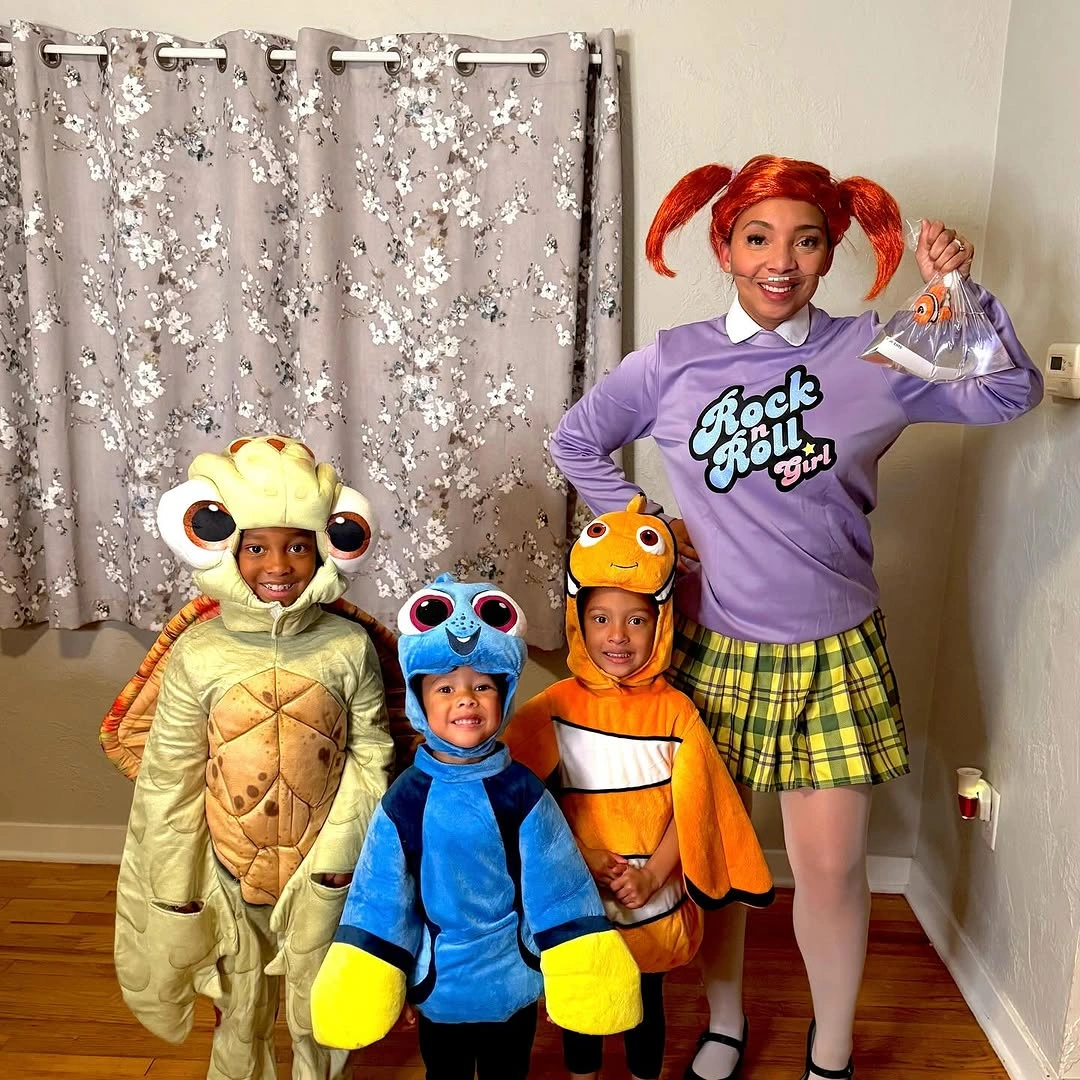
The plaid skirt adds a second pattern, but it works because it repeats the yellow and purple already present in the group. If movement or indoor heat is a concern, the adult look could be reduced to a colored top, skirt, and one small themed accessory without losing its role. The hooded children’s suits then remain the playful center.
Use this formula when children want distinct characters but adults do not want a full disguise: reserve the clearest costume shapes for the kids and build the adult look from separates. A single color that appears in at least two places will keep the connection visible. It is the fun option when comfort needs to stay high on the list.
4. Teddy, Surgeon, and Animal Costume Mix
A pink teddy, a skeleton-like surgeon, and small animal costumes turn this into a deliberately mixed Halloween character family, not a coordinated fashion look. Fuzzy pink and brown animal suits sit beside a white outline-based costume, giving this group contrast before any individual reference needs to be named. Plush surfaces create volume, while the flat black linework on the white outfit reads cleaner and narrower. That difference makes every person easy to spot, which is especially useful when a small group has mixed ages and different costume preferences.
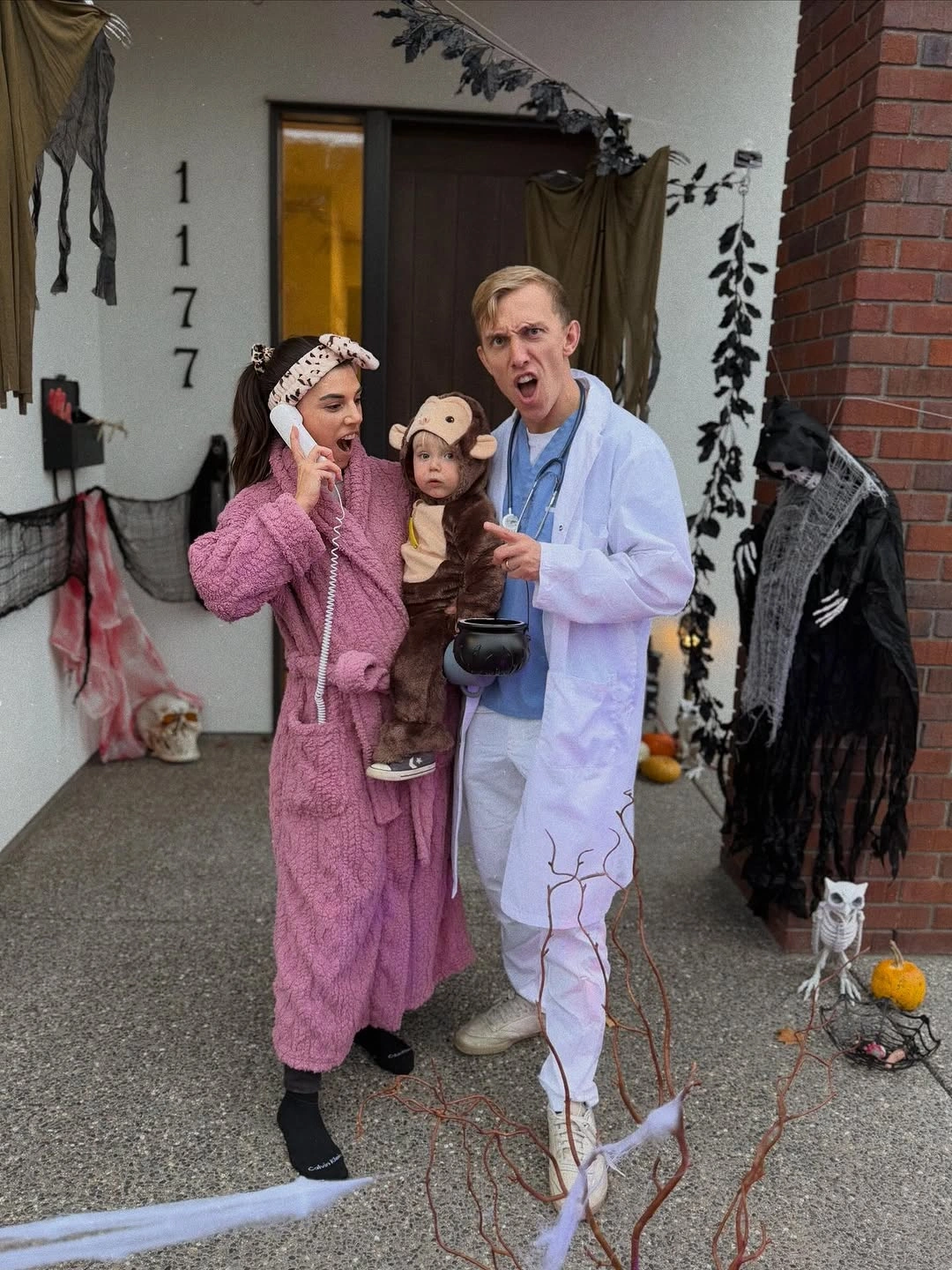
The soft materials are strongest when they are balanced by one crisp graphic look rather than another fuzzy piece in every position. A simple black shoe or dark legging can quietly connect the group and make the lighter white costume feel less isolated. Avoid adding several unrelated hats here, because the costume textures already provide enough information.
For a practical variation, give the youngest child the coziest one-piece and let older family members choose printed separates with a similar palette. That keeps the visual mix intentional while allowing easier bathroom breaks and temperature adjustments. The contrast between plush and graphic texture is the detail worth preserving.
5. Harry Potter Family With a Young Witch
The round glasses, dark wizard styling, and witch-like black dress point toward a Harry Potter-inspired household with a bright child character at the center. Black lace, dark stripes, burgundy tones, and round glasses give the adults a moody storybook direction, while the child’s pink outer layer becomes the lively focal point. The family does not rely on exact matching, but the adults’ repeated darkness keeps the different costume references from drifting apart. It is a useful color strategy when one child has a favorite outfit that is much brighter than everyone else’s.
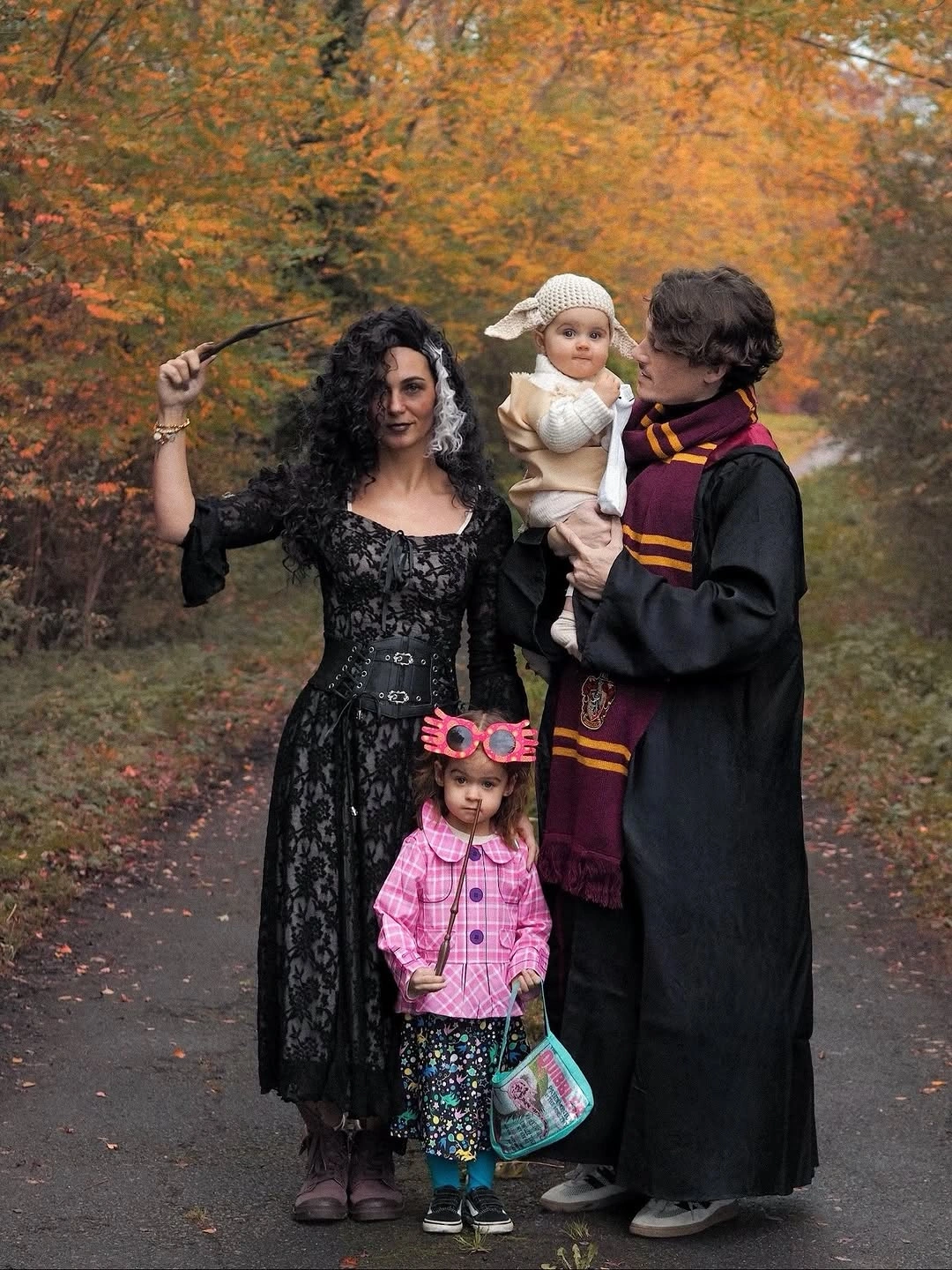
The vertical stripe pattern and long dark dress create two strong adult silhouettes, leaving the child’s shorter coat and patterned trousers easy to read in the middle. A black bag, boots, or hat could extend the connection if the group needed more continuity, but extra color would weaken the point. Let the bright child look stay alone as the color moment.
When assembling a mixed-reference family costume, decide whether the adults should frame the children or compete with them. This composition chooses framing, which makes sense for a group photo and for keeping a young child visible in low light. The shared dark base is what gives the idea its structure.
6. Wizard of Oz Family Character Lineup
The pink princess, green witch-like adult, pointed hats, and metallic child look create a Wizard of Oz-style cast with recognizable roles. A pink full skirt, green-and-black adult outfit, witch hat, cowboy-style hat, and white uniform-inspired costume make this a large group with very different volumes. The longest and widest shapes sit toward the outside, while smaller figures occupy the center, so the arrangement remains readable. That kind of proportion planning is more useful than forcing every person into the same genre.
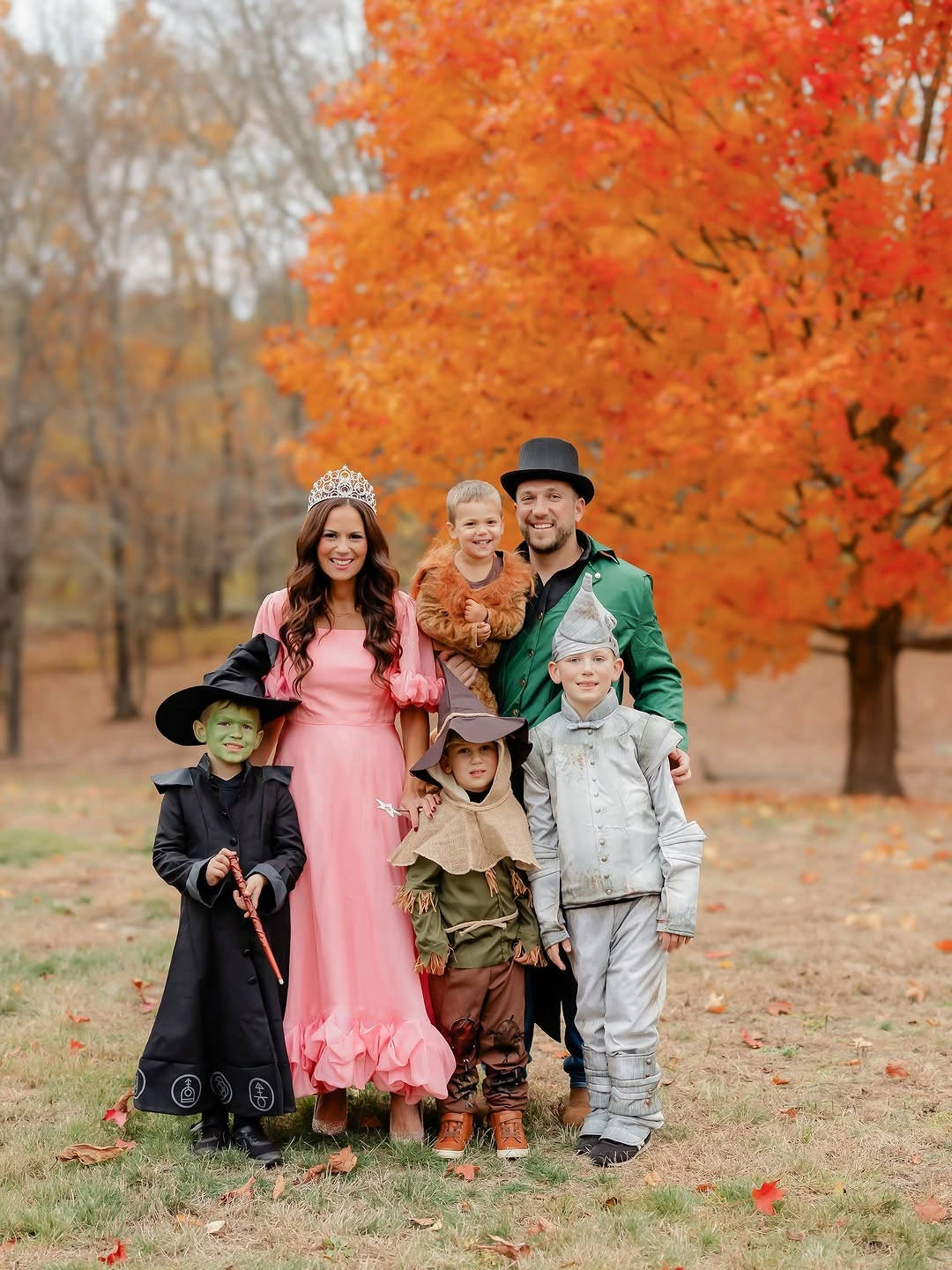
Each person gets one clear identity cue: a hat, a dress silhouette, a color block, or a uniform-like outline. If the group is walking rather than posing, choose shoes first and let the costumes build upward from that practical base. For family-photo coordination beyond Halloween, the same principle appears in family outfit coordination that balances scale instead of forcing sameness.
Large groups look calmer when the boldest costumes are separated rather than clustered in one corner. Here, pink, green, black, tan, and white are distributed across the frame, giving each visual weight somewhere to land. The best adjustment would be to keep accessories simple once those main silhouettes are set.
7. Shrek, Donkey, and Puss in Boots Pair
Green ogre makeup, the donkey prop, and the small booted companion make the Shrek reference immediately legible as a parent-child Halloween story. The green ears, broad brown vest, cream shirt, and small booted companion form a clear two-role story without requiring a matching uniform. The adult costume has the larger silhouette, while the child’s hat and boots hold the supporting role in a compact, playful way. That size contrast makes the pairing read quickly even when the group is moving rather than standing still.
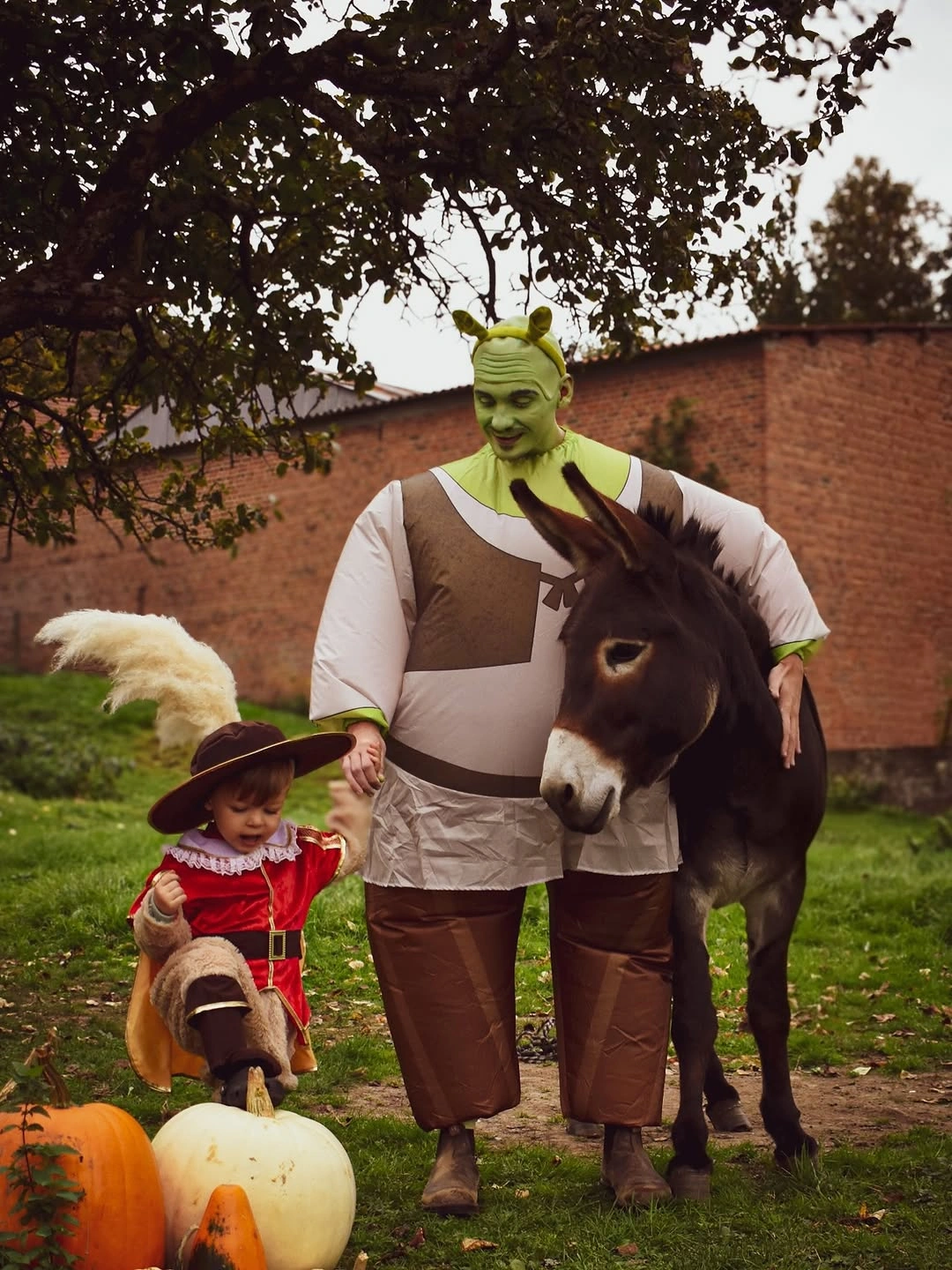
Brown, cream, and green repeat across both looks, which is why the stuffed donkey prop feels like a continuation rather than a separate visual idea. A child who dislikes a mask could keep the hat and vest while wearing warm basics underneath. The costume works because the most recognizable pieces are placed high on the body, where they stay visible.
Parent-child costumes benefit from one obvious lead role and one simplified companion role, especially when the child needs an easier fit. Do not overload the smaller costume with every symbol from the story. A hat, boots, and one color cue are enough to preserve the relationship between the two looks.
8. Hogwarts Parents With a Baby Mandrake
The green and mustard layers support a baby dressed as a potted mandrake, giving this family a Harry Potter-inspired costume premise. A brown ribbed baby outfit, terracotta pot shape, and leafy headpiece make the smallest person the clear theme carrier, while the adults use forest green and mustard layers as quiet support. The color family feels grounded without making the parents look like they are wearing costumes they cannot move in. This is a thoughtful structure for a baby who needs softness and an adult who needs pockets and practical shoes.
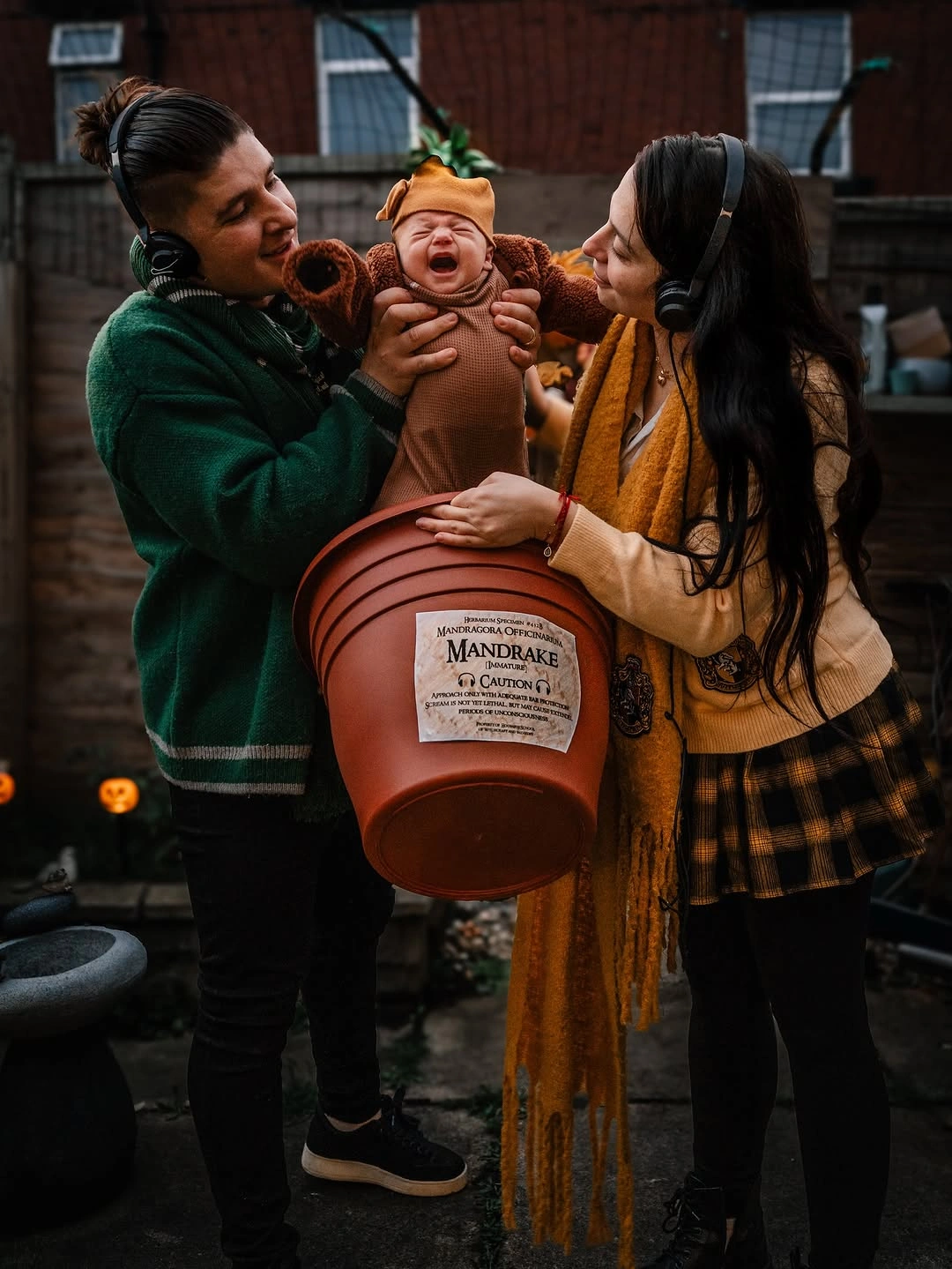
The plaid skirt and mustard scarf add texture, but they stay within the earth-tone range established by the baby’s plant costume. If the pot prop feels awkward for a stroller or car seat, a simple brown romper and leaf headband would communicate the same idea with less bulk. Keep the adult layers matte and low contrast so the baby remains the focal point.
A baby-led concept is often the easiest family route because the adult outfits only need to echo the palette, not imitate the character. Choose supporting colors that look natural as everyday clothes, then add one small themed piece if needed. The earth-tone relationship is what makes this arrangement feel complete.
9. Thing One, Thing Two, and Cat in the Hat
The blue wigs, red-and-white clothes, and bright character colors clearly reference Dr. Seuss’s Thing One and Thing Two world. Red trousers, a red T-shirt, black trousers, white sneakers, and vivid blue hair create an immediate family identity with very few complicated pieces. The adult outfits remain close to casual clothing, yet the wig colors and compact bright accents make the transformation unmistakable. That balance is useful for families who want a strong visual effect without navigating capes, masks, or bulky one-pieces.
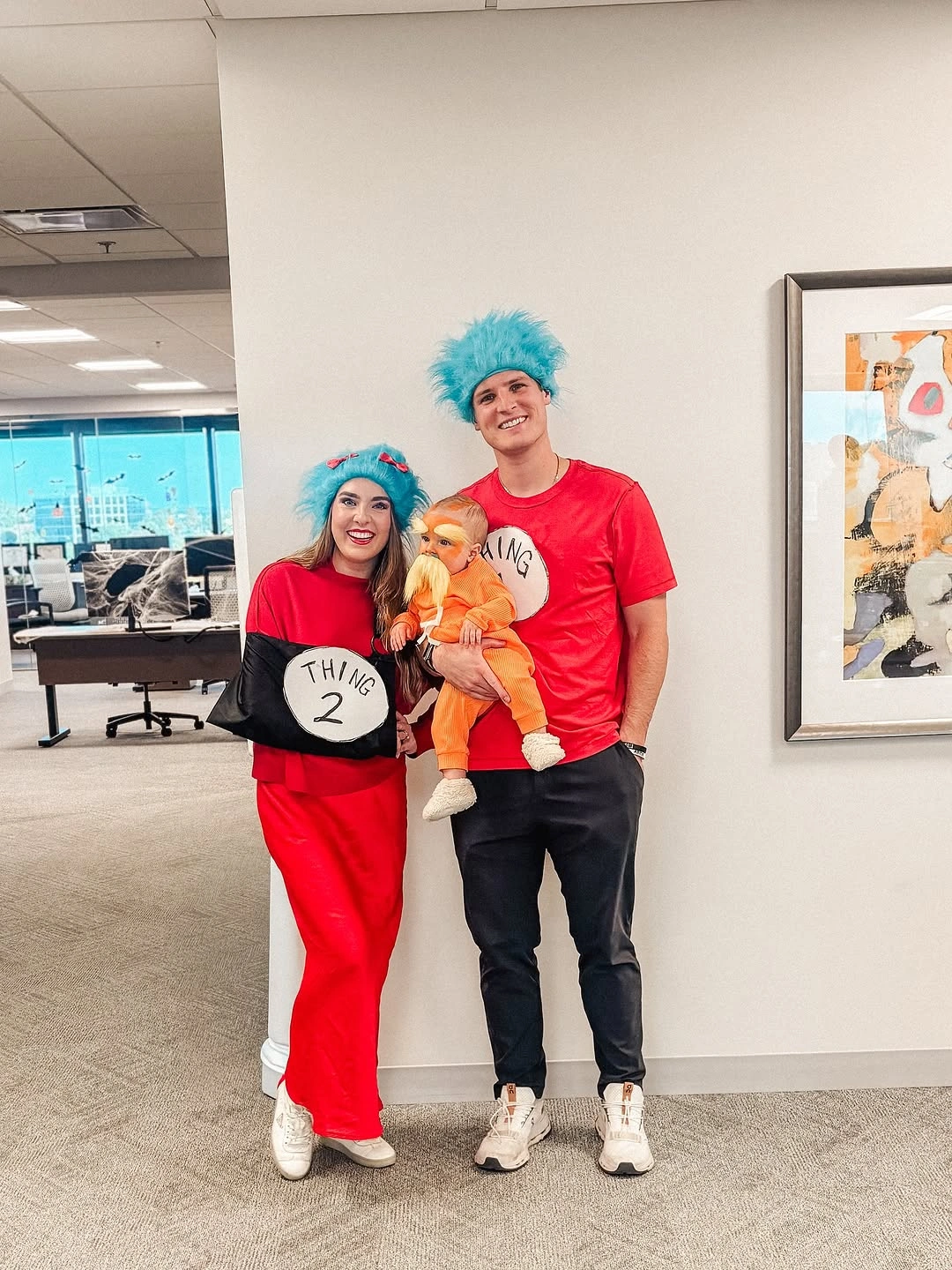
Blue and red repeat just enough to bridge the two adult looks, while the baby’s orange hair adds a small warm interruption rather than a competing palette. If the wig is not comfortable for a full evening, a colored beanie or temporary hair accessory could do a similar job. The base clothes should stay plain so the color blocks do not lose their impact.
Use a limited palette when you want a family costume to remain easy to assemble from home. Two strong colors plus black and white are enough to look intentional in person and in photographs. Concentrating color near the face is the decision that makes this version feel lively. It also keeps the visual energy visible when the group is wearing everyday shoes and outer layers.
10. Sea Characters and a Crowned Little Mermaid
A mermaid-like green skirt, dark sea-costume layers, and a crowned child create an underwater Halloween character story rather than unrelated costumes. Sea green, black, pale blue, and silver create a cool-toned family direction even though the adult silhouettes are quite different. One adult wears a dark tunic with gold trim, another has a flowing green-and-black skirt, and the child’s pale blue dress and small crown catch the eye. The group works because the lightest color is reserved for the smallest central figure.
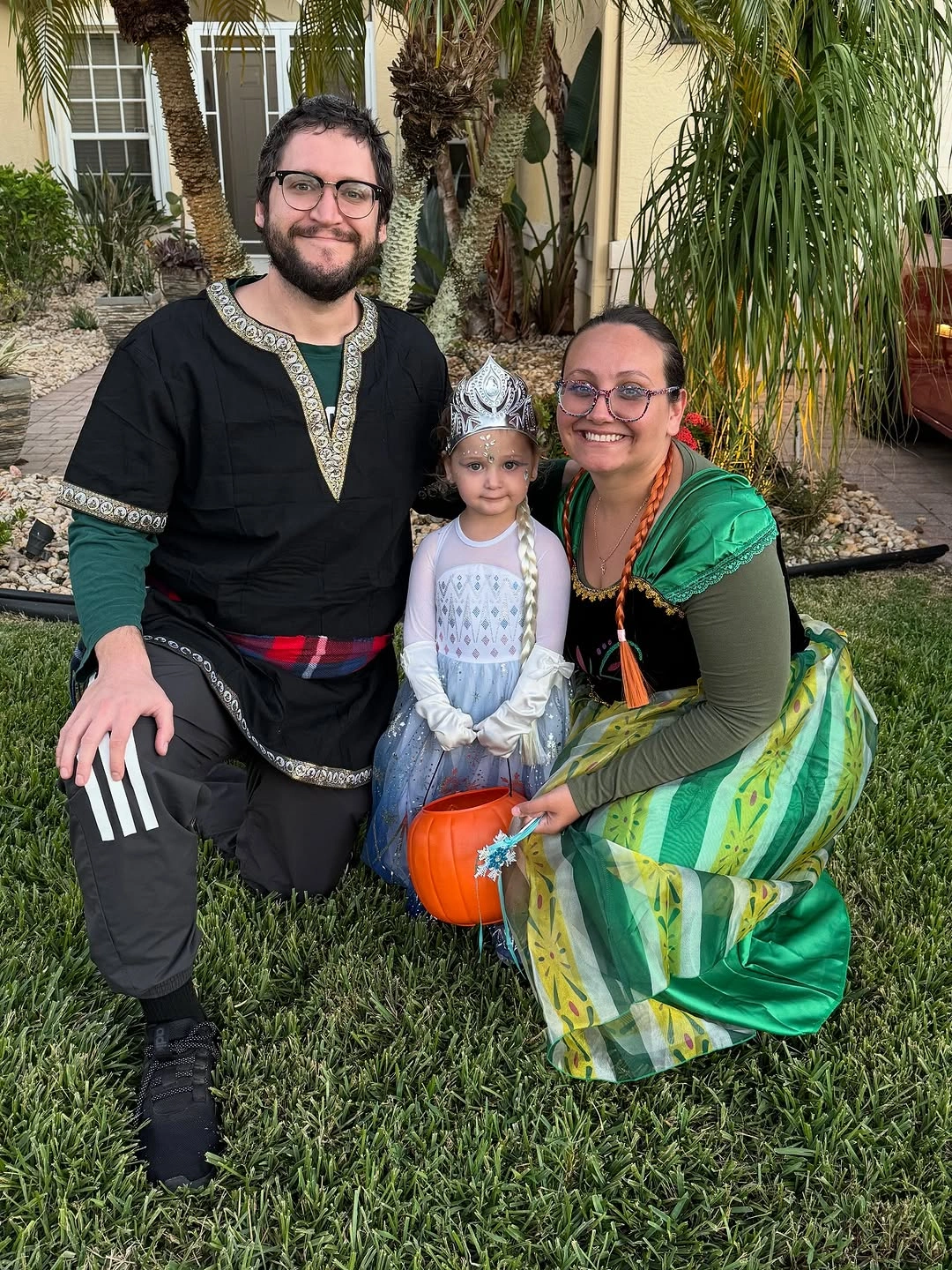
Flowing skirt movement gives the adult costume texture, while the child’s structured dress keeps the group from becoming all dark drape. An orange pumpkin bucket is a useful practical object here because it adds a seasonal note without changing the main cool palette. If you wanted less contrast, swap a bright bucket for a dark metallic one.
Different costume roles can still belong together when their undertones agree. Cool greens and blues are calmer beside black than several unrelated brights would be, especially in an evening setting. Reserve the lightest shade for the person you want the eye to find first. That simple hierarchy is more useful than adding a second bold accessory.
11. Lilo and Stitch Family Costume Idea
The blue hooded character suit, orange accent, and tropical color route make the Lilo and Stitch association the key Halloween reference. Mint, soft blue, orange, yellow, and cobalt appear across this family, but the strongest saturation belongs to the children’s hooded costumes. The adults stay in quieter separates, which lets the padded blue and orange shapes read cleanly without visual competition. It is a sensible choice when a family wants the children’s costumes to feel like the main event while parents remain comfortable.
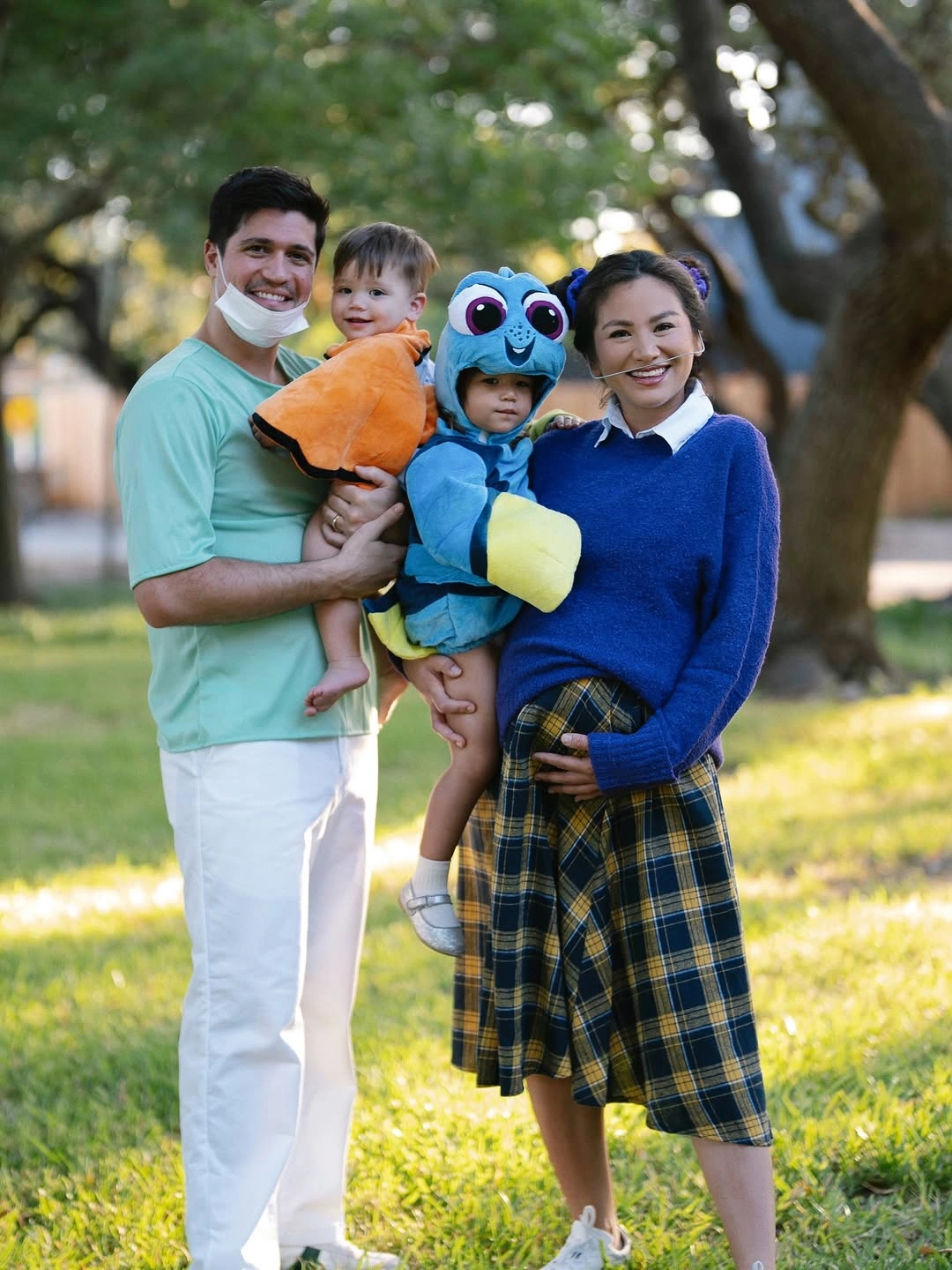
The adult plaid skirt picks up color from the children’s outfits without copying their cartoon scale, and the mint top keeps the opposite side of the group from going visually blank. A more weather-ready version could add solid navy or cream jackets to the adults rather than covering the bright child costumes. The supporting layers should stay low-key for the same reason.
Parents do not need to match a child’s costume literally to look included. Choose one echoing shade, one simple pattern, or one accessory that acknowledges the same palette, then stop there. The contrast between muted and saturated color is what makes the family grouping readable. It also leaves room for practical adult layers when the evening gets cooler.
12. Eighties Workout Costume Family
Headbands, neon leggings, waist bags, and striped socks turn the family into recognizable 1980s aerobics characters for Halloween. Headbands, bright fitted tops, striped socks, leg warmers, and an orange waist bag turn simple black leggings into a clear retro workout-inspired costume. Each accessory is small, but the repeated neon and turquoise accents create a recognizable language across both adults. That is a high-mobility idea for a family event because the base layers are familiar and easy to adjust.
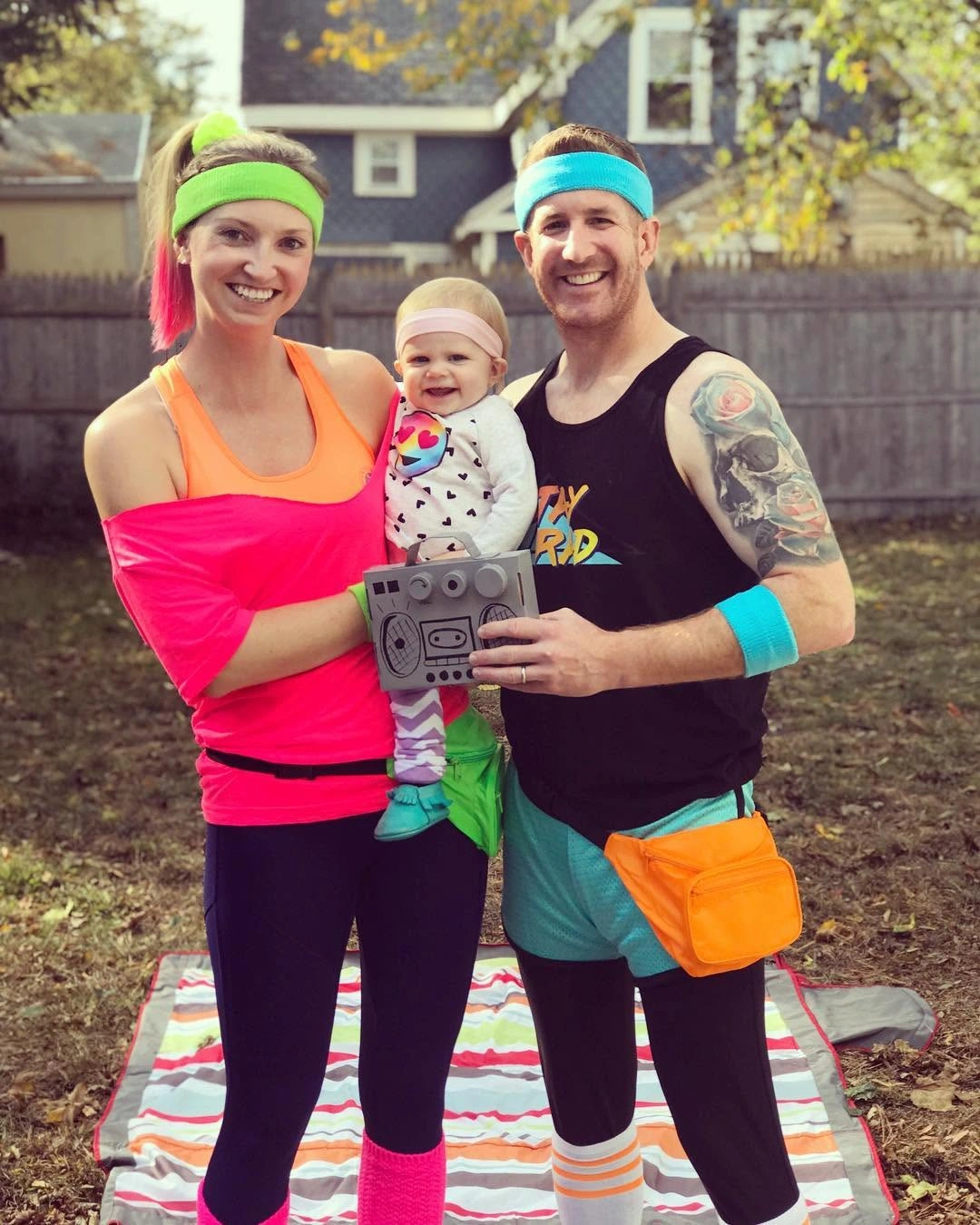
The baby stays close to the adults’ color energy without needing the same number of accessories, which keeps the group from feeling overly staged. If you are building this from existing clothes, prioritize the headband, socks, and waist bag before hunting for exact tops. Those repeated details carry more visual weight than a perfect color match.
Accessory-led costumes work best when every person repeats at least two elements, not just one. Here, bright color and sport-inspired styling create the thread, while the specific pieces can vary by comfort and age. That flexibility is the reason this family idea stays practical. It also makes last-minute fit changes less disruptive to the overall look.
13. Bright Monster Character Family Trio
The full green creature suit, red hooded character, and bright blue dress create a deliberately cartoonish monster-family Halloween cast. Green, red, and bright blue give these three costumes separate identities, while the clothing shapes remain straightforward enough for walking and quick changes. The full green suit is the strongest silhouette, the red hood is compact, and the blue dress creates a lighter vertical line. Because each color occupies a clear role, the group does not need matching prints or elaborate accessories.
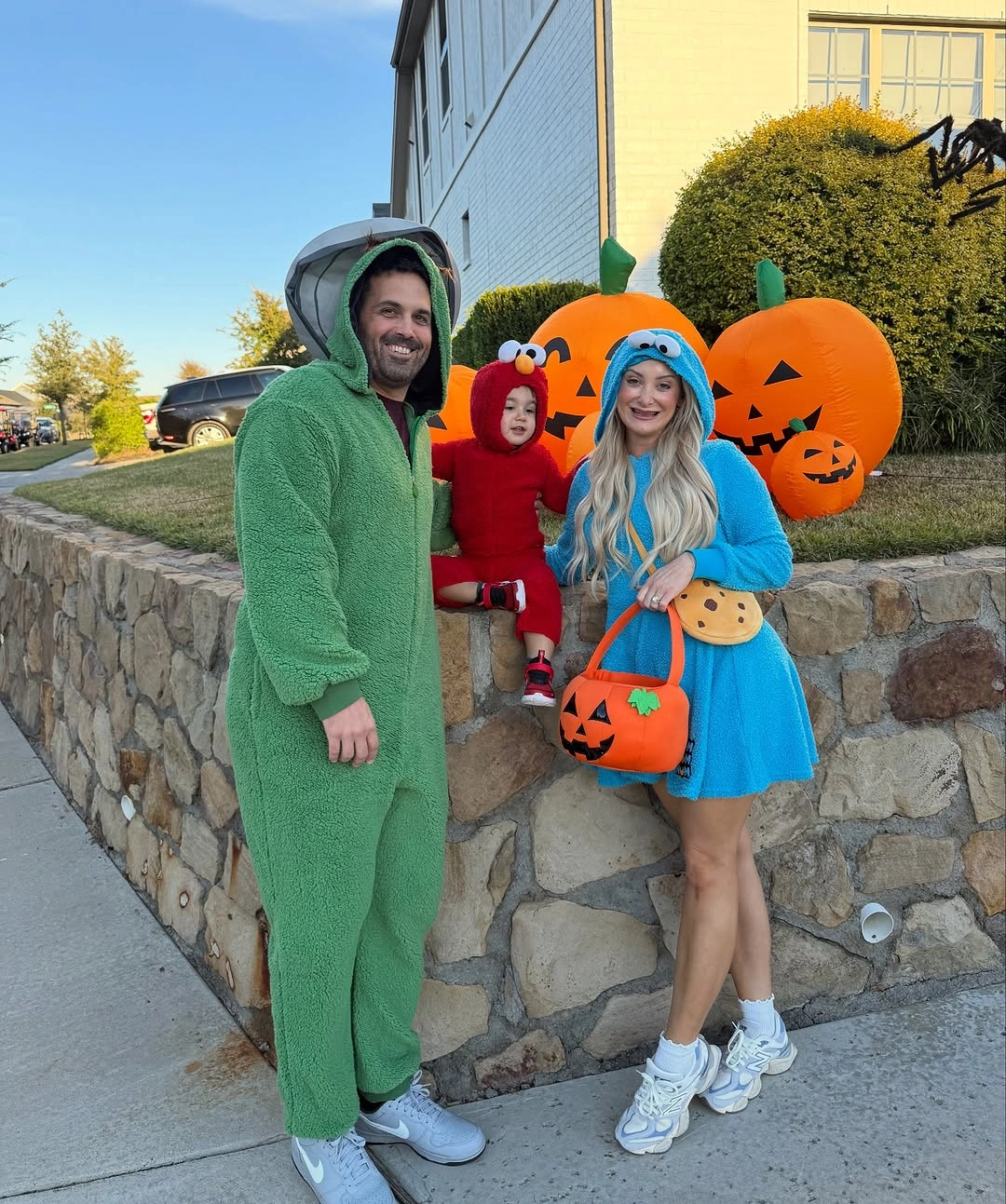
Orange pumpkin accessories repeat across the group and create a small bridge between the three main colors. White sneakers also help by keeping the bottom of the outfits visually light instead of adding a fourth dark color. For an indoor event, that kind of simple shape is easier to layer down than a costume built from several stiff pieces.
A trio needs each person to be distinct, but not equally complicated. Assign one large shape, one strong color block, and one lighter silhouette, then use a small shared accessory to connect them. The clear color roles are what make this family costume feel deliberate. That approach also helps the group stay recognizable when everyone is not standing side by side.
14. Star Wars Family With Darth Vader
The black armored figure, white robed character, and child Stormtrooper make the Star Wars costume family unmistakable. A white robe, black armored suit, and white child uniform rely on crisp black-and-white contrast, while a single orange-red prop supplies the only warm interruption. The palette feels disciplined because every costume uses the same dark and light relationship even though the shapes range from long and flowing to sharply structured. It is a strong option for family members who want different roles within one visual world.
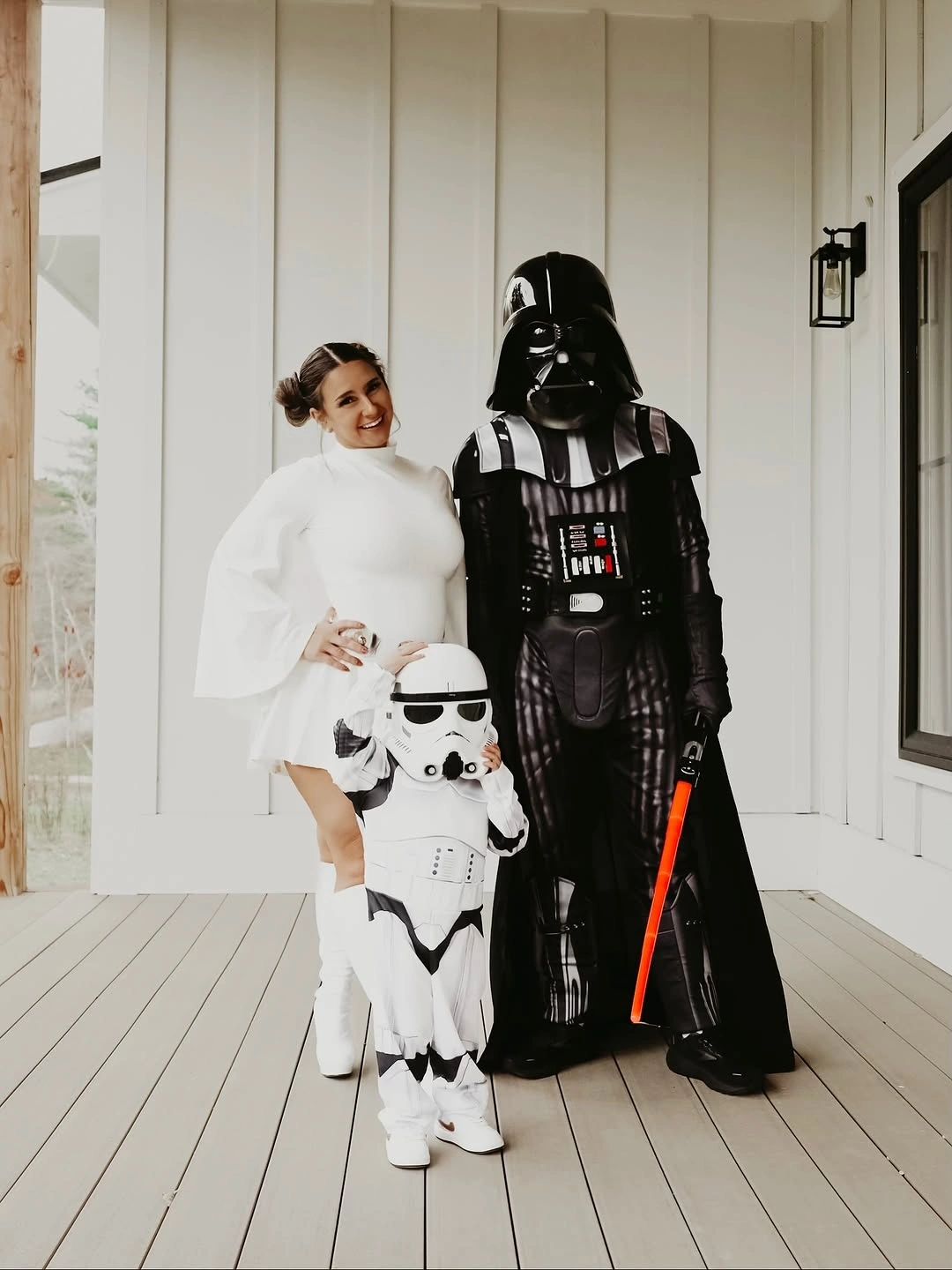
Dark belts and helmet details prevent the white looks from becoming blank blocks, and the black suit creates a useful vertical anchor at one side. A cold-weather layer in either solid black or solid white would preserve the group far better than a bright jacket. The small warm prop should stay singular, because its contrast is doing real compositional work.
When a theme has several strong costume silhouettes, strict color can provide the cohesion that matching pieces cannot. This group would lose clarity if each person added a different accent shade. Keep the black-and-white foundation intact and let one warm detail handle the seasonal energy. A restrained palette also makes replacement accessories easier to choose.
15. Jack Skellington and Sally Costume Pair
The skull face, black-and-white stripes, long red hair, and stitched face detail identify this as a Nightmare Before Christmas pairing. A red wig, pink-striped top, black-and-white striped shirt, and skull-style face detail create a pairing built around lines rather than matching garments. The costumes do not need the same silhouette because stripes repeat near both faces and pull the eye upward. That makes the connection visible in a close photo as well as from across a porch or sidewalk.
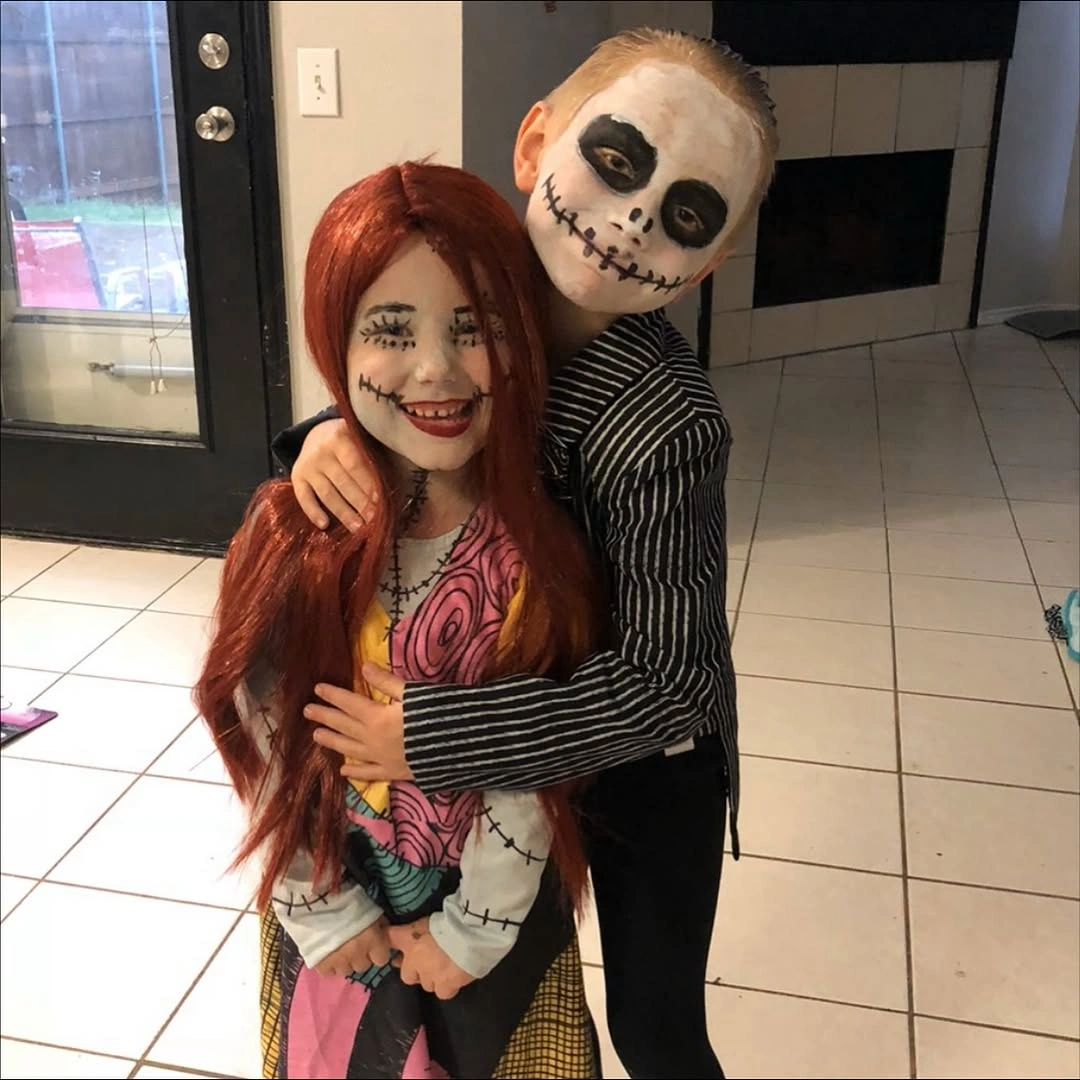
The darker striped outfit gives the composition a firm graphic base, while the red hair and pink top provide a softer, warmer counterpoint. If face paint is not practical, a skull mask or printed hood could preserve the same black-and-white face cue. Do not add several more patterns, since the stripes already create enough movement.
Two costumes can become a pair through one repeated visual device instead of a shared character reference. Here, the device is linear contrast around the head and torso. Keep that motif visible and let the rest of each outfit stay distinct for a more personal result. The pairing will still read clearly if one person removes a less essential accessory.
16. Joker and Harley Quinn Inspired Family
Green hair, printed character clothing, and pink details signal a Joker and Harley Quinn-inspired Halloween family with flexible casual layers. Green hair, a printed white T-shirt, a black jacket, dark trousers, and a bright patterned suit show how a family can suggest character ideas without committing to full head-to-toe disguises. The clothing remains close to everyday layers, so the group is better prepared for a long evening with temperature changes. A few high-visibility cues do the storytelling instead of a pile of costume pieces.
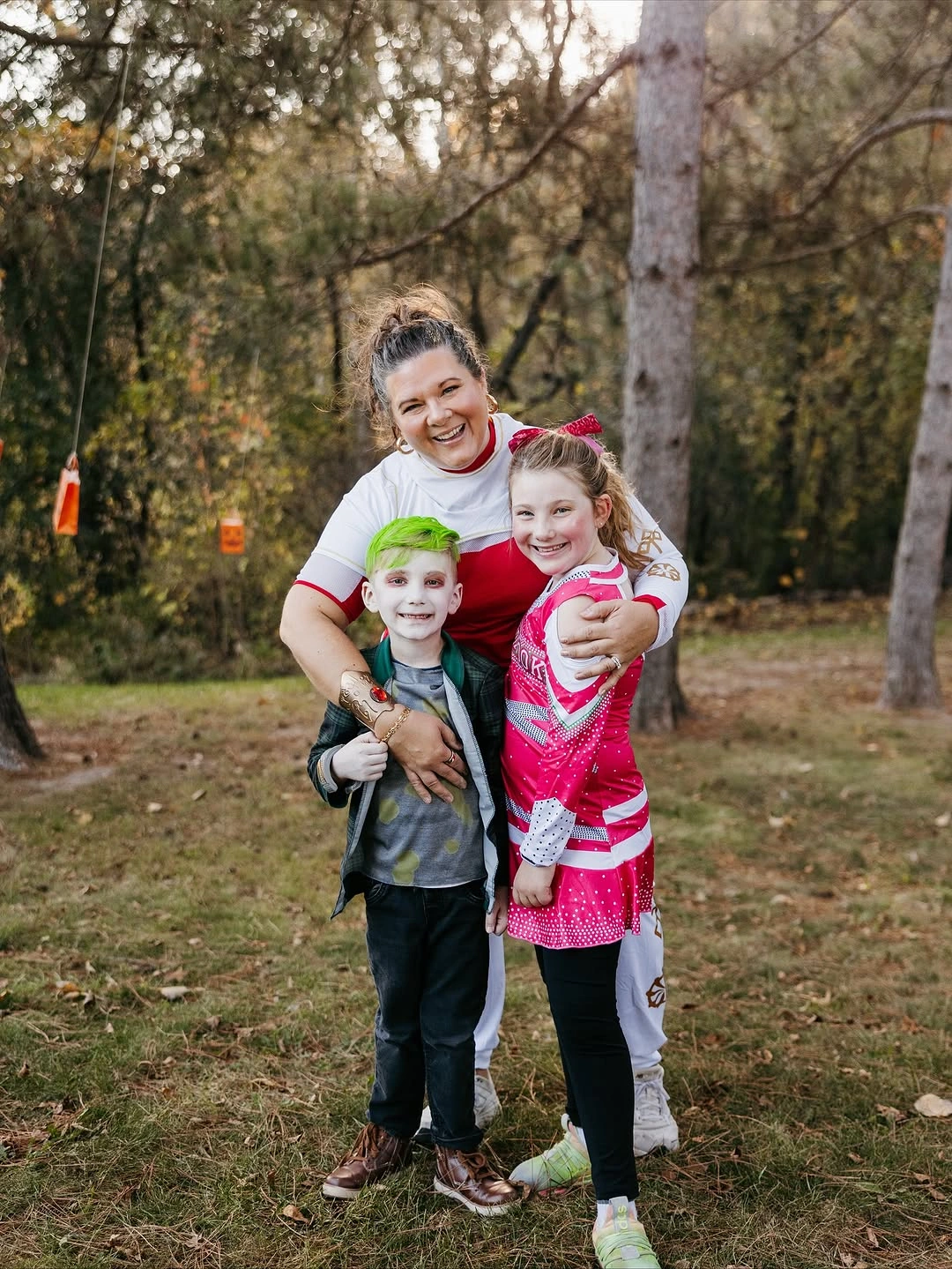
The black jacket and dark trousers act as neutral support for the stronger hair color and printed clothing, keeping the group from looking too scattered. If a child rejects a wig or mask, a colored hood, face sticker, or recognizable graphic can take its place. Comfort is not a compromise here; it is the structure that allows the cues to stand out.
Partial costumes are especially useful when different family members have very different tolerance for texture and layers. Agree on one color range or visual mood, then let everyone choose the level of transformation they can actually wear. The intentional cues are more memorable than forcing a uniform.
17. Jack Skellington Meets Monarch Butterfly
The skeleton suit and oversized monarch wings create a Halloween group where a recognizable Jack Skellington-style figure anchors the fantasy mix. Oversized orange-and-black butterfly wings create the widest shape in this dark family group, immediately giving the eye a place to land among skeleton print, black dresses, and orange accents. The wings do not need to be repeated on everyone because their scale already organizes the composition. That is a useful lesson for a large group with many individual costume preferences.
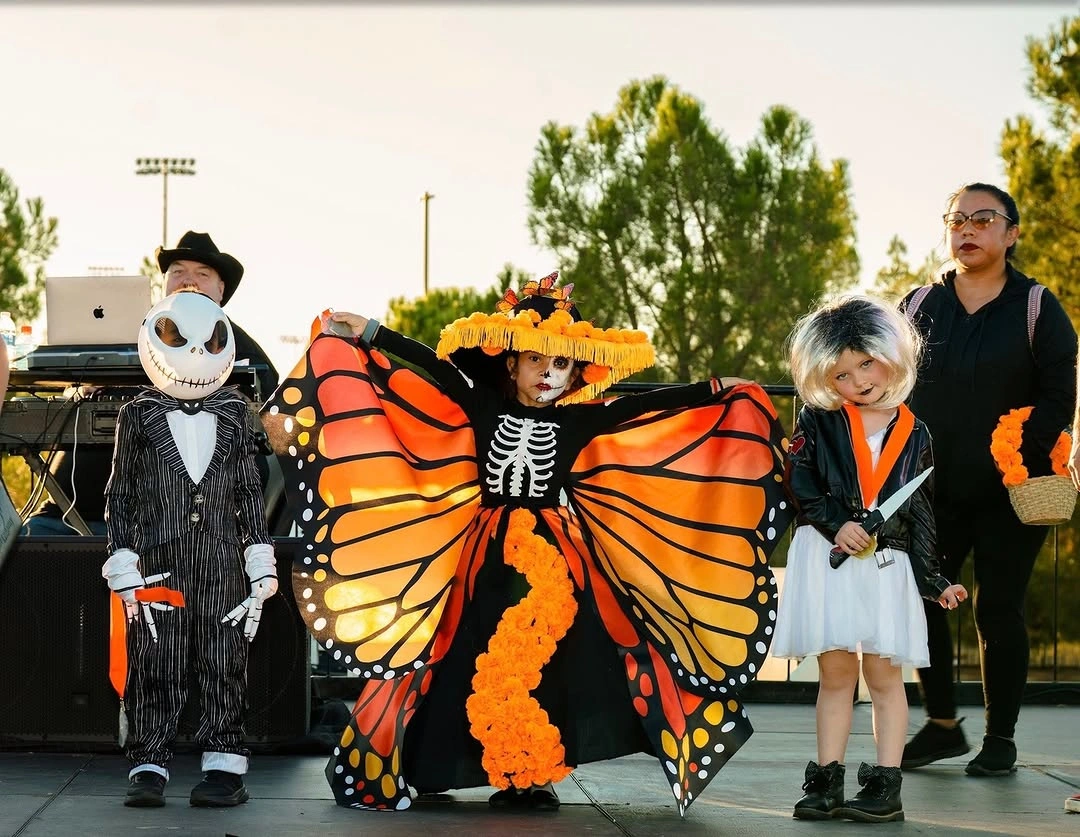
The black clothing around the wings acts like negative space, making the orange pattern appear even more defined. If the winged costume is for a child, make sure the attachment allows easy sitting and doorways; if it is for an adult, keep nearby accessories narrow. One dramatic silhouette is enough to establish the family’s visual center.
Rather than asking every person to match a statement piece, assign one family member the focal costume and let everyone else echo the palette. Orange flowers, a small black-and-white print, or a dark dress can support the same story quietly. The scale contrast is what gives this group its energy. Everyone else then has more freedom to choose a wearable costume shape.
18. Cruella de Vil and Dalmatian Family
The spotted child costumes, black-and-white hair, red gloves, and dark coat make the Cruella de Vil and Dalmatian reference direct. Black-and-white spotted child suits, a dark adult coat, a high-contrast hair detail, and red gloves create a family theme based on one repeated print and one precise accent color. The spots make the group recognizable, while red appears sparingly enough to feel intentional rather than noisy. This approach is especially helpful when you need a theme that reads in a quick photograph.
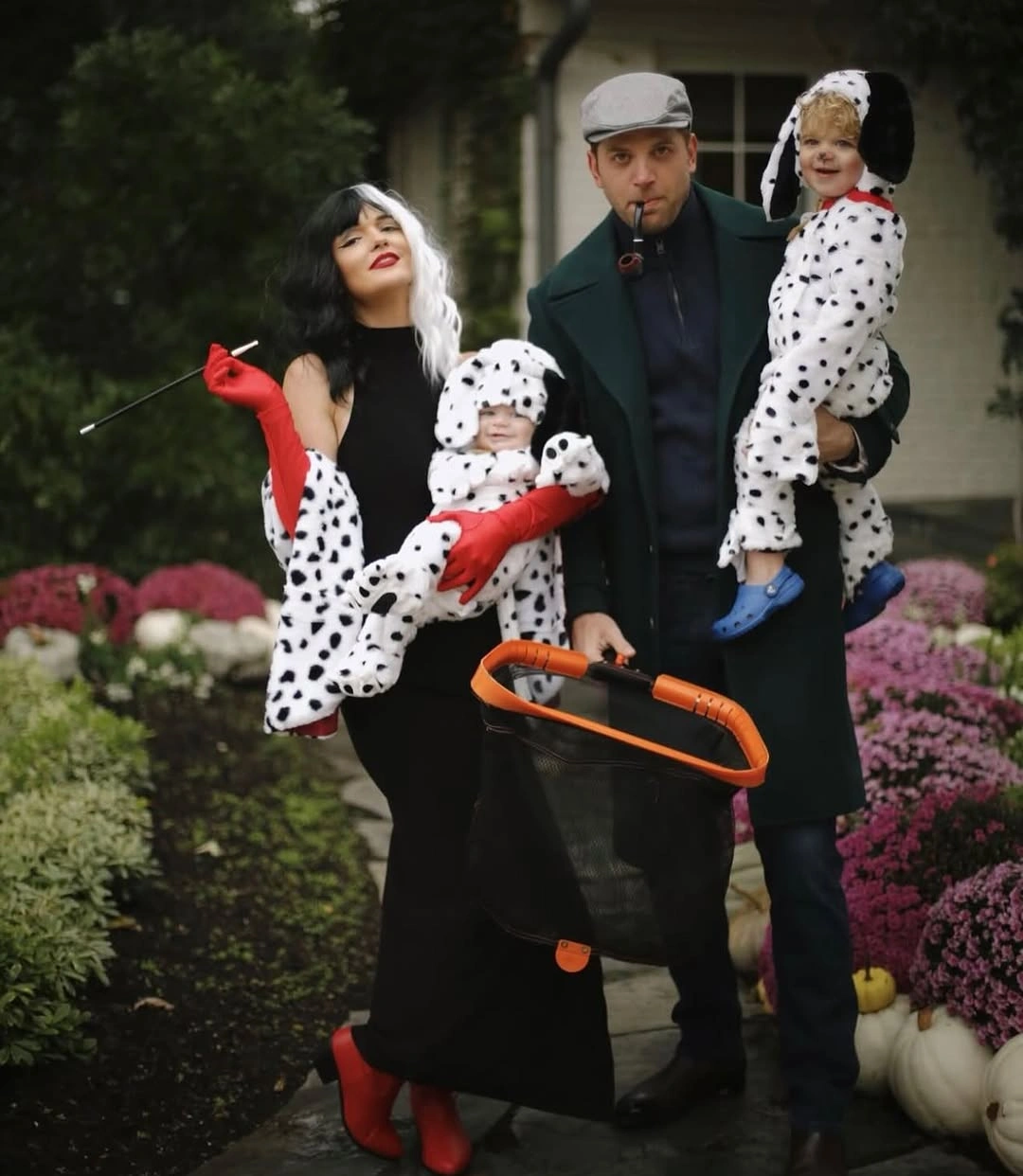
The children’s rounded hoods soften the graphic print, and the adult’s long dark silhouette gives the composition a strong edge. Red shoes or gloves work better than a full red garment because they punctuate the design without competing with the spots. If a child needs a warmer layer, choose black rather than another print.
For a coordinated look, pick one repeatable print and decide exactly where the accent color will appear before buying extra pieces. That prevents a costume family from accumulating too many unrelated details. The red accessory placement keeps this spotted theme crisp. It is also a simple rule to explain to children choosing their own finishing pieces.
19. The Addams Family in Formal Black
The black gown, dark suit, pale styling, and long blonde Cousin Itt-like wig turn this into an Addams Family-inspired Halloween portrait. Black suits, a long black gown, dark children’s outfits, and one dramatic blonde wig form a quiet but memorable family composition. The pale wig becomes the focal contrast because every surrounding garment stays deep and relatively matte. It is a restrained way to make a costume group feel theatrical without adding several bright colors or bulky props.
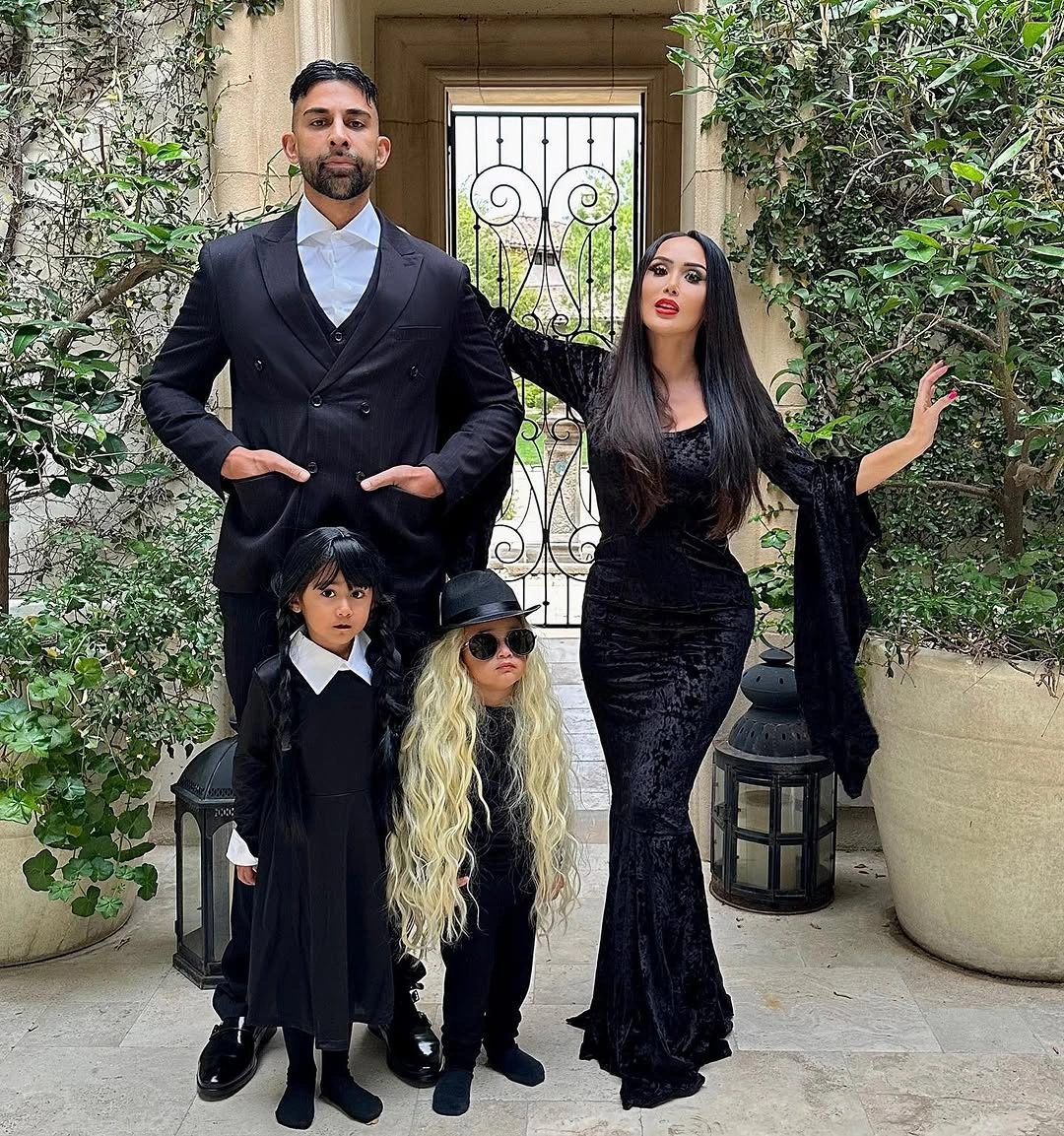
The tall adult silhouettes frame the smaller dark outfits below, while the wig introduces movement and texture near the center of the group. If the wig is not comfortable, a light hat or pale hair accessory could create the same contrast at a lower commitment level. Keep shoes and bags dark so they do not dilute the one-light-detail plan.
A dark family palette benefits from one surprise, not five. Choose a single pale, shiny, or textured element and let the rest of the looks remain calm around it. That controlled contrast is what makes the group feel intentional rather than simply dressed in black. The result is easier to photograph because the eye has one clear destination.
20. Freddy, Pennywise, Ghostface, and Georgie
The striped sweater, clown look, black robe, and yellow raincoat assemble a classic horror-character lineup with Georgie as the bright child cue. Striped knits, dark masks, orange textured costumes, pale clown details, black robes, and one yellow raincoat create a spooky family line with a clear child focal point. The yellow layer is both visually bright and practical, which makes it a useful solution for a younger member in a mostly dark theme. It proves that a family costume can preserve the mood without making every child wear the same level of intensity.
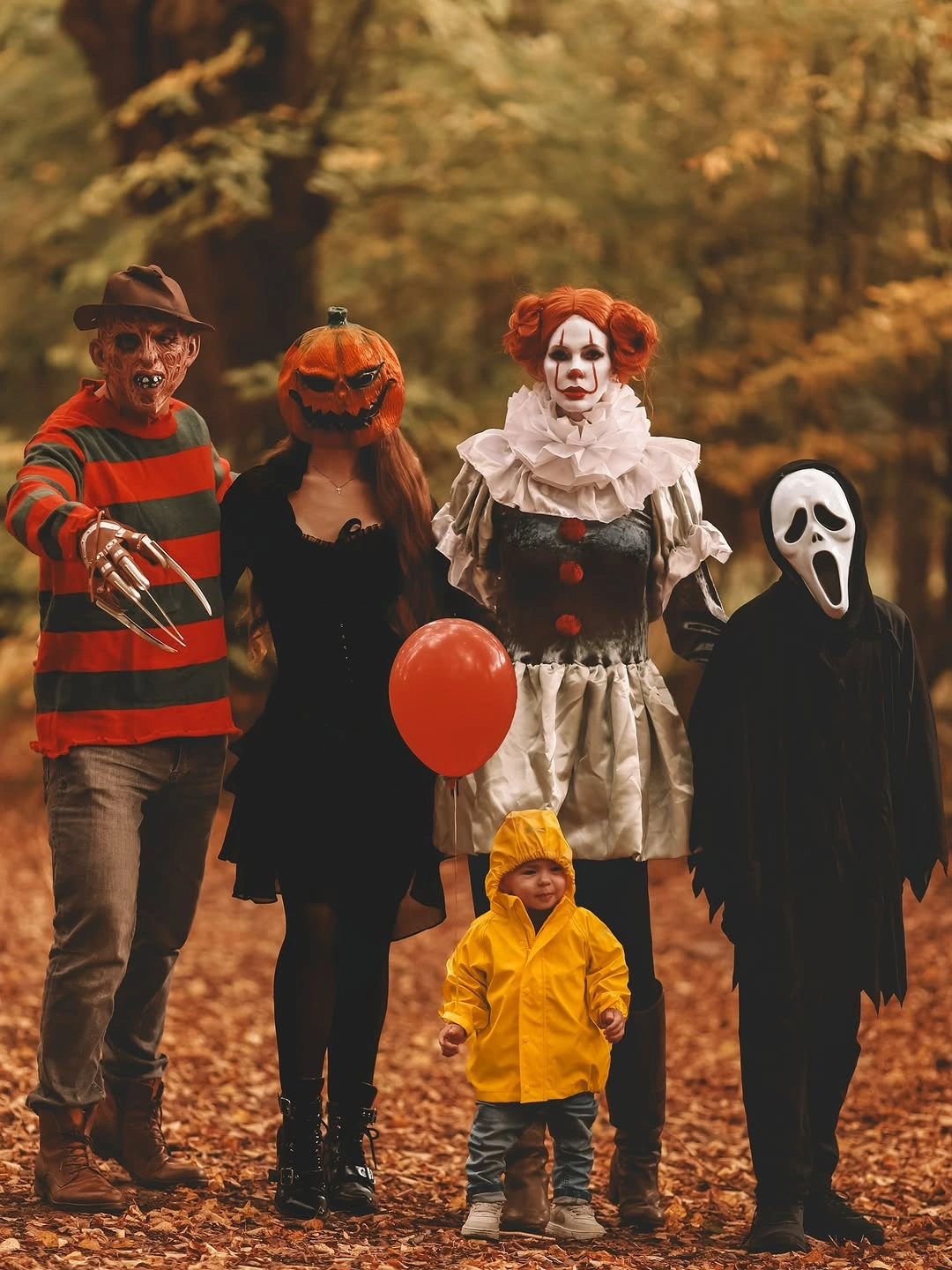
Orange and red details keep the dark costumes from blending into one silhouette, but the yellow raincoat is the highest-contrast color in the group. A waterproof layer in a theme color is smart for outdoor plans because it can replace a regular coat rather than cover the costume. Let the bright color stay confined to one person for the strongest effect.
Spooky costume families often work best when the children’s outfits get the clearest practical consideration. A simple vivid layer can make a young child easier to spot and more comfortable while still belonging to the visual story. The yellow block is the detail that gives this lineup balance. It also prevents the smallest silhouette from getting lost in a cluster of dark costumes.
21. Nightmare Before Christmas Family Cast
The striped Jack Skellington styling, red-haired Sally reference, and skeletal child costume create a Tim Burton-style Halloween family scene. Black-and-white adult stripes, a red-haired patterned dress, a skeleton print, and a bulky brown child costume bring several different volumes into one family group. The narrow vertical stripes and flowing red hair keep the eye moving upward, while the rounded child shape provides an intentionally different weight near the bottom. That balance works because black, white, and red repeat across the taller looks.
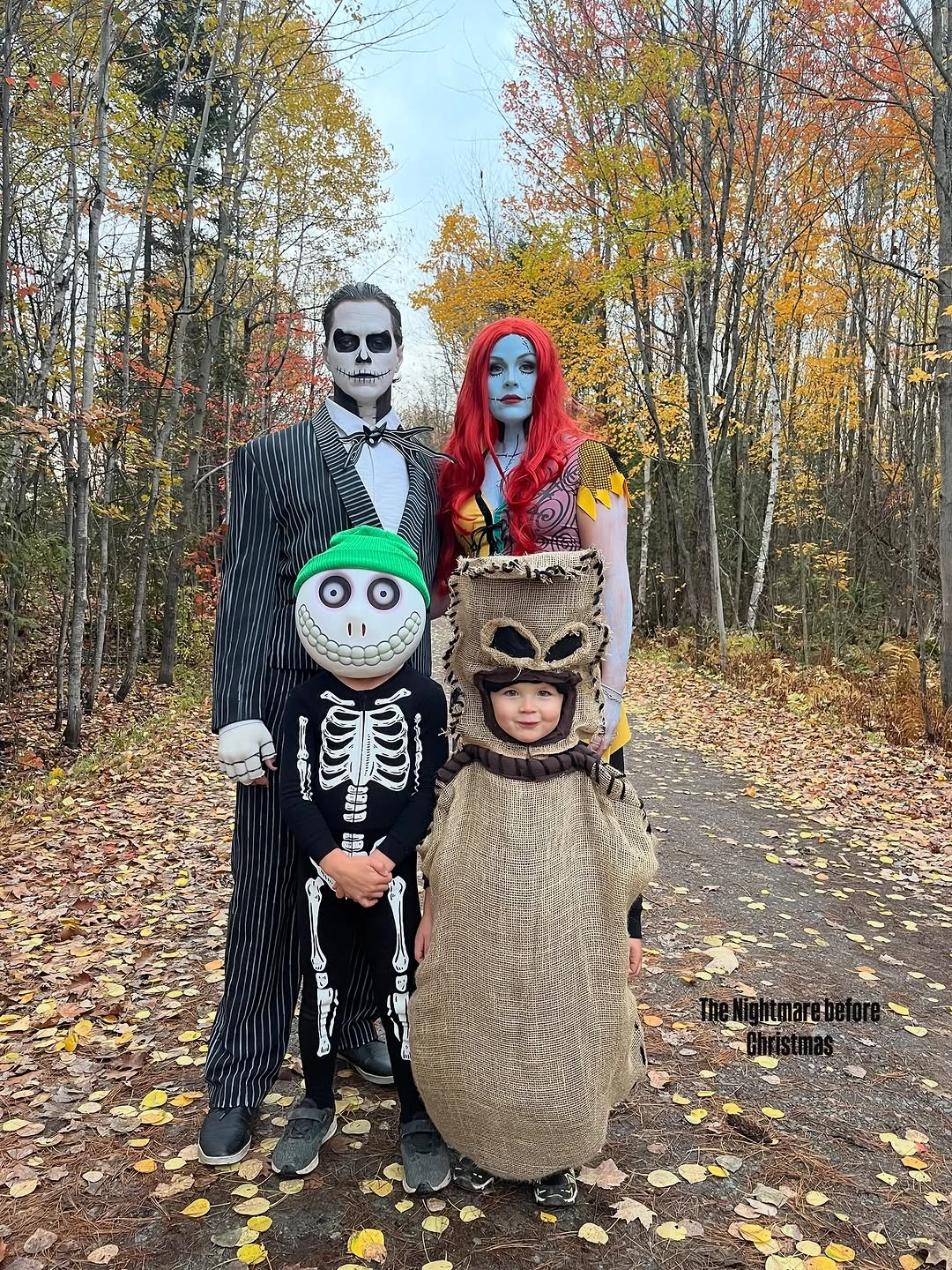
When one child has a wide or padded costume, give the adults longer or more vertical pieces so the group does not feel bottom-heavy. A dark accessory on the rounded costume would strengthen the connection without adding unnecessary pattern. For additional styling ideas involving skirts and tights, layered skirt outfits offer a useful reference for proportion rather than costume matching.
Mixed costume volume is not a problem when the palette remains controlled and the tallest silhouettes are spread through the group. Think about the overall outline before adding another prop or hat. The repeat of black, white, and red is what holds these different shapes together. That visual consistency gives each member room to keep a preferred costume detail.
22. The Incredibles Family With Their Dog
Red superhero suits, black eye masks, chest emblems, and a small matching dog shirt identify the group as The Incredibles. Matching red suits, black masks, black gloves, tall boots, and a small red dog shirt create the clearest kind of family costume system: one uniform repeated at several scales. The black graphic details break up the red enough that the group still has shape in a photograph. Including the dog through a simple shirt keeps the idea charming without requiring a complicated pet costume.
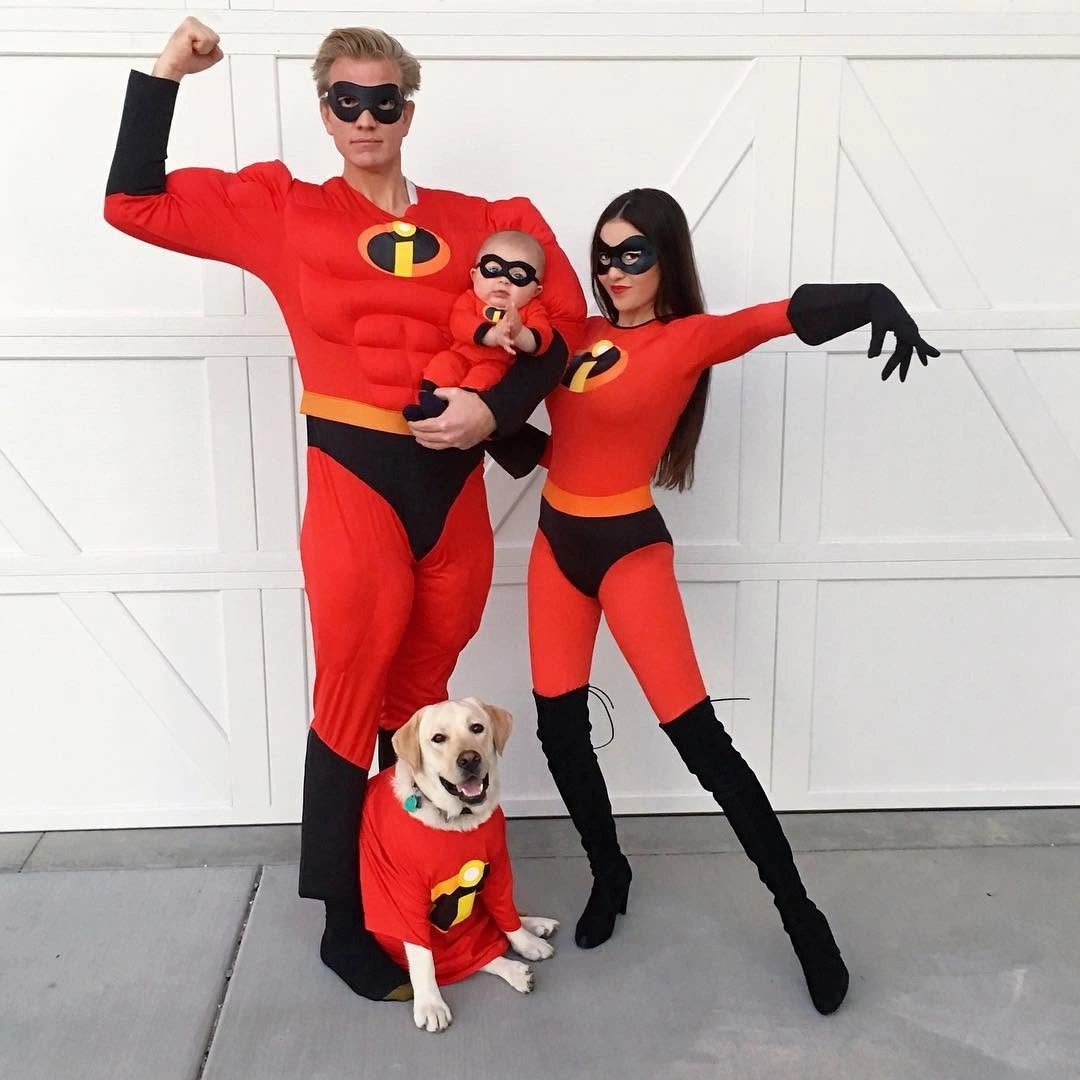
Because every outfit repeats the same chest symbol and black accents, there is no need to add extra colors or elaborate accessories. Check mobility around gloves, boots, and masks before committing, especially for children who may remove pieces during the night. A red hoodie with a black eye mask could be a softer version of the same costume language.
Uniform-based family ideas are efficient because the visual connection is obvious and each person can adjust the fit independently. The smallest member only needs one matching color cue to feel included. Repetition is doing all the work here, which is why the group reads so cleanly. It also makes it easier to replace one piece without weakening the shared idea.
23. Inside Out Emotions as a Family Costume
The blue, green, purple, yellow, and fiery orange face-and-hair colors clearly evoke Sadness, Disgust, Fear, Joy, and Anger from Inside Out. White shirts, a tie, a green dress, an argyle vest, a yellow dress, vivid wigs, and brightly painted faces create a family transformation without relying on heavy costume layers. The clothing shapes remain close to everyday wear, which gives the color work room to become the headline. That makes this a flexible route for families who need to travel, sit, or manage changing temperatures.
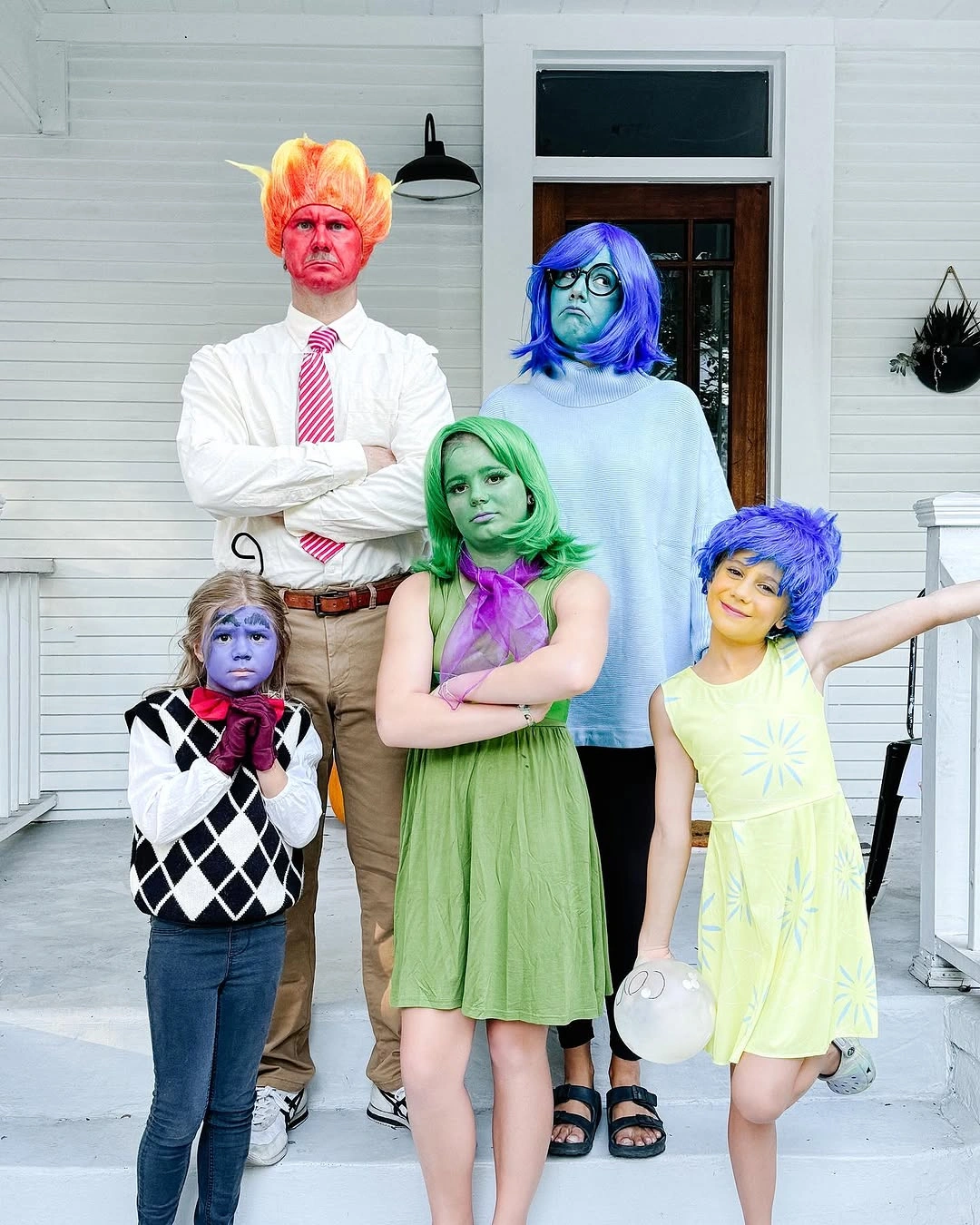
The bright blue, green, purple, and yellow face-and-hair accents are separated by plain white or neutral clothing, so they do not blur together. If full face paint feels like too much, keep one colored wig and add a bold eye or cheek detail instead. The ordinary silhouettes are an advantage because they make the color transformation feel more surprising.
Color-led costumes are strongest when the clothing stays restrained and the chosen shades repeat across at least two family members. Focus the transformation around hair and face rather than adding another themed garment to everyone. The crisp neutral base is what lets the bright color choices hold together.