At a nail table, the smallest choice can change the whole mood: a translucent pink left nearly bare reads differently from the same softness edged with a sharp line or interrupted by a scatter of dots. Put a glossy surface beside a smoky reflective one, and the contrast becomes less about adding decoration than about deciding where the eye lands first. That is the kind of detail I notice most in November nail designs, because placement, finish, and proportion can make familiar colors feel deliberately different.
November nail trends for 2026 make the most sense as an exercise in visual balance rather than a prediction about what everyone will wear. A short rounded nail can let translucency do the work, while a longer almond or squared shape gives color blocking, reflective effects, and fine pattern more room to register. The useful question is not which idea is the loudest, but what each choice does to the outline, rhythm, and contrast of the manicure.
1. Red Dots Turn Repetition Into a Design Thread
These medium almond-to-oval nails use glossy red, sheer pink, and pale pink as a shared palette, but the color is distributed differently from finger to finger. Some nails carry broad red curved areas near the tips, while others leave more of the translucent base visible. The result feels coordinated through repetition rather than through five matching surfaces.
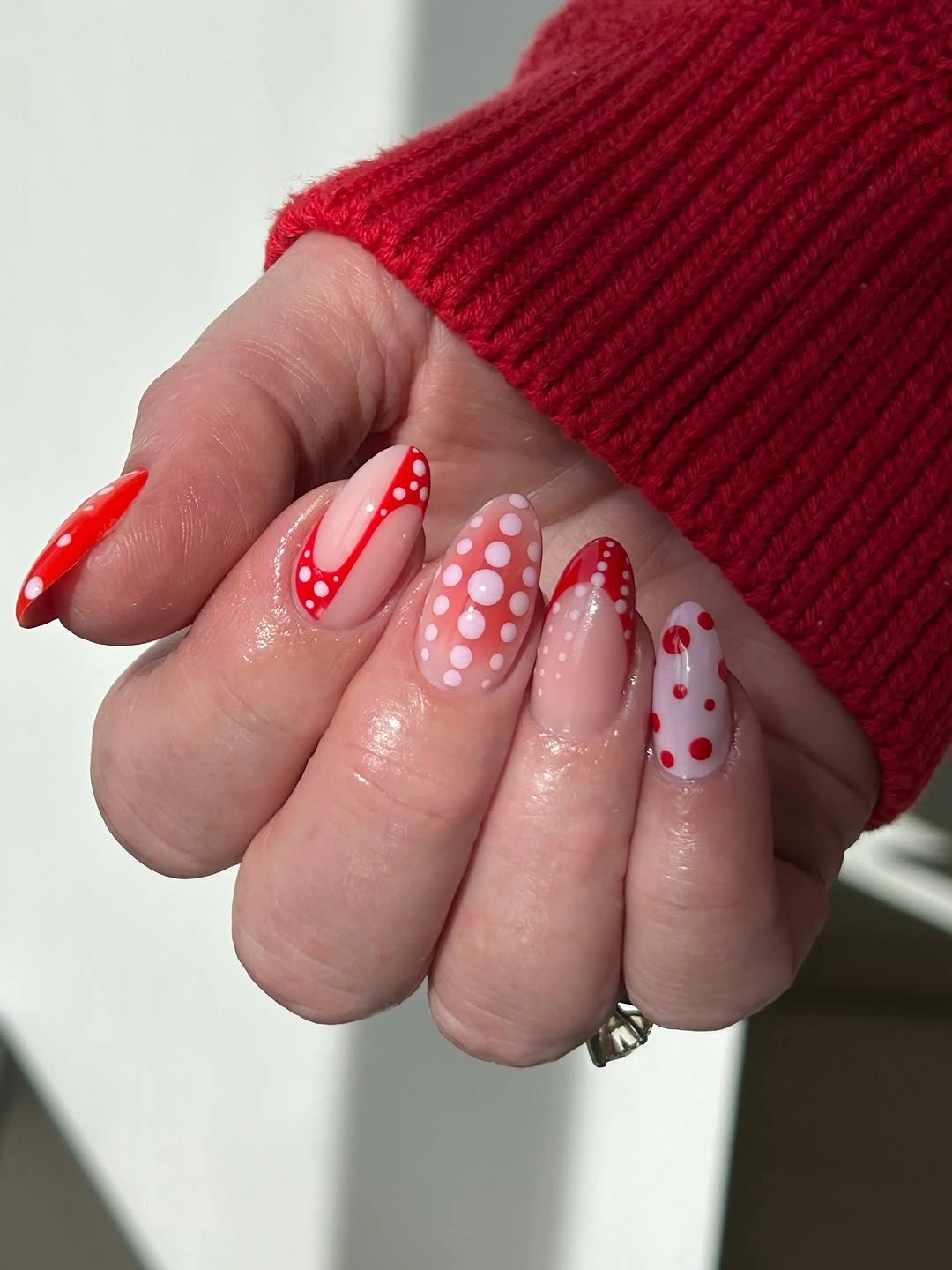
Photo via Instagram
The dots do most of the connecting work. One pale pink nail is covered much more densely with white dots, while nearby nails use smaller clusters or isolated red and white points around the curved red shapes. That change in density keeps the repeated motif recognizable without making each nail read as a duplicate of the one beside it.
For a mixed set, repeating one small mark at different scales can create continuity without requiring identical art on every finger. Here, the dots function as a visual thread while the red placement keeps shifting.
2. Milky Pink Lets Short Shape Lead
The short rounded-square shape is the main structural feature here, and the translucent milky pink keeps that outline easy to see. There is no visible graphic motif competing with the compact length, so the gentle squaring at the free edge becomes part of the design itself. The pale color also allows the natural-looking variation beneath the glossy surface to remain softly visible.
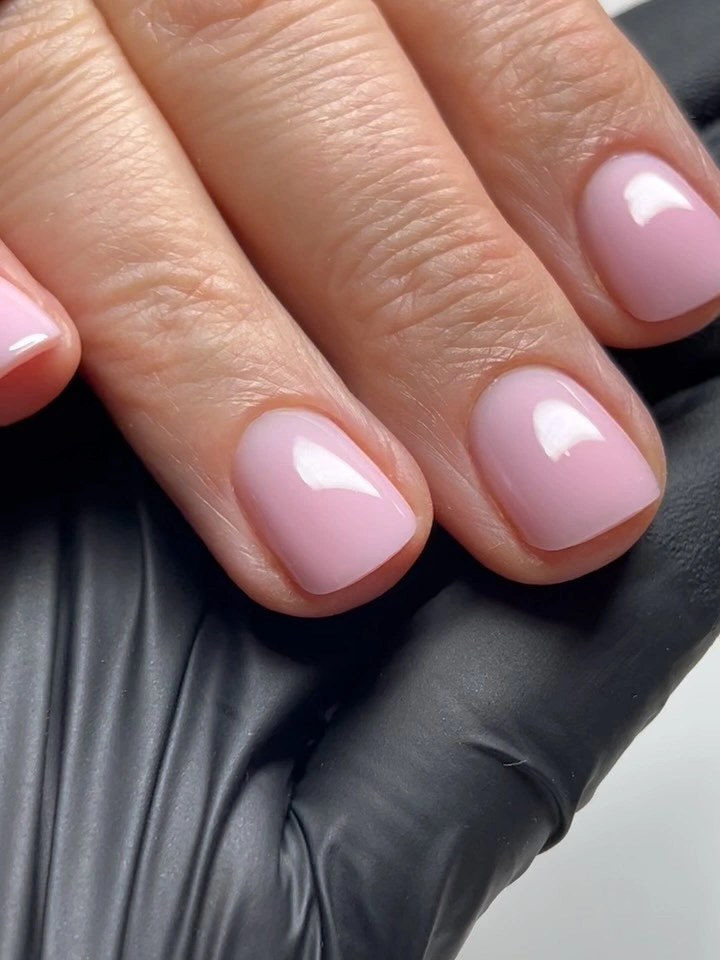
Photo via Instagram
Broad reflected highlights move across the nails and give the simple pink surface more dimension than a flat block of color would have. Because the tone stays consistent from nail to nail, the eye notices the balance between translucency, shine, and the softly rounded corners. For short November nails, that restraint can be visually strong without needing extra linework or embellishment.
This direction makes sense when the appeal is in a compact silhouette and a polished-looking surface rather than added ornament. A sheer or milky color can leave enough visual breathing room for the shape itself to matter.
3. Pearly Mauve Adds Depth Without Pattern
A pale mauve-taupe neutral covers these medium almond nails, giving the set a muted base with very little color contrast from finger to finger. The tapered outline stays soft rather than sharply pointed, which works with the quiet tone. What prevents the manicure from looking flat is the pearly reflective sheen that travels across the curved surface.
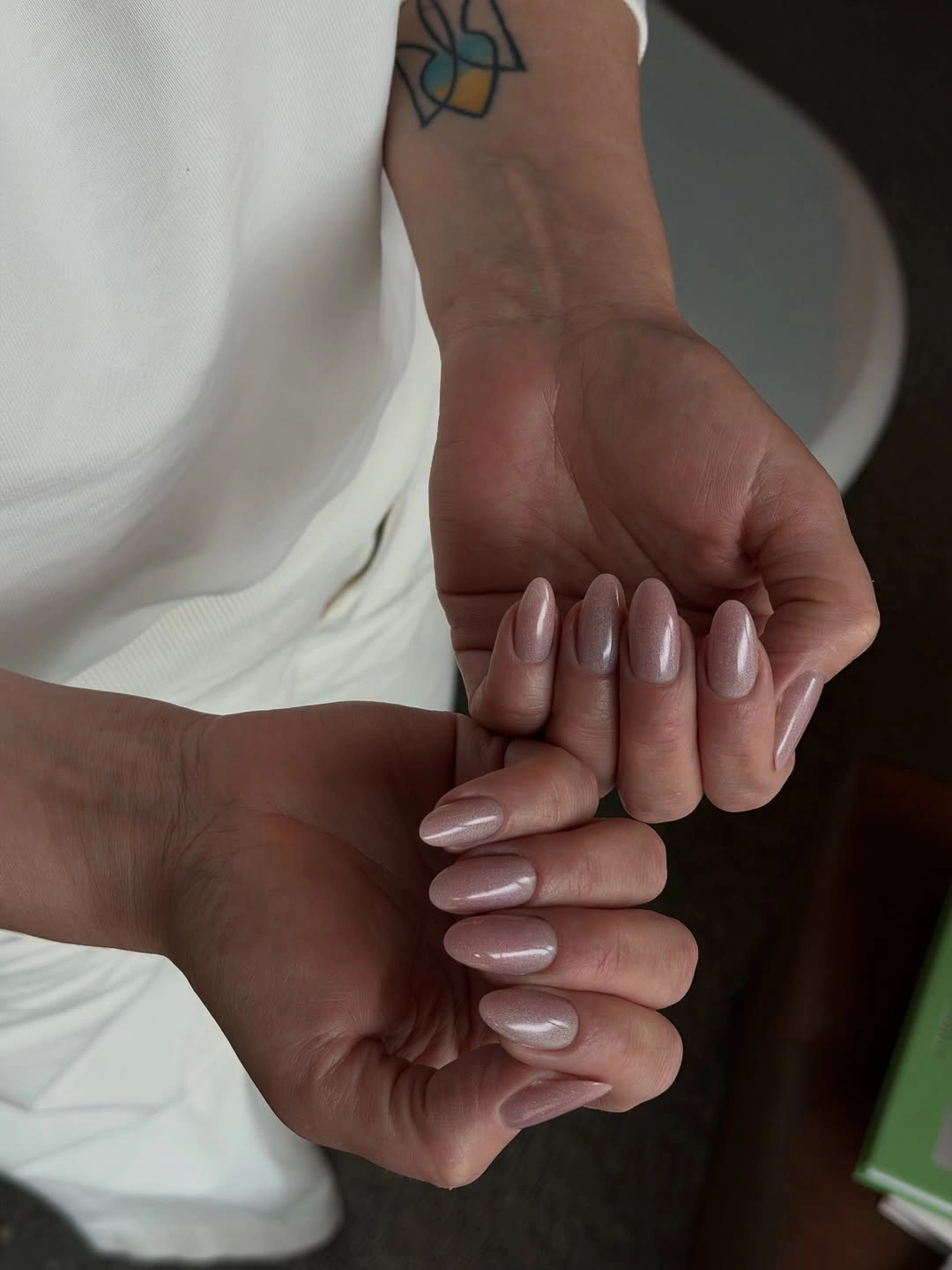
Photo via Instagram
That sheen creates gentle shifts between lighter and deeper areas as each nail catches the light, even though the underlying color remains consistent. The effect is smooth and luminous rather than patterned, so the interest comes from reflection instead of drawn detail. It is a useful reminder that finish alone can change how much dimension a restrained neutral appears to have.
If subtle depth is the goal, a reflective-looking finish can do more than adding another color or motif. Keeping the hue quiet lets the changing light remain the feature that gives the manicure movement.
4. Pale Blue Tips Stretch a Sheer Pink Base
These long tapered-square nails start with a sheer pink base and finish in translucent pale blue tips, creating a clear division between the natural-looking center and the cooler free edge. The squared ends make that blue placement feel especially structural because the color follows a broad, straight boundary. Their length gives the contrast enough room to stay visible without becoming dense.
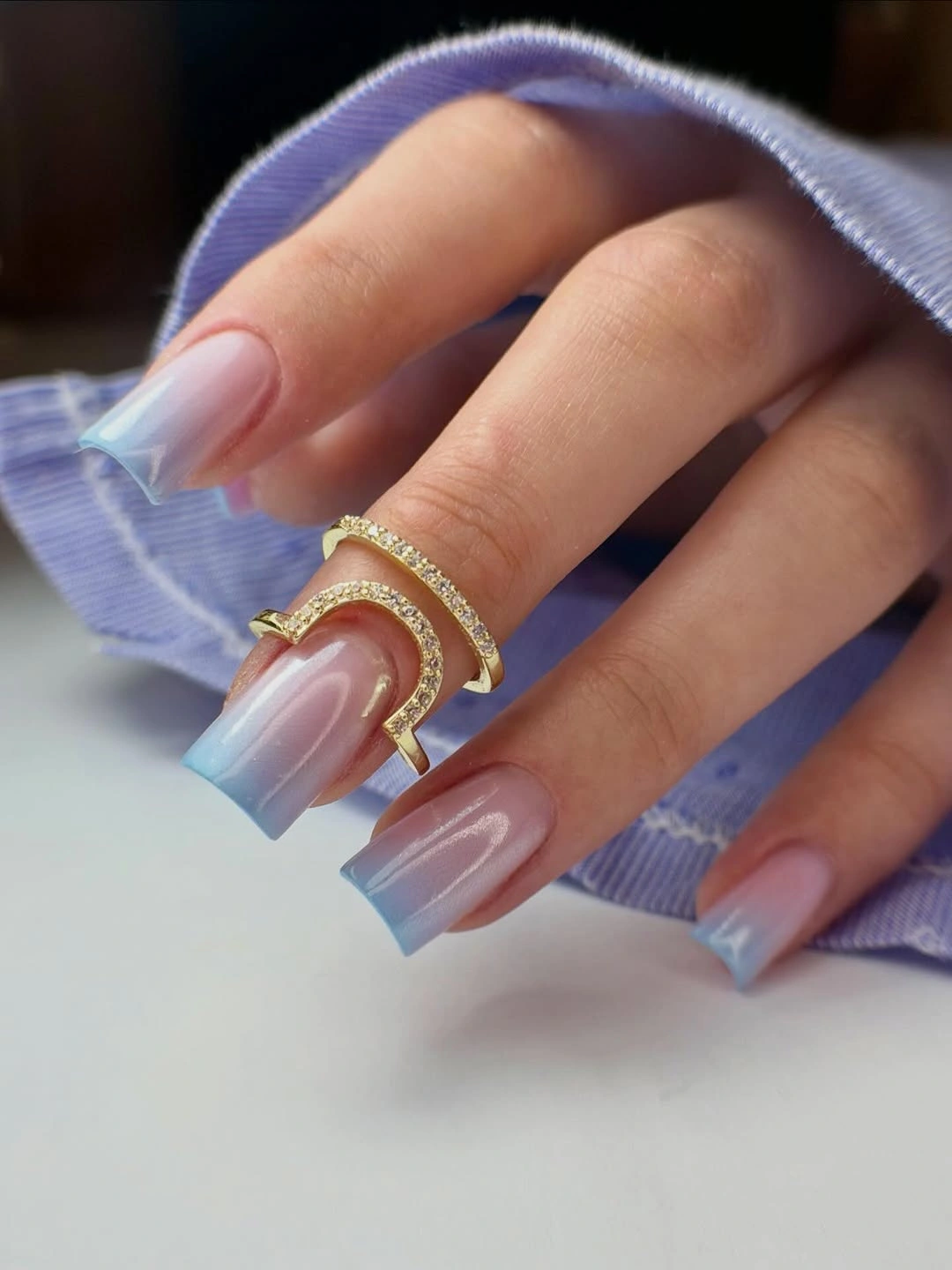
Photo via Instagram
Several nails also carry narrow blue-white vertical accents that extend upward from the tip area into the pink, so the design is not limited to a simple horizontal French edge. Those slim lines pull the cool color farther along the nail and emphasize the elongated shape. The relationship between the sheer center and the pale blue perimeter is more important here than any single decorative motif.
A translucent tip color can be a useful option when you want the free edge to define the manicure without filling the whole nail. On a long squared shape, even a pale shade can create a noticeably graphic boundary.
5. Turquoise Patterning Balances Brown Tip Accents
Long almond nails provide the base for a more intricate combination of sheer nude-pink, turquoise, deep brown, and fine gold-toned detail. One nail carries a dense turquoise scale-like pattern outlined in dark lines, while neighboring nails use the same turquoise or brown in much smaller areas near the tips. The shared colors hold together designs that vary greatly in density.
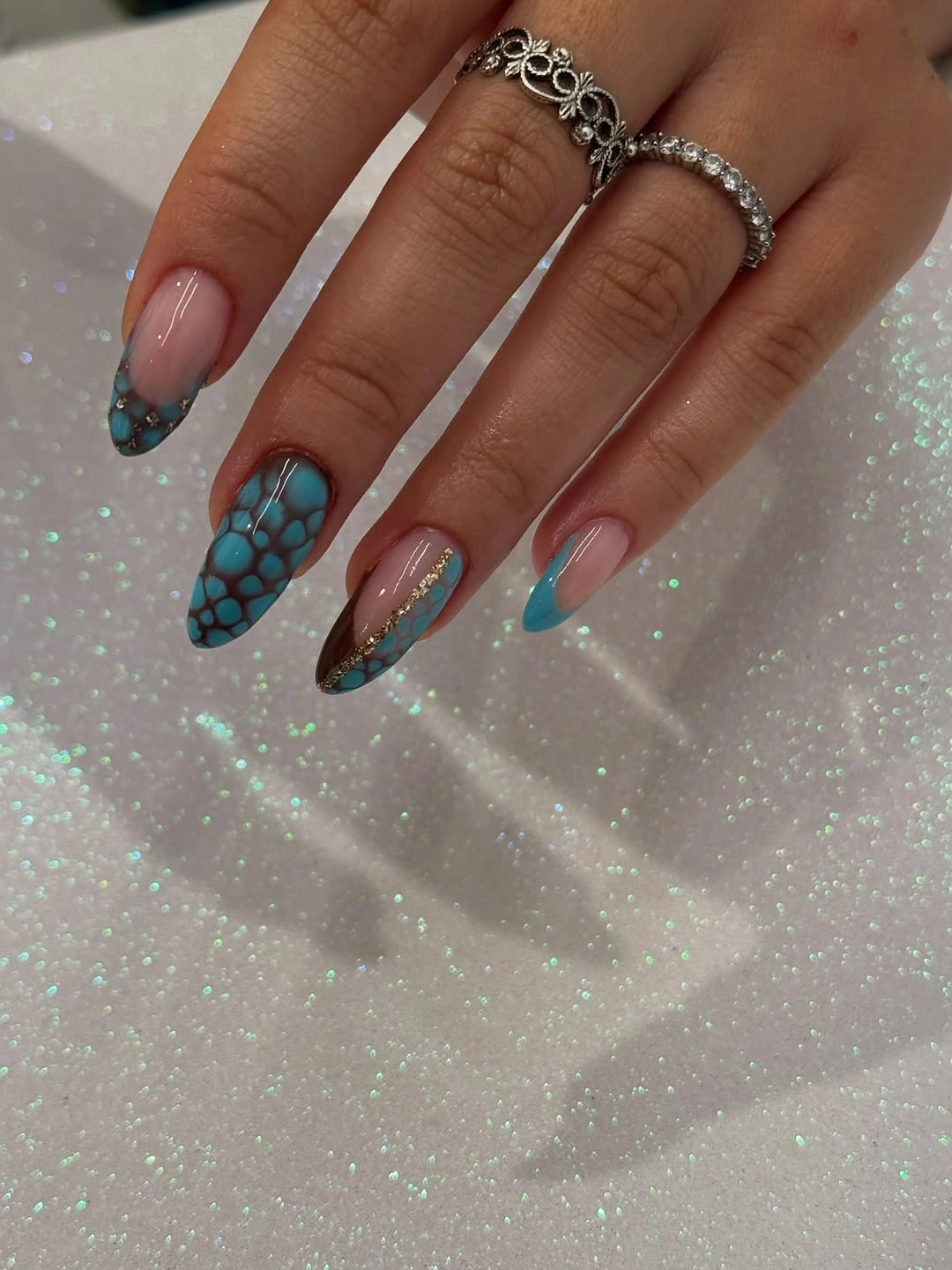
Photo via Instagram
The fullest patterned nail acts almost like a concentrated version of the palette, because turquoise and dark outlines cover much more of its surface than they do elsewhere. Another nail introduces delicate gold-toned lines beside the brown and turquoise accents, adding a finer layer of contrast without repeating the scale-like pattern. That distribution keeps the set varied while still making the color relationships easy to trace.
When several motifs share one manicure, carrying the same few colors through both busy and sparse areas can create a stronger connection than copying one pattern repeatedly. The visual link here comes from turquoise, brown, and nude-pink returning in different proportions.
6. Organic Color Blocks Make Muted Shades Move
These short-to-medium rounded almond nails bring several muted colors together without dividing them into rigid stripes or repeated motifs. Creamy pale areas sit beside burgundy, olive green, teal, brown, and blue-gray shapes, with each color appearing in irregular patches rather than matching placements. The compact silhouette keeps the palette visually concentrated while the curved forms give it movement.
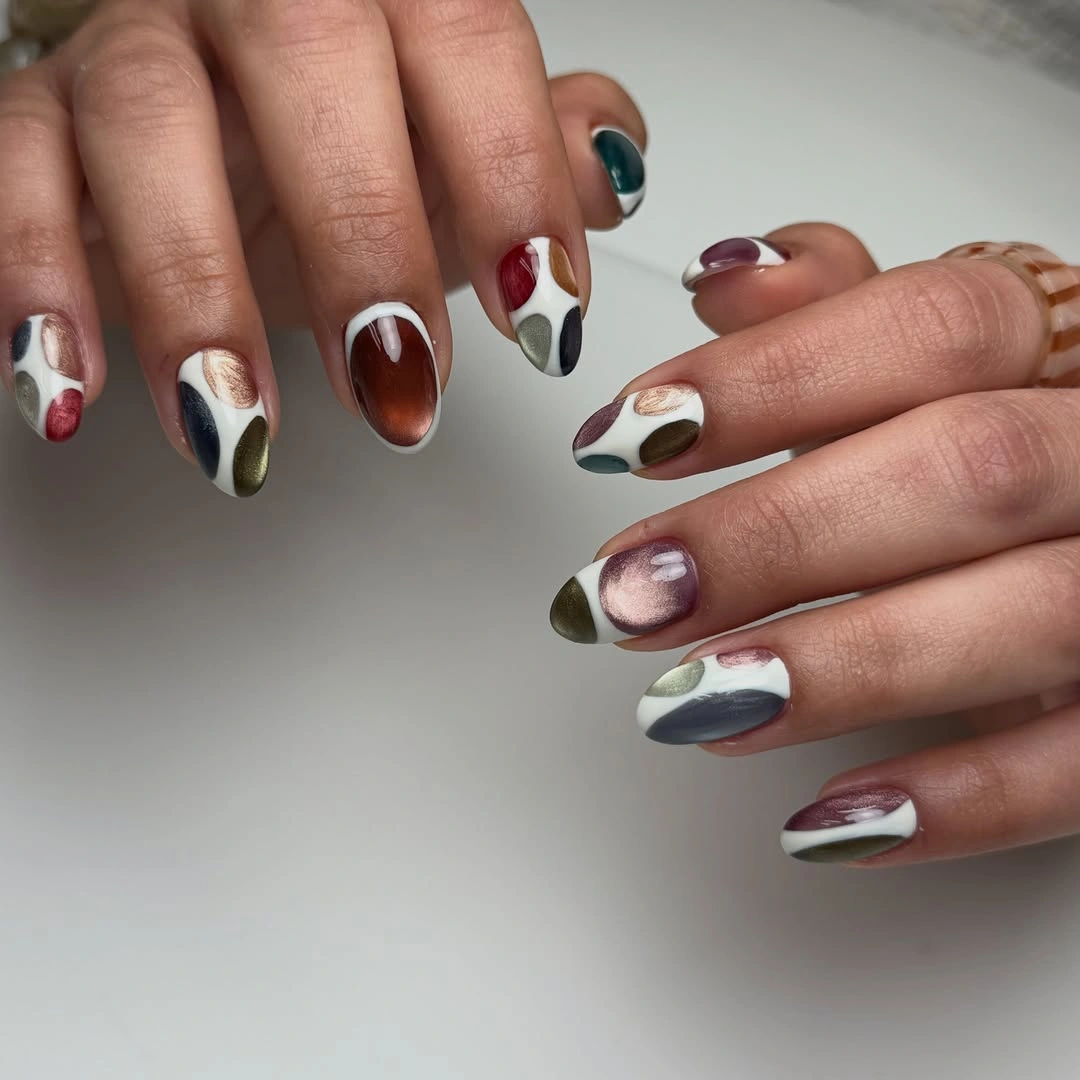
Photo via Instagram
Some color areas read as rounded ovals or petal-like marks, while others sweep along an edge or stretch farther across the pale background. That uneven distribution matters because no single shade takes over every nail, and the pale spaces keep separating the darker tones. For November nails, green accents can work especially well as one part of an earthy multicolor arrangement rather than as the entire manicure.
A palette like this can stay varied if the colors return in changing shapes instead of fixed positions. The organic boundaries are what make the separate shades feel related.
7. Short Nails Carry a Deliberately Mixed Graphic Set
Short rounded-square nails become a compact canvas for several visibly different treatments here, including glossy red, highly reflective silver, translucent pink, bright pink accents, white with black dots, and crisp black-and-white details. The variety is immediate, but the small scale of each design keeps individual elements readable. No single motif has to explain the whole manicure.
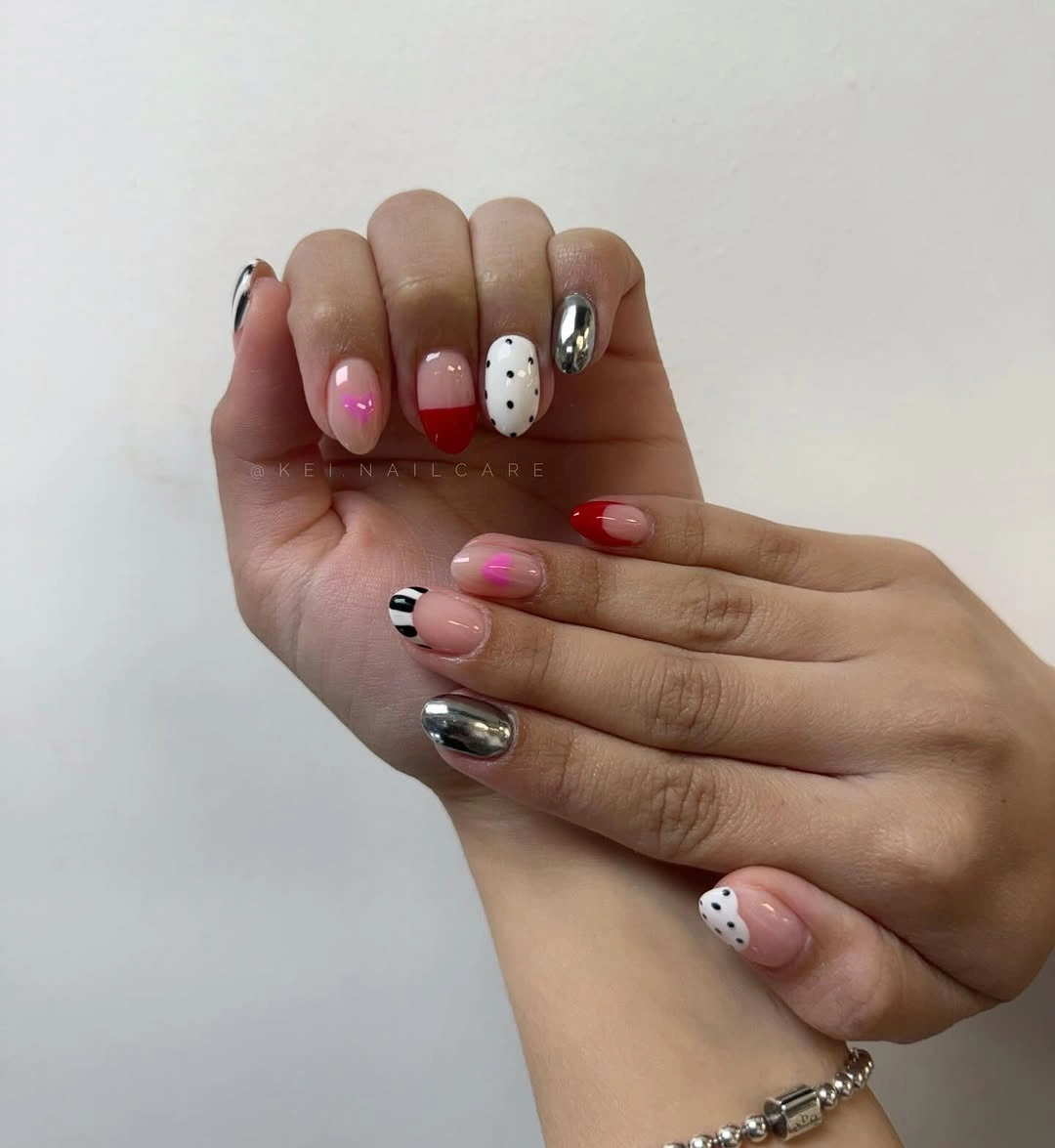
Photo via Instagram
The mirror-like silver nail brings the strongest change in finish, while glossy red supplies a dense block of color and the dotted white nail introduces a much finer pattern. Elsewhere, pink sits against translucent areas and black-and-white details create sharper boundaries near the tips. Moving between surface finish, dots, and color blocking gives each short nail a separate role instead of simply changing the polish shade.
On a compact length, mixed art can stay clear when each nail carries a few decisive marks rather than many tiny competing details. Here, the visual interest comes from changing the type of design as much as changing the color.
8. Coral Centers Glow Against Golden Orange Edges
These short-to-medium rounded-square nails use a smooth warm transition instead of drawn motifs, with coral-pink concentrated through the central area and warmer orange-yellow tones appearing toward the edges. The glossy surface makes the colors look especially luminous where they overlap. Because the gradient continues across every nail, the set feels unified without relying on repeated symbols or linework.
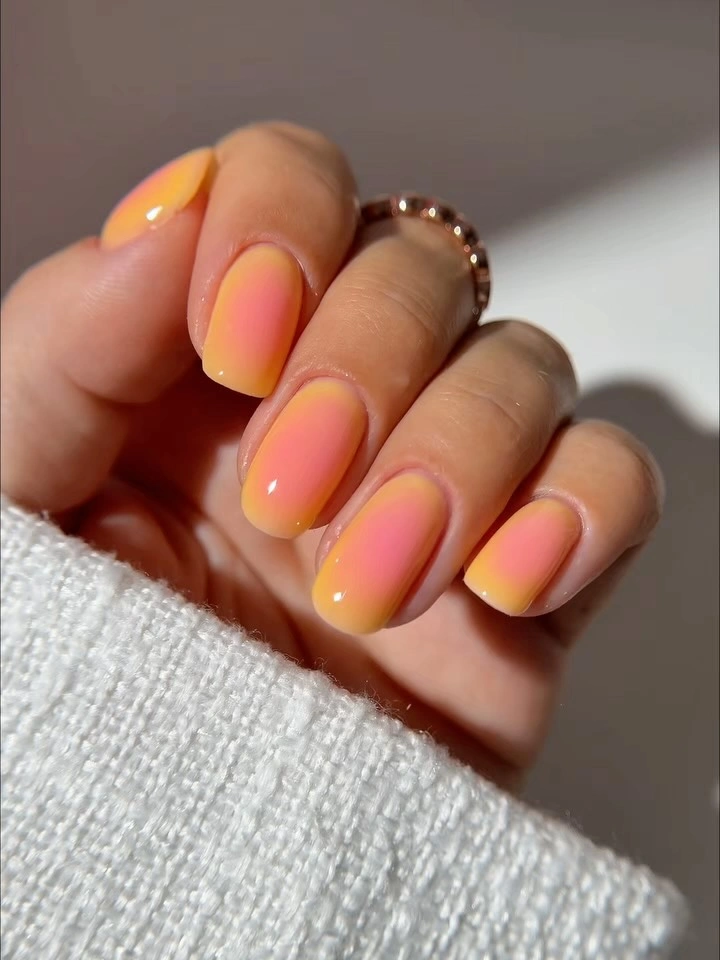
Photo via Instagram
The most interesting relationship is between the pinker center and the warmer perimeter, which creates the impression of color radiating outward rather than moving in one straight direction. Yellow-orange becomes more visible along the sides and free edges, while coral remains strongest through much of the middle. That placement gives a relatively simple palette a sense of depth and motion across the curved nail surface.
A center-to-edge shift is worth considering when you want color movement but do not want separate decorative elements. The gradient itself supplies the changing detail from one area of the nail to another.
9. Silver Curves Give Blush Pink a Jewelry Effect
Translucent blush-pink bases keep these medium almond nails visually light, while thin silver-toned curves trace irregular paths around portions of the surface. The lines do not form identical borders from nail to nail, so they feel more like individual outlines than a repeated French tip. Tiny gem-like points add another scale of detail without covering the soft pink underneath.
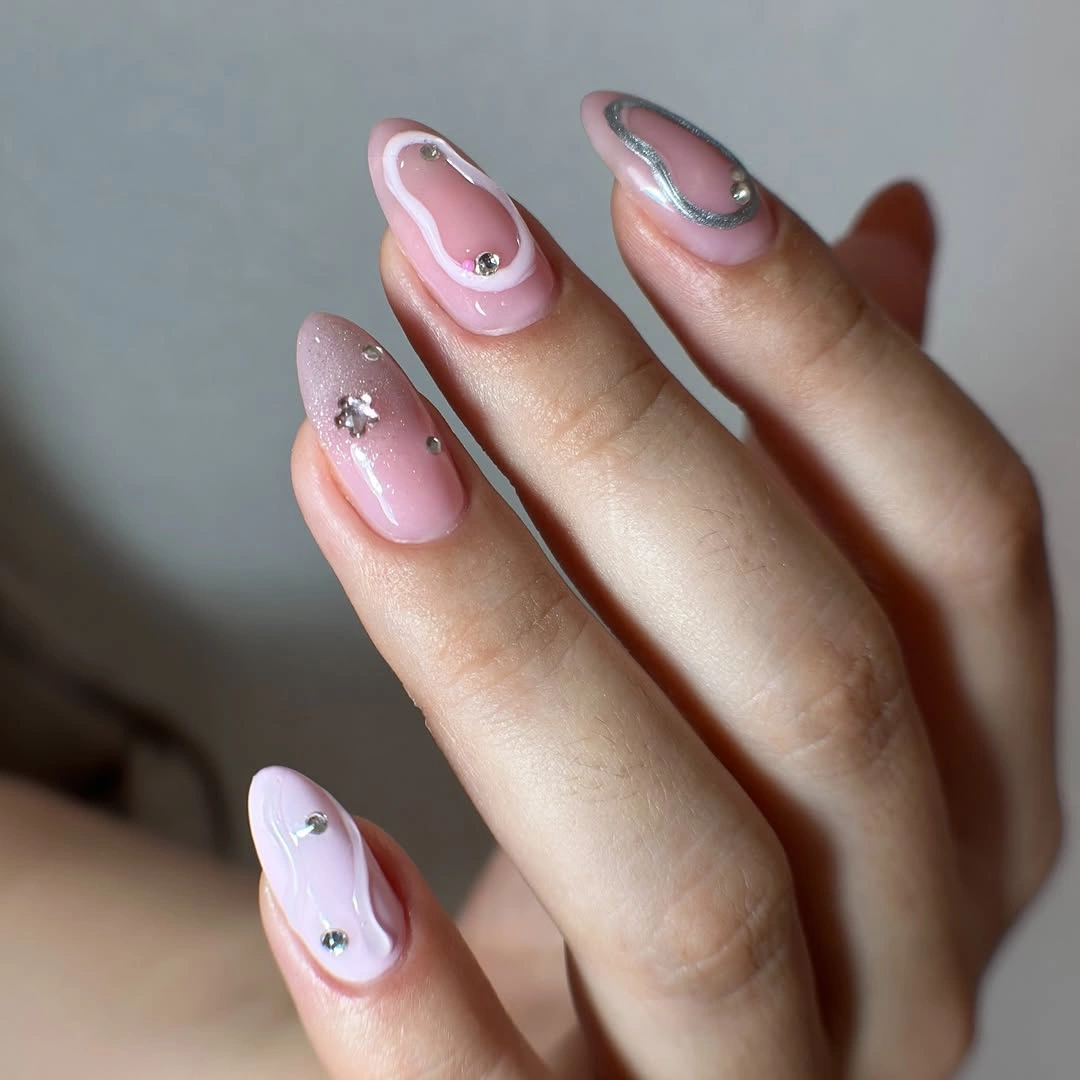
Photo via Instagram
The larger silver curves provide the main directional movement, but several much smaller embellishments create precise stopping points for the eye. One nail carries a small clustered accent, while others use isolated round details beside or inside the looping linework. I like the separation between those two scales because the metallic-looking lines can remain fluid while the smaller pieces feel deliberate and concentrated.
If you want a jewelry-like manicure without filling every nail with decoration, linework and tiny focal accents can perform different jobs. Letting some nails emphasize the curve and others emphasize a small sparkle keeps the surface varied.
10. A Tiny Silver Heart Breaks the Creamy Yellow
A glossy creamy pale yellow covers these short rounded nails almost completely, so the manicure first reads as a clean single-color set. The softly curved shape and consistent coverage give the warm shade plenty of uninterrupted space. Against that simplicity, the one decorated nail becomes noticeable without needing a larger motif or a contrasting background color.
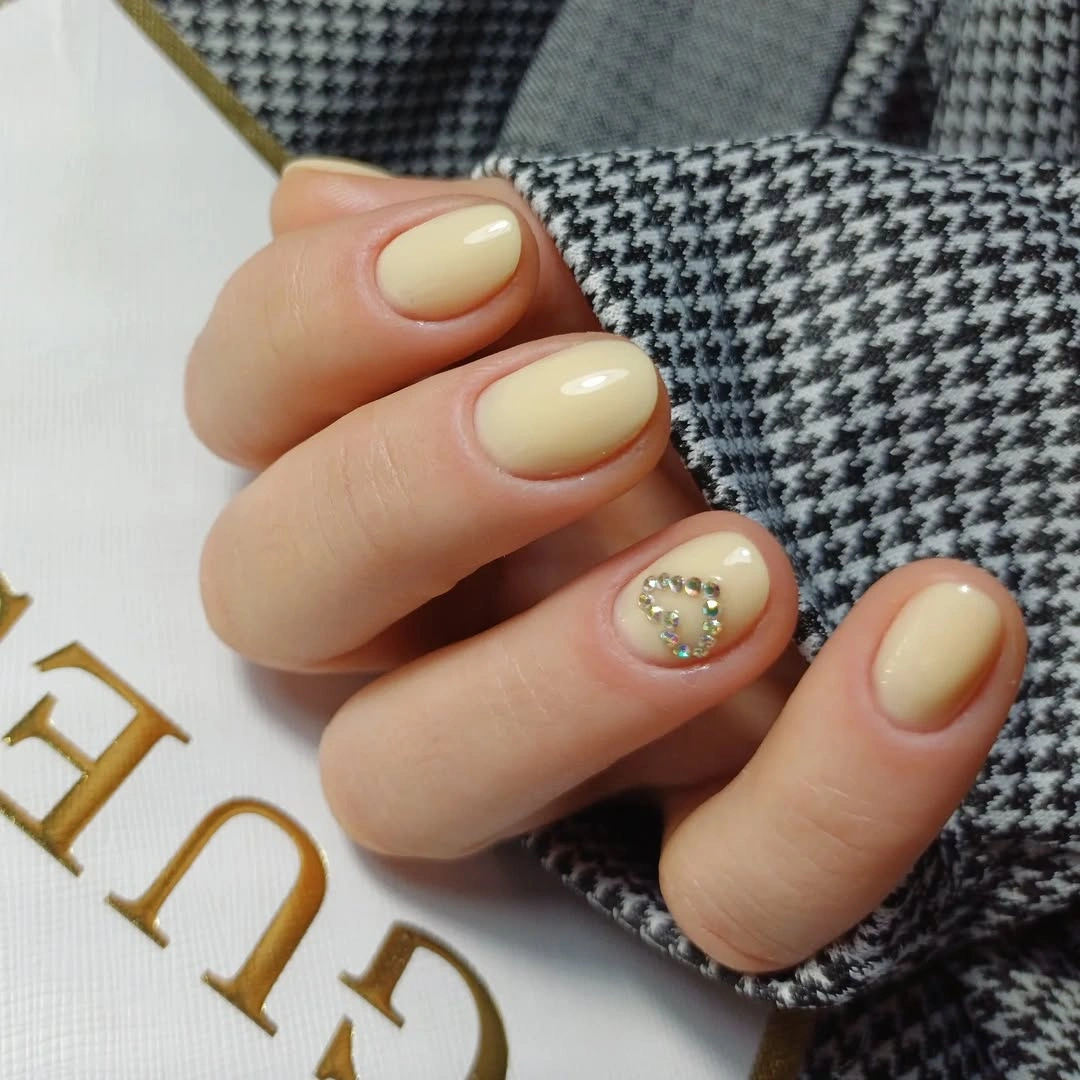
Photo via Instagram
The accent is a small heart outline formed from silver-toned bead-like pieces, placed near the center of one nail while the surrounding nails remain plain. Its scale is important because it interrupts the yellow surface without competing with the base color across the entire hand. The cool silver-toned detail also creates a crisp visual contrast against the softer creamy hue.
A single compact symbol can feel especially intentional when it is truly isolated rather than repeated automatically. In this manicure, the pale yellow remains the dominant idea, and the heart functions as one precise interruption.
11. Burgundy Bridges Checks and Illustrated Black Accents
Deep burgundy gives these short-to-medium oval nails a dark, glossy foundation, but the manicure quickly moves beyond solid color. Several nails stay fully burgundy, while others switch to black or a beige-and-black checkerboard pattern. The warm wine tone sits comfortably beside both the pale squares and the much darker accent surfaces, giving the contrasting designs a shared visual weight.
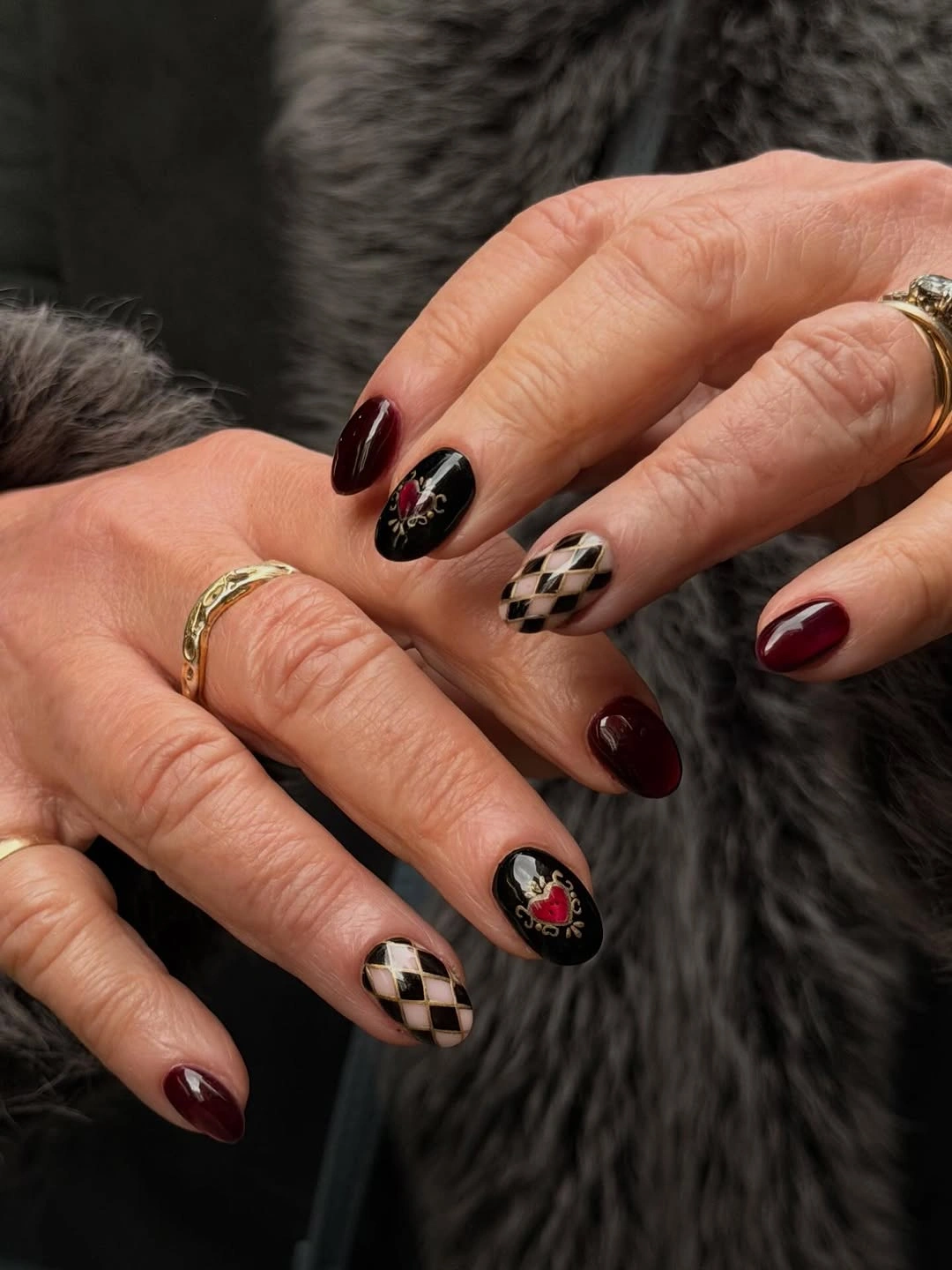
Photo via Instagram
The checkerboard nails use bold repeating geometry, while the black accent nails carry much smaller red-and-cream emblem-like details surrounded by open dark space. That difference in scale is what catches my eye: one pattern fills most of the nail, while the illustrated accents remain compact and centered. Burgundy then appears as a simpler shape between them, preventing the manicure from becoming one continuous field of pattern.
An eclectic set can feel connected when its darkest and warmest colors reappear across different kinds of decoration. Here, burgundy, black, and beige form the link even though the geometry and illustrated details follow separate visual rules.
12. Yellow-Gold Reflection Keeps One Color in Motion
Bright yellow-gold covers these short oval nails from base to tip, with no visible line art, contrasting tips, or separate accent motif interrupting the color. The rounded shape gives the reflective surface a curved field to move across, so the manicure reads differently from a flat opaque yellow. Even with one uninterrupted hue, the nails do not look visually still.
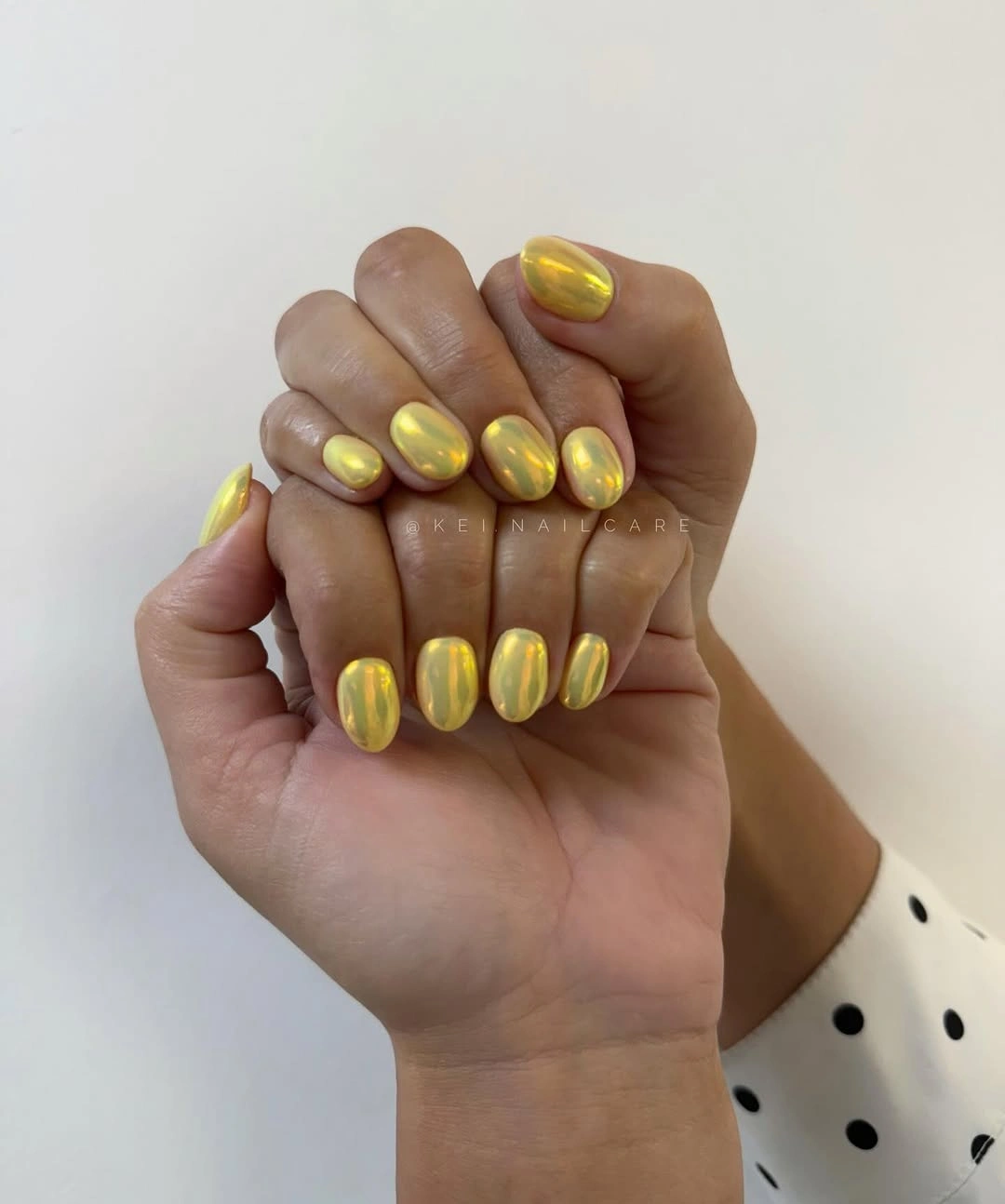
Photo via Instagram
Strong pale bands appear across the center of several nails, while deeper yellow-gold areas remain around them and shift with the angle of the curved surface. Those luminous bands create a striped impression without actually introducing a second painted pattern. I especially like how the reflective effect changes the value of the color itself, moving from almost lemon-bright highlights into richer gold around the edges.
A finish with this much visible light variation can carry the manicure without additional motifs. If the reflective surface is the feature you want to notice first, leaving the color uninterrupted gives it space to keep changing.
13. Curved Boundaries Unite a Mixed Neutral Manicure
These medium almond nails combine several treatments that could easily feel unrelated: sheer pink, translucent dark brown-and-black marbling, a smoky gray solid, a dark dotted tip, and a sweeping white tip. Small gold-toned gem-like accents appear near the boundaries on two pink nails. The palette stays largely neutral, allowing the contrast in pattern and placement to become more noticeable than a clash of bright colors would be.
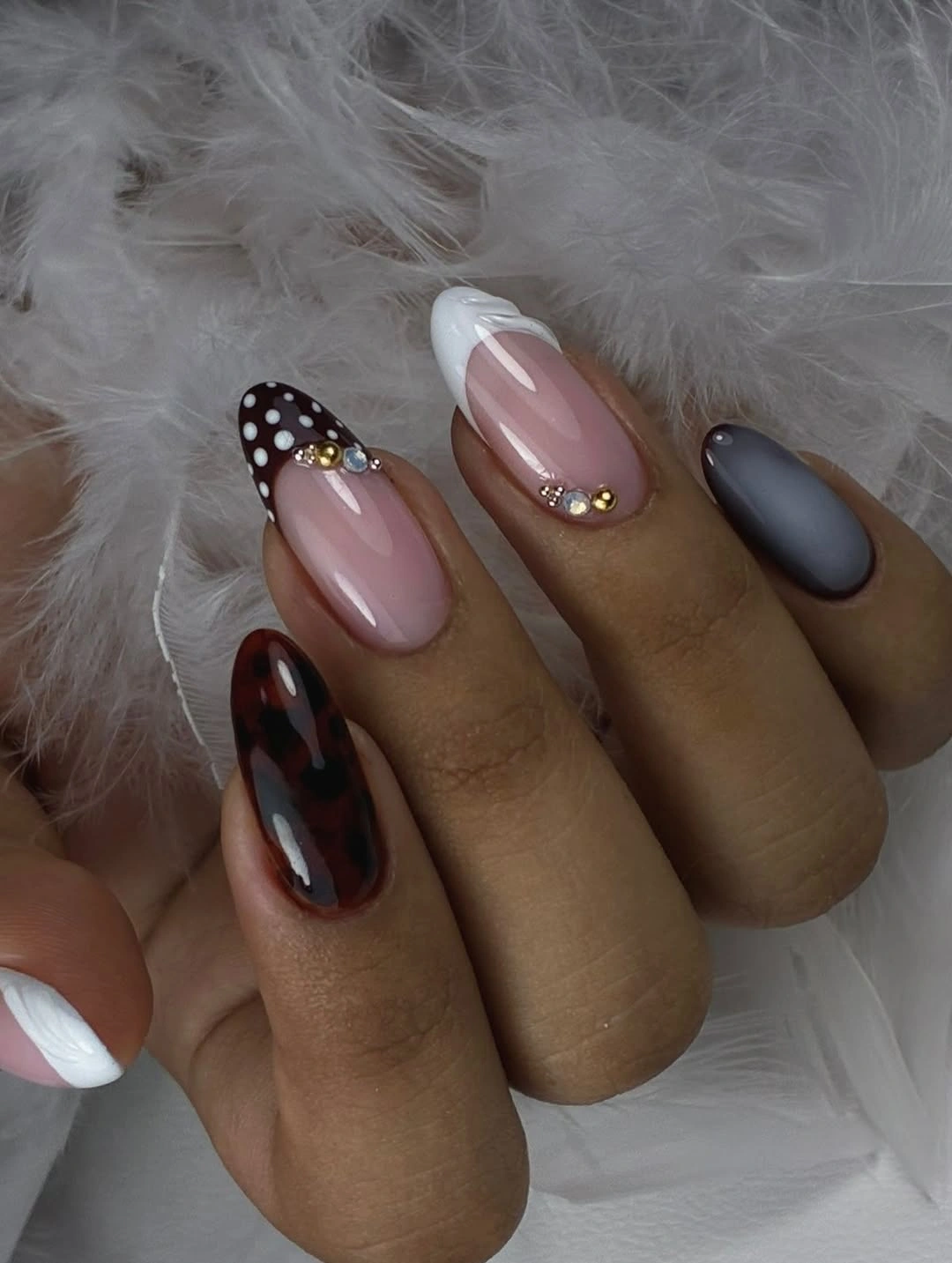
Photo via Instagram
One pink nail ends in a dark curved tip dotted with white, while another uses a broader white curve that sweeps diagonally across the free edge. The translucent brown patterned nail has fluid dark patches rather than a hard geometric division, and the gray nail supplies a smooth uninterrupted surface beside all that detail. Rounded boundaries recur often enough that the different treatments still seem to speak the same visual language.
When several motif families share one manicure, repeating a base tone or a recognizable boundary shape can create coherence without making the designs match. The sheer pink and curved divisions do that work here while the darker nails provide contrast.
14. Tiny Marks Reward a Very Short Nail Shape
Very short rounded-square nails make the scale of every detail especially noticeable here. A pale milky base leaves most of each nail open, while thin reddish-brown lines trace portions of the edges and tiny blue, red, green, and dark marks appear across the surface. Because the decoration is so small, the compact nail shape feels like part of the composition rather than simply a background for larger art.
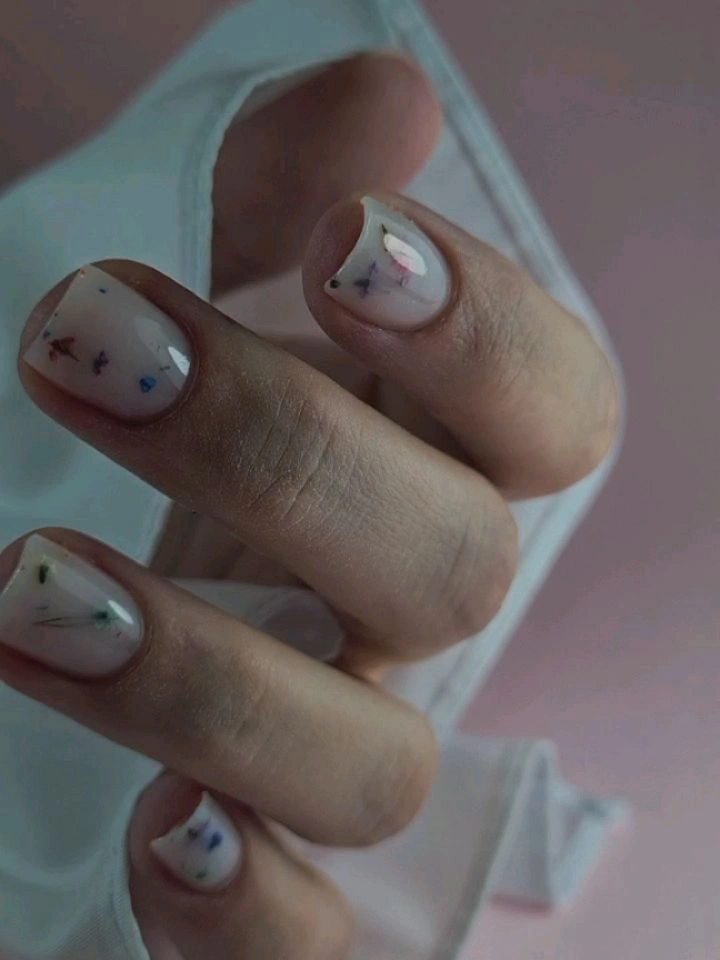
Photo via Instagram
The colored marks are spaced apart instead of forming one continuous pattern, and several nails include small pale curved details that sit separately from the darker points. Fine edge lines add another layer without closing every nail into a complete border. That sparse placement gives each tiny mark room to register, which is more interesting here than trying to assign every miniature shape a specific object or symbol.
Widely spaced micro-details can suit a very short surface precisely because they do not need much room to remain legible. Leaving visible milky space between them makes the scale of the decoration feel deliberate rather than crowded.
15. Pink and Aqua Gradient Meets One Raised Accent
Very long coffin nails create a broad surface for a smooth color transition, moving from bright pink through the upper portion into pale aqua-blue toward the squared tips. The gradient stretches along the full length rather than stopping at a crisp boundary, so the two colors appear to melt into each other. That elongated transition emphasizes the dramatic proportions of the shape without adding repeated line art.
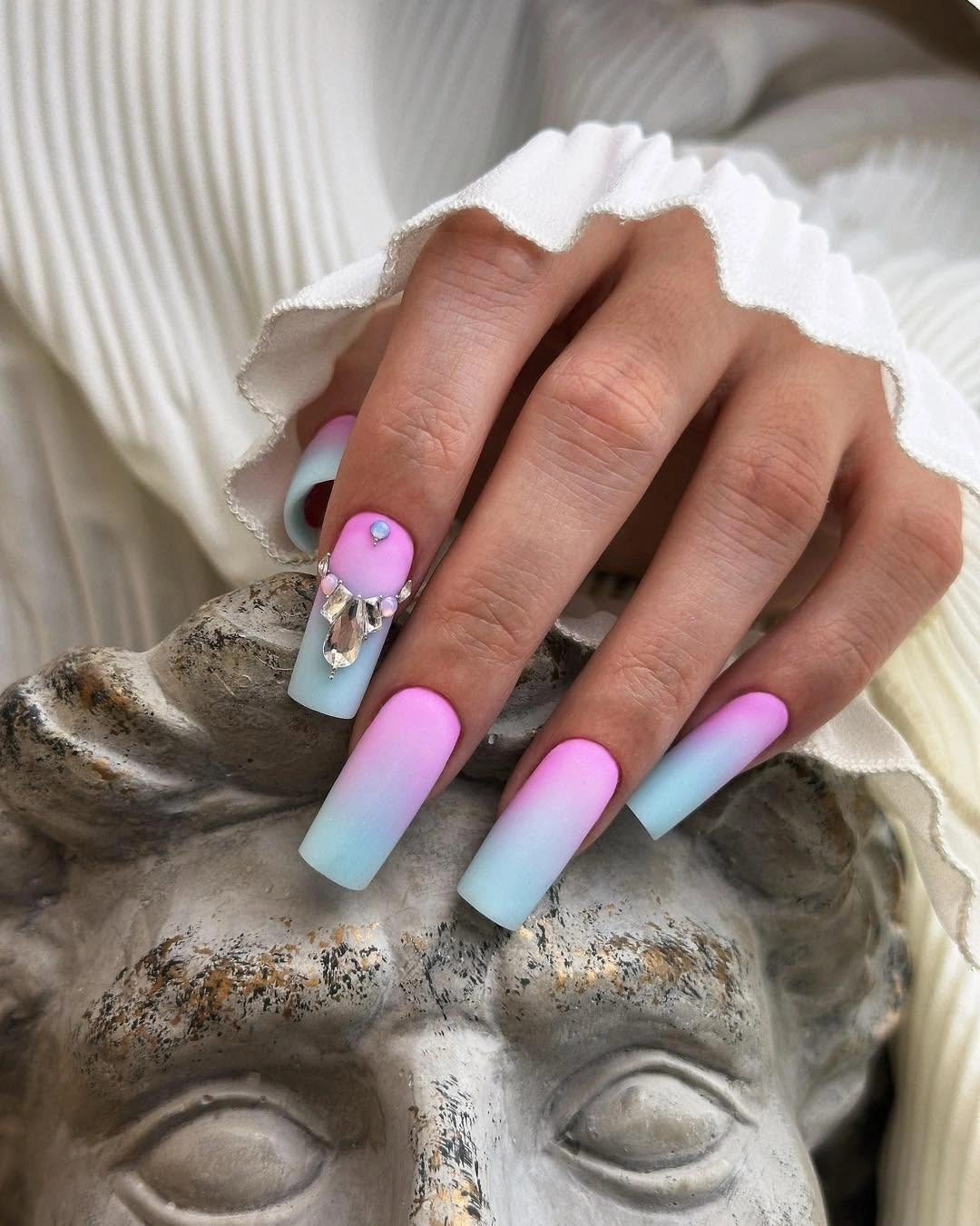
Photo via Instagram
One nail changes the texture of the set with a raised silver-toned bow-like decoration positioned against the gradient, accompanied by a small round accent above it. The ornament projects from the surface and therefore catches attention differently from the flat color transition surrounding it. I like that contrast because the manicure combines movement created by color with a single point where physical dimension becomes the dominant detail.
If a long gradient already provides plenty of visual movement, concentrating dimensional decoration on one nail can preserve the effect of the color shift elsewhere. The raised accent then reads as a distinct punctuation point rather than another repeated motif.
16. Leopard Spots Gather Along Milky White Edges
These medium soft-square nails keep most of their surface milky white, then concentrate black-and-brown leopard-like marks around selected tips and corners. The placement leaves broad pale areas exposed instead of covering every nail from base to edge. On one nail, the spots spread across a noticeably larger area, creating a denser version of the same pattern used more sparingly elsewhere.
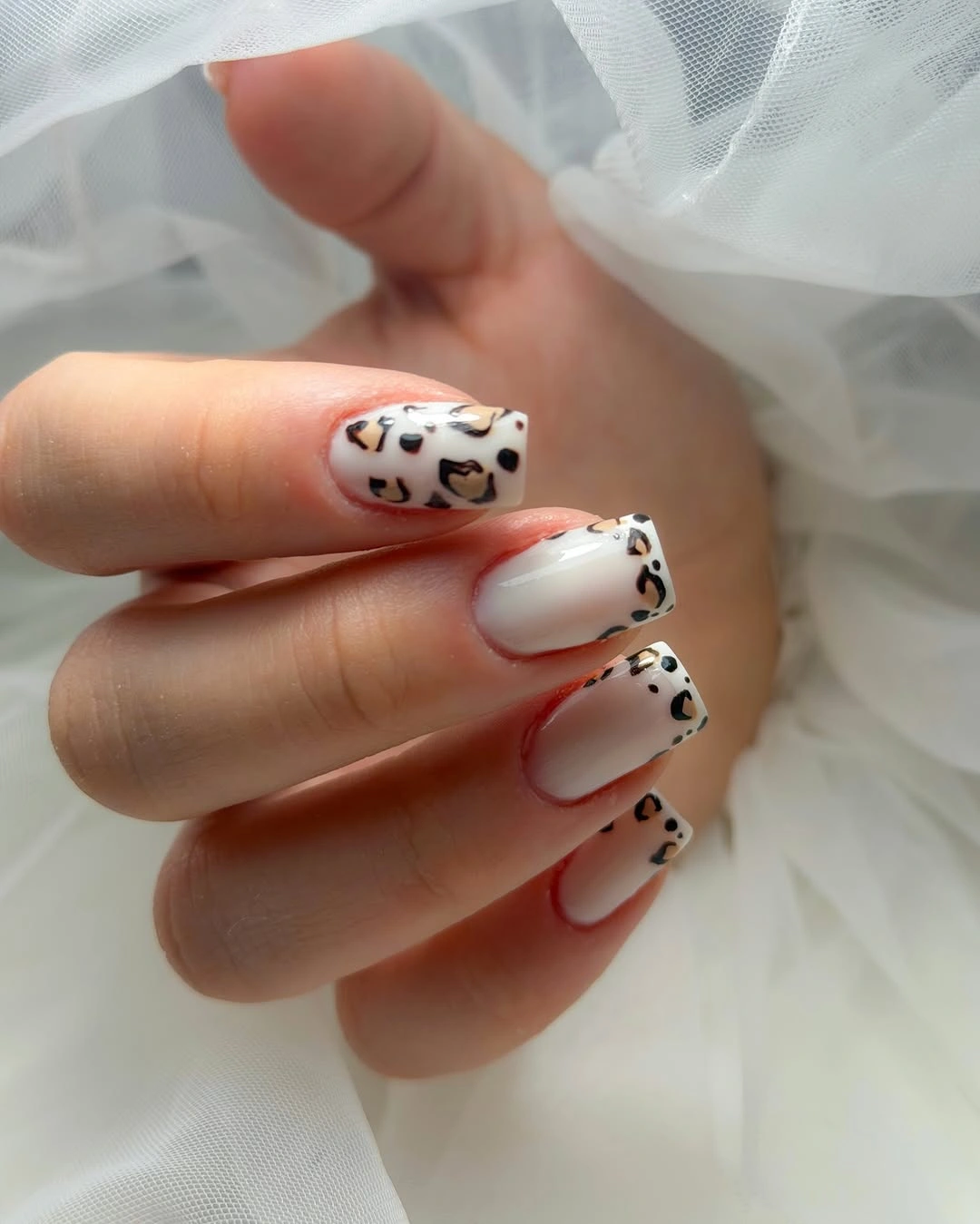
Photo via Instagram
The scattered edge clusters change how the animal pattern meets the nail shape, especially where individual spots wrap around a corner or sit directly against the free edge. Black outlines and warm brown centers create enough contrast to remain clear against the white base, while the larger patterned area introduces a deliberate change in density. The pattern therefore behaves almost like an irregular border rather than a full-surface print.
Moving a recognizable motif toward tips and corners can make placement itself part of the design. The same leopard-like pattern feels different when it appears as a small edge cluster on one nail and a broader field on another.
17. Brown Neutrals Connect an Eclectic Mixed Manicure
These medium-to-long almond nails combine sheer pink, white, taupe, translucent mottled brown, tan, and pale blue across a deliberately varied set. White curved lines appear on several nails, while brown tones return through both solid-looking areas and a tortoiseshell-like mottled accent. The cool blue nail stands apart chromatically, yet its rounded shape and pale detailing still belong to the same overall composition.
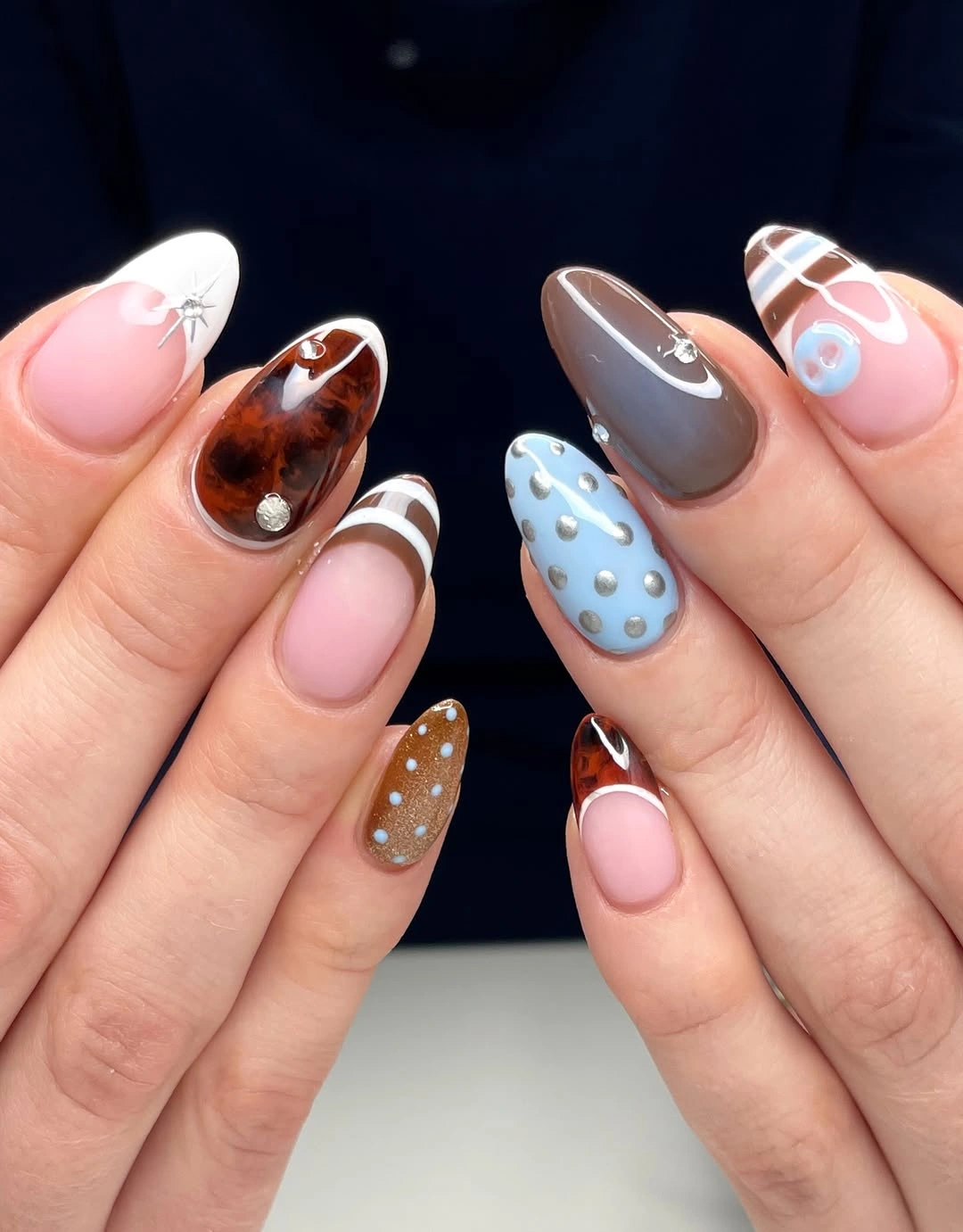
Photo via Instagram
The details change sharply from finger to finger: one brown nail has translucent dark mottling, another carries a curved white boundary, and a tan surface is scattered with small white dots. Pale blue is punctuated by raised silver-toned dots, while another tip uses crossing brown-and-white lines that read as plaid-like. I like the tension here because the manicure embraces variety without pretending every pattern needs to match.
A mixed set this varied can still feel intentional when a few colors and line qualities recur across unrelated designs. Brown, white, and rounded curves provide those points of recognition while the blue accent keeps the combination from becoming visually predictable.
18. Vivid Orange Makes Color the Whole Statement
Vivid orange covers these short-to-medium oval nails from base to tip, with no visible graphics, contrasting tips, or decorative accents interrupting the hue. The rounded silhouette keeps the edges smooth, while the intense color remains consistent across both hands. Among fall nail colors for November, this kind of saturated orange makes the color itself the primary visual decision rather than a backdrop for another motif.
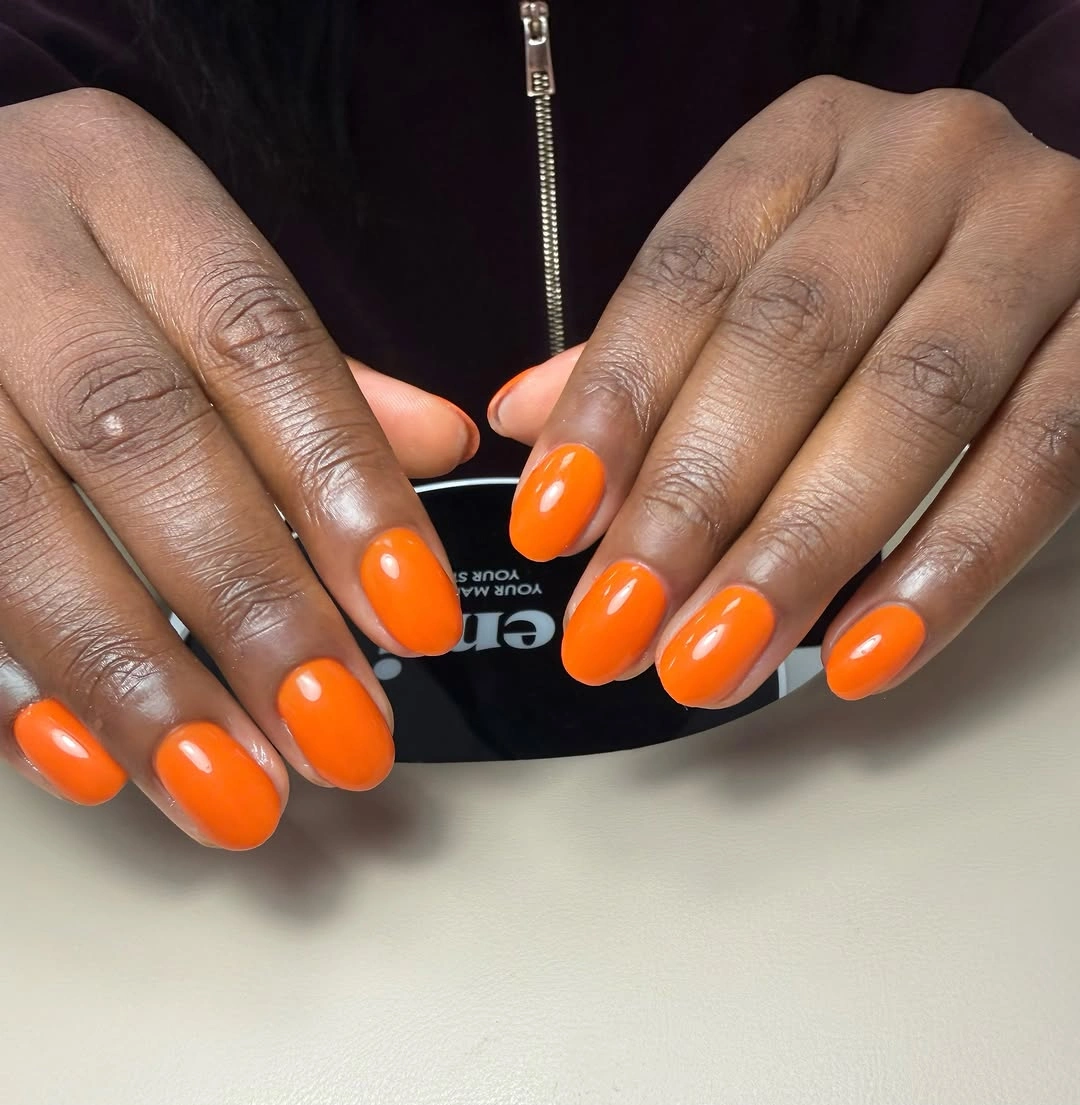
Photo via Instagram
Glossy reflected highlights run across the curved surfaces and make the orange appear slightly brighter wherever the light catches it, but the manicure remains visually straightforward. There is no gradient or secondary shade creating the movement, so attention stays on the relationship between saturated color, rounded shape, and smooth coverage. That directness gives the manicure a different energy from the more pattern-heavy sets.
One strong hue can be enough when color intensity is the quality you want to emphasize. Keeping the entire set orange allows its saturation and shape to register without competing decoration.
19. Deep Burgundy Sharpens an Elongated Almond Silhouette
Long almond nails take on a particularly defined appearance in this uniform deep wine-burgundy color, because the dark shade follows every taper toward the pointed ends. There are no visible contrasting tips or graphic accents to break that continuous outline. The combination makes length and silhouette unusually prominent, which gives these almond November nails a distinctly streamlined character.
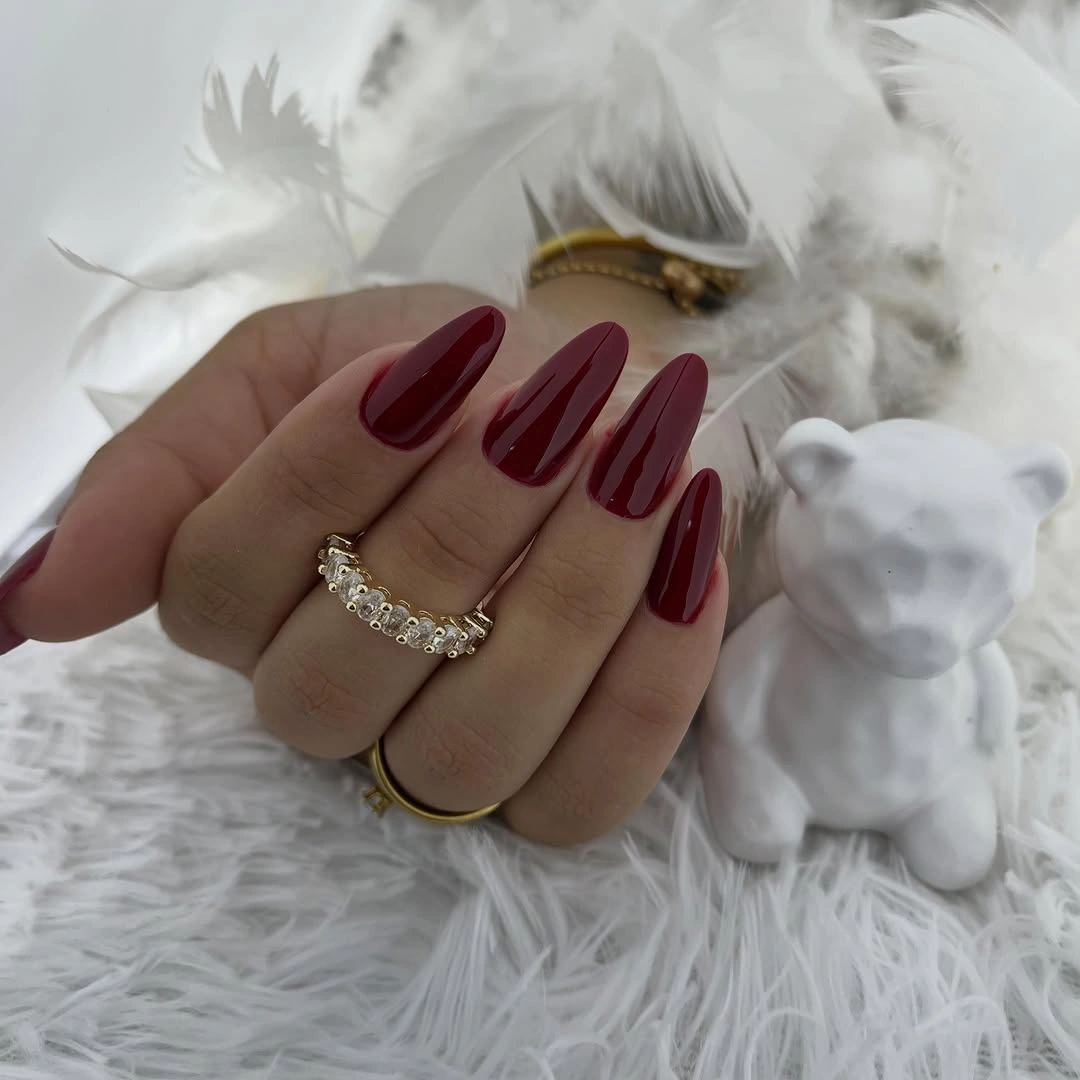
Photo via Instagram
Narrow glossy highlights travel along the length of several nails, emphasizing their curved surfaces while the burgundy remains uninterrupted from cuticle area to tip. The deepest portions of the color read almost brown-red in shadow, while brighter reflections bring out a richer wine tone. That subtle variation comes from light across the glossy surface rather than from another visible polish color or pattern.
Pairing an elongated shape with one deep color can make the outline do more visual work than additional art would. Here, the tapered form and dark glossy surface reinforce each other without needing a separate focal motif.
20. Black Branching Lines Fill Crisp White Panels
These medium almond nails begin with sheer pink bases, then introduce sharply defined white panels near the tips instead of a uniform curved French edge. The white areas angle differently across the nails, giving each one a distinct boundary while preserving the same pale foundation. Thin black markings are contained inside those white shapes, so the decorated area stays clearly separated from the translucent pink.
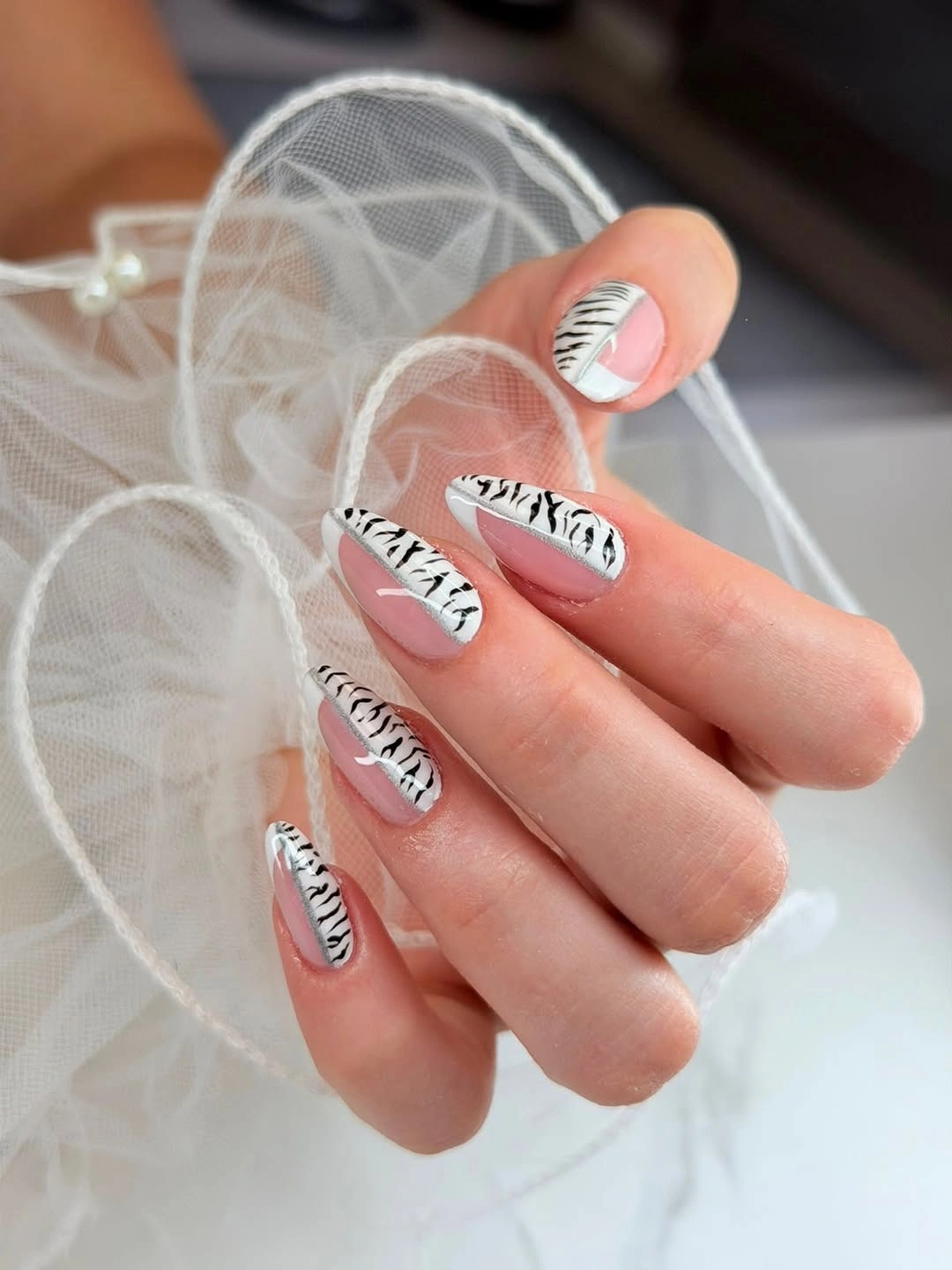
Photo via Instagram
The black linework resembles fine twigs, leaves, or branching strokes, with narrow marks extending in different directions across the white panels. Because the pattern remains inside those light areas, the edges of the white shapes become part of the composition rather than simply framing the nail tip. The strong black-on-white contrast also makes very fine marks readable without spreading them across the entire surface.
Detailed linework can feel more defined when it is confined to a specific color block instead of floating over the whole nail. Here, the angled white panels provide both a boundary and a high-contrast field for the delicate black marks.
21. Smoky Blue-Gray Nails Hold Light Inside the Color
These medium almond nails sit in a smoky graphite blue-gray range, with a dark base that becomes noticeably lighter through broad oval areas near the centers. The softly pointed shape gives those pale reflections a long curved surface to move across. Instead of reading as separate painted blocks, the lighter areas appear embedded within the darker color and shift the depth of each nail.
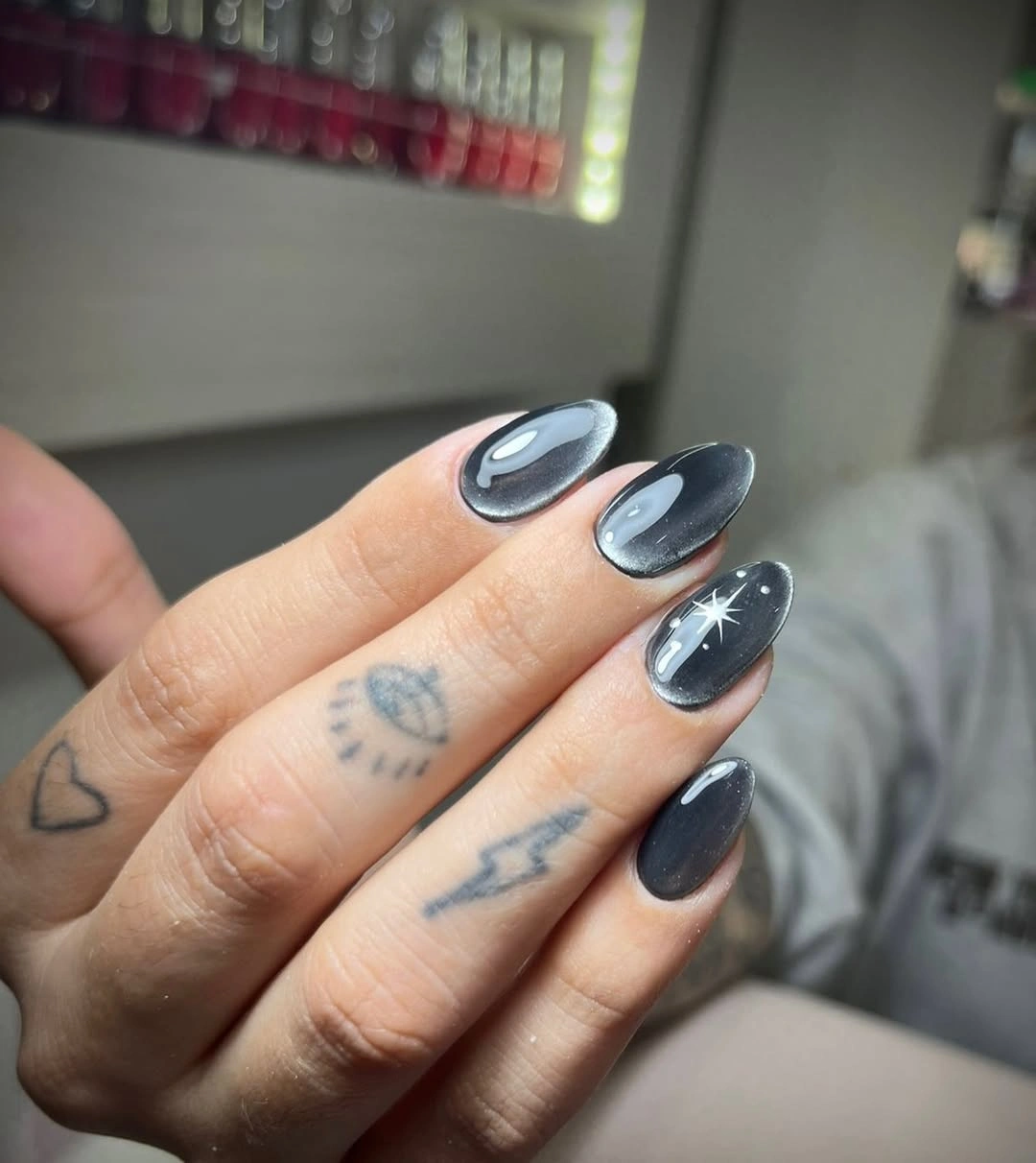
Photo via Instagram
Most nails use diffuse pale blue-gray highlights with softened edges, but one introduces a crisp white starburst made from thin intersecting lines. That sharper mark changes the visual scale immediately because it sits beside much broader, hazier areas of light. I like the contrast between those effects: one feels atmospheric and rounded, while the other is precise enough to interrupt the smoky surface.
A dark manicure can gain internal variation by pairing broad reflected-looking highlights with one controlled linear detail. Keeping the starburst isolated lets its sharp geometry stand apart from the softer light effects around it.
22. Diagonal Pink Bands Cut Through Sparkling Burgundy
Short soft-square nails take on a dense wine-burgundy color here, with fine sparkle visible across the dark surfaces rather than concentrated on a single accent nail. The compact squared outline keeps the color blocks broad and easy to read. Pale dusty-pink diagonal bands then cross several nails, adding direction to a manicure that would otherwise be dominated by one deep sparkling shade.
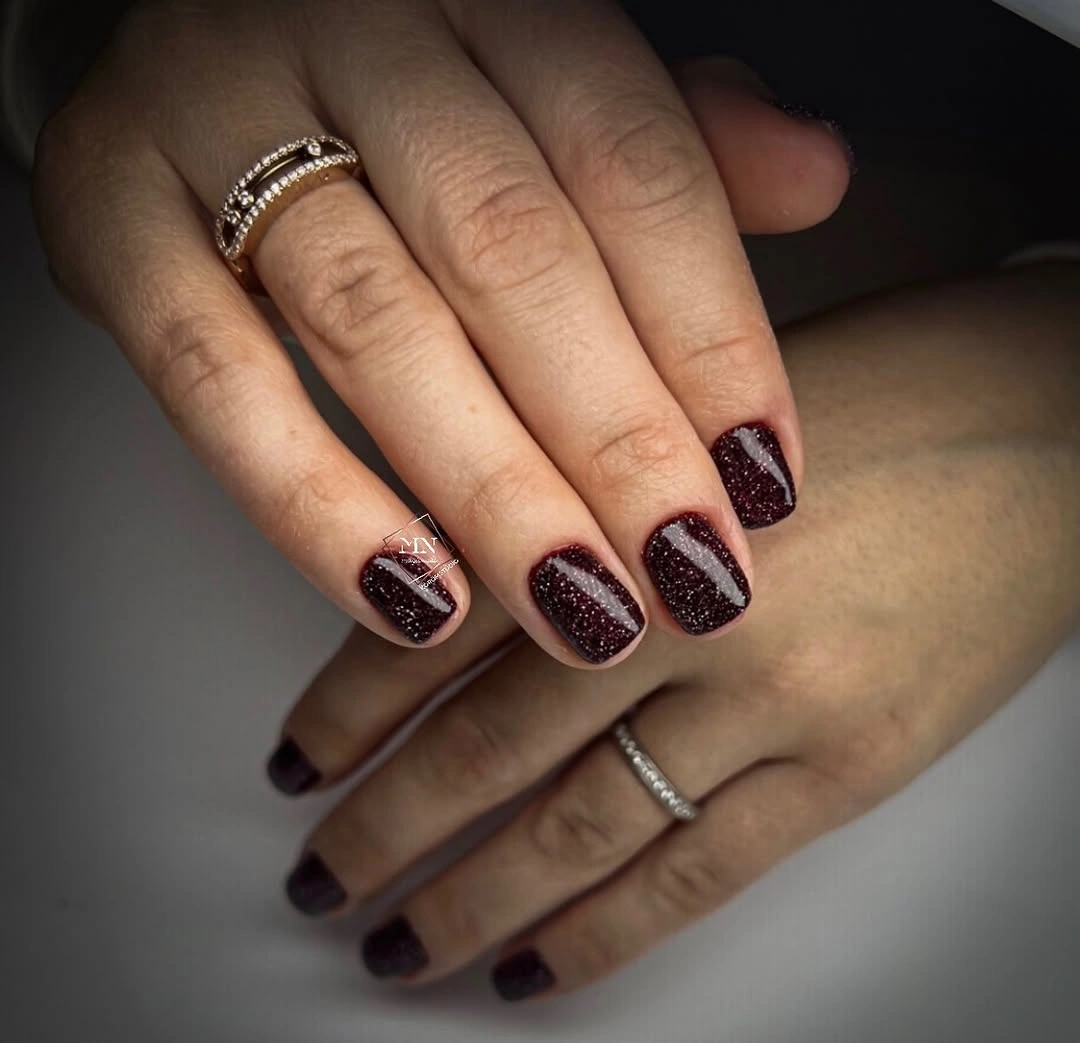
Photo via Instagram
The lighter bands do not follow the free edge like conventional tips; they slice across the burgundy at an angle and create narrow interruptions in the darker field. One nail also carries finer linear detail alongside the broader stripe, which introduces a second scale without changing the palette. Those diagonals make the short nails feel more graphic because the eye follows their direction across the squared surfaces.
Directional bands can change the rhythm of a dark manicure without requiring several unrelated motifs. Here, the pale lines create movement while the burgundy sparkle remains visible on both sides of each interruption.
23. White Marks Drift Across Sheer Blush Pink
Medium oval nails are covered in a sheer blush-pink tone that leaves the overall surface light and translucent-looking, with a glossy reflection running across several fingers. Small white details interrupt that softness without forming a dense repeated pattern. The rounded outline and pale base give the marks plenty of visible space, so even the smallest dots remain distinct rather than blending into a larger decorative field.
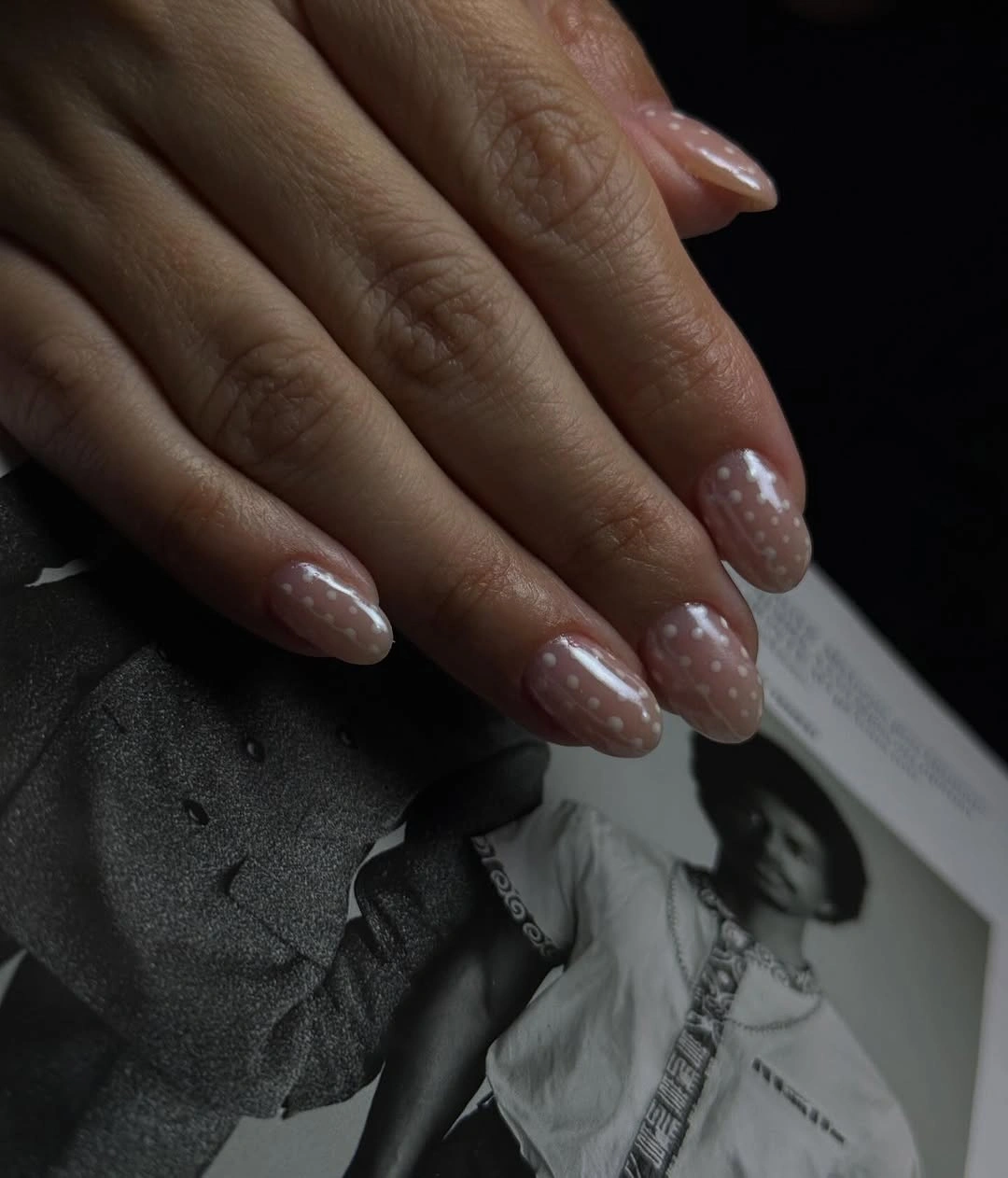
Photo via Instagram
Some nails carry little clusters of white dots, while others add short irregular strokes that bend, branch, or curve across the pink. The marks vary in spacing and direction, which makes the placement feel loose rather than mechanically repeated from finger to finger. Because the longer strokes are still quite small, they add shape to the design without overwhelming the translucent base beneath them.
Leaving generous space between tiny marks can make small-scale decoration feel more deliberate and easier to notice. On a sheer blush base like this, a few dots and curved white strokes are enough to create an intimate pattern without filling every available area.