Trendy winter business casual outfits make more sense when polish is treated as a relationship between structure and ease rather than as a rigid dress code. The strongest choices usually feel intentional because their proportions, finishes, and visual weight support one another, allowing a more relaxed element to coexist with a sharper one without making the overall result feel unfinished or overly formal.
Formality becomes easier to judge when you stop asking whether every individual piece qualifies and start looking at the balance of the whole. A defined line can be softened by looser volume, while a refined finish can sharpen something more casual, and those shifts matter more than following a fixed checklist. The goal is visual clarity: enough structure to feel deliberate, enough ease to keep the styling flexible.
1. Pink Knit Layers Soften Black Wide-Leg Trousers
The pink sleeveless knit sits over a pale checked button-up, so the upper half combines visible softness and texture with the sharper line of a shirt collar and cuffs. Its shorter shape stops well above the hem of the cropped black wide-leg trousers, which keeps the knit from merging into the darker lower block and gives each layer a distinct job in the silhouette.
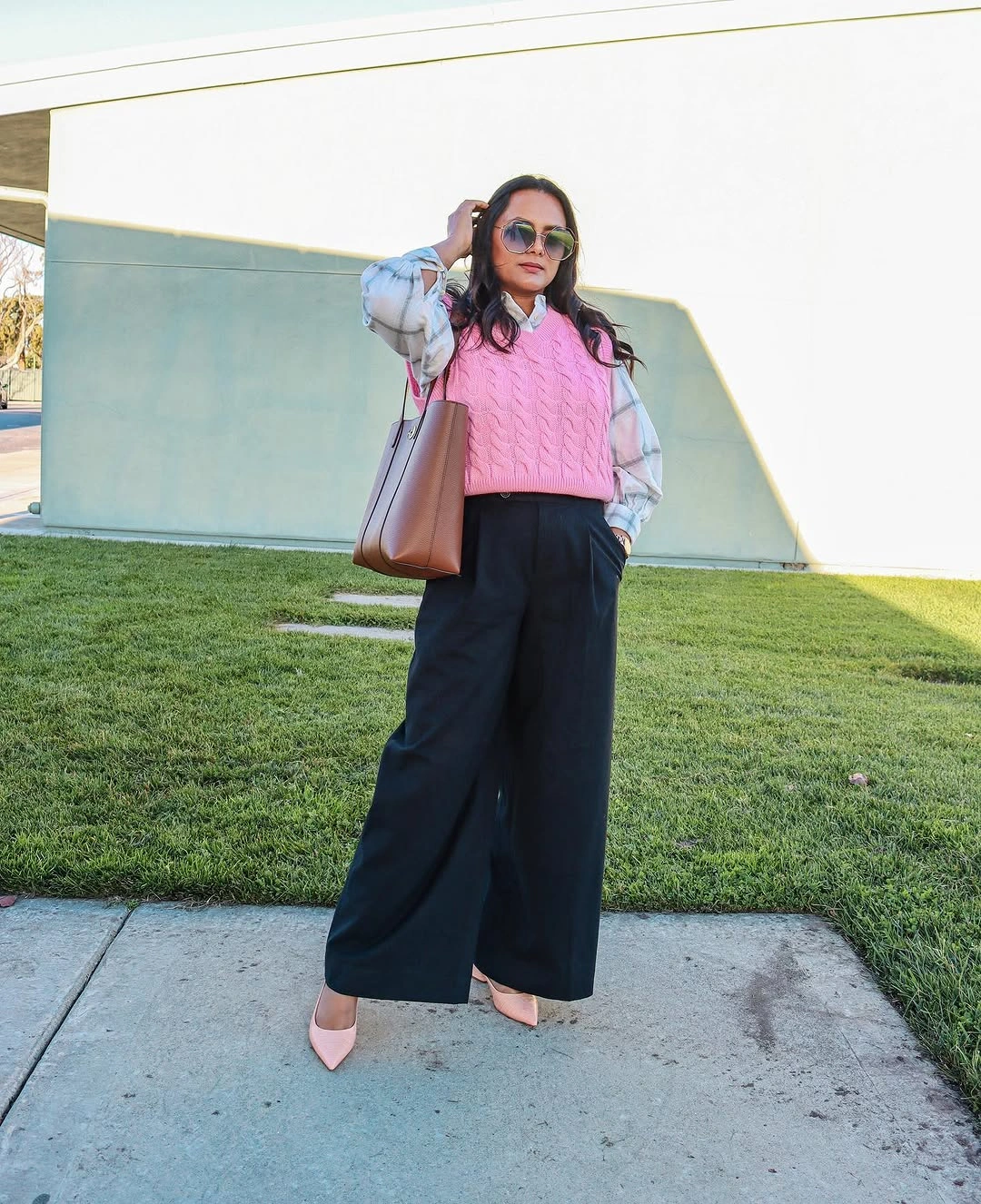
Photo via Instagram
The trousers add breadth through the leg, but their cropped length leaves enough open space for the pointed pink pumps to register clearly instead of disappearing underneath the hem. That repeat of pink from the textured knit to the shoes makes the color placement feel deliberate, while the brown tote stays separate from the brighter pairing rather than competing with it.
For winter business casual outfits with layered knitwear, the strongest idea here is not brightness alone but the way the knit changes the formality of the checked shirt beneath it. The pointed pumps bring back a sharper finish, so the outfit retains structure while the sleeveless layer keeps the upper half from feeling conventionally tailored.
2. A Defined Jacket Sharpens a Pleated Midi Skirt
The pale blue jacket draws the eye toward the waist because its front closes closely and a visible tie detail gathers the shape before the black skirt begins. Below that point, the pleated midi skirt falls in a longer vertical line, so the outfit balances a more defined upper section against a lower half that has movement and visual length.
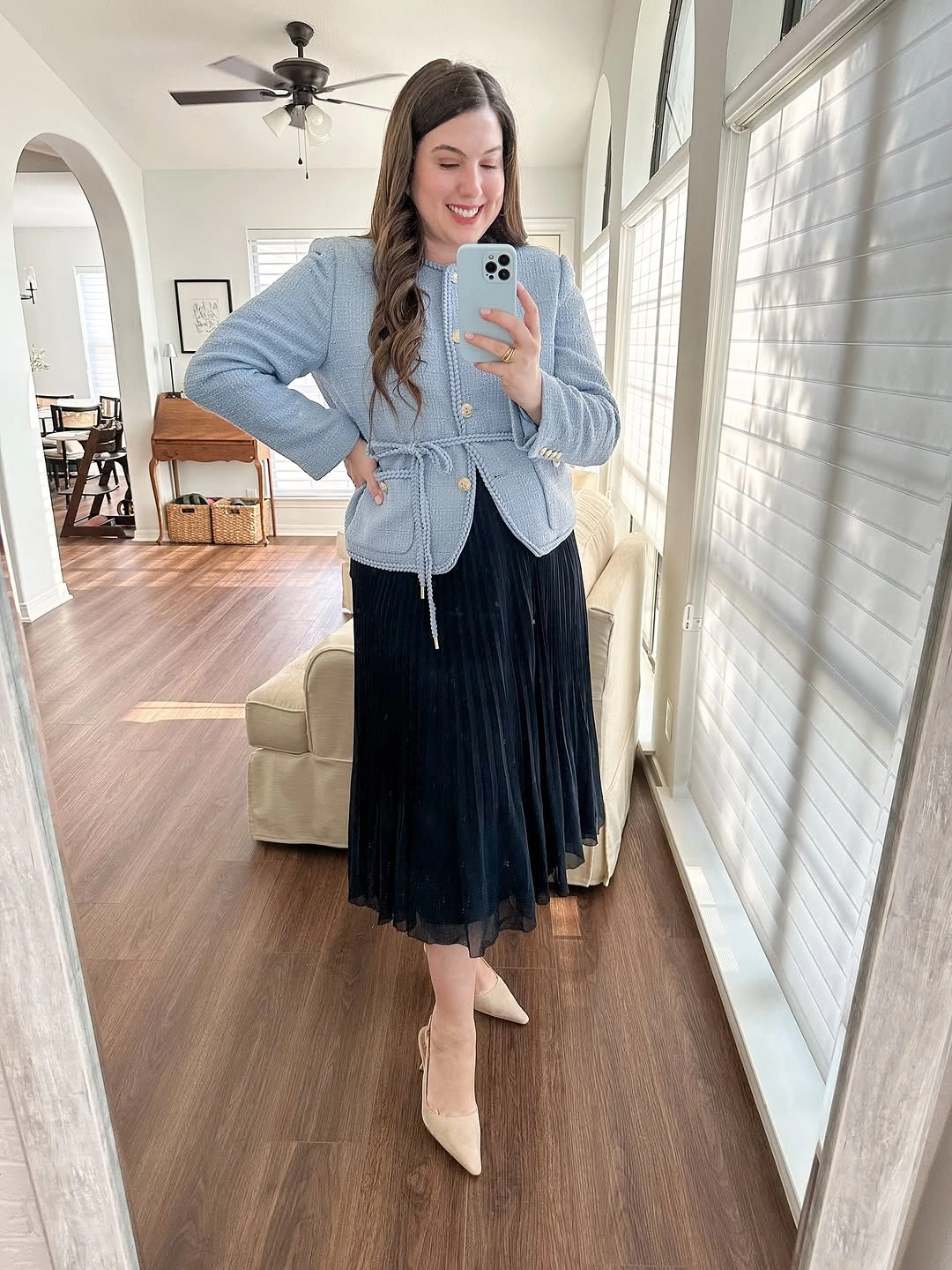
Photo via Instagram
Color does a large part of the organizing here: the pale blue top section sits clearly against the black skirt, while the light pointed slingback shoes keep the base from ending in another dark, heavy block. The shoes also leave more visible space around the ankle, which gives the long skirt a lighter finish than a dark closed shoe would.
Business casual skirts with a structured jacket often depend on where the silhouette changes, and here the waist becomes the hinge between a defined top and a flowing lower line. The beige pointed slingbacks keep the long black skirt from becoming visually bottom-heavy while preserving a polished finish.
3. Pinstripes Meet Pleats With a Loafer Finish
The long gray pinstriped blazer creates most of the tailored structure, extending well below the hip before the white pleated midi skirt becomes the dominant lower shape. That overlap matters because the blazer feels substantial and linear, while the bright pleats introduce both contrast and movement instead of continuing the same gray tailoring all the way down.
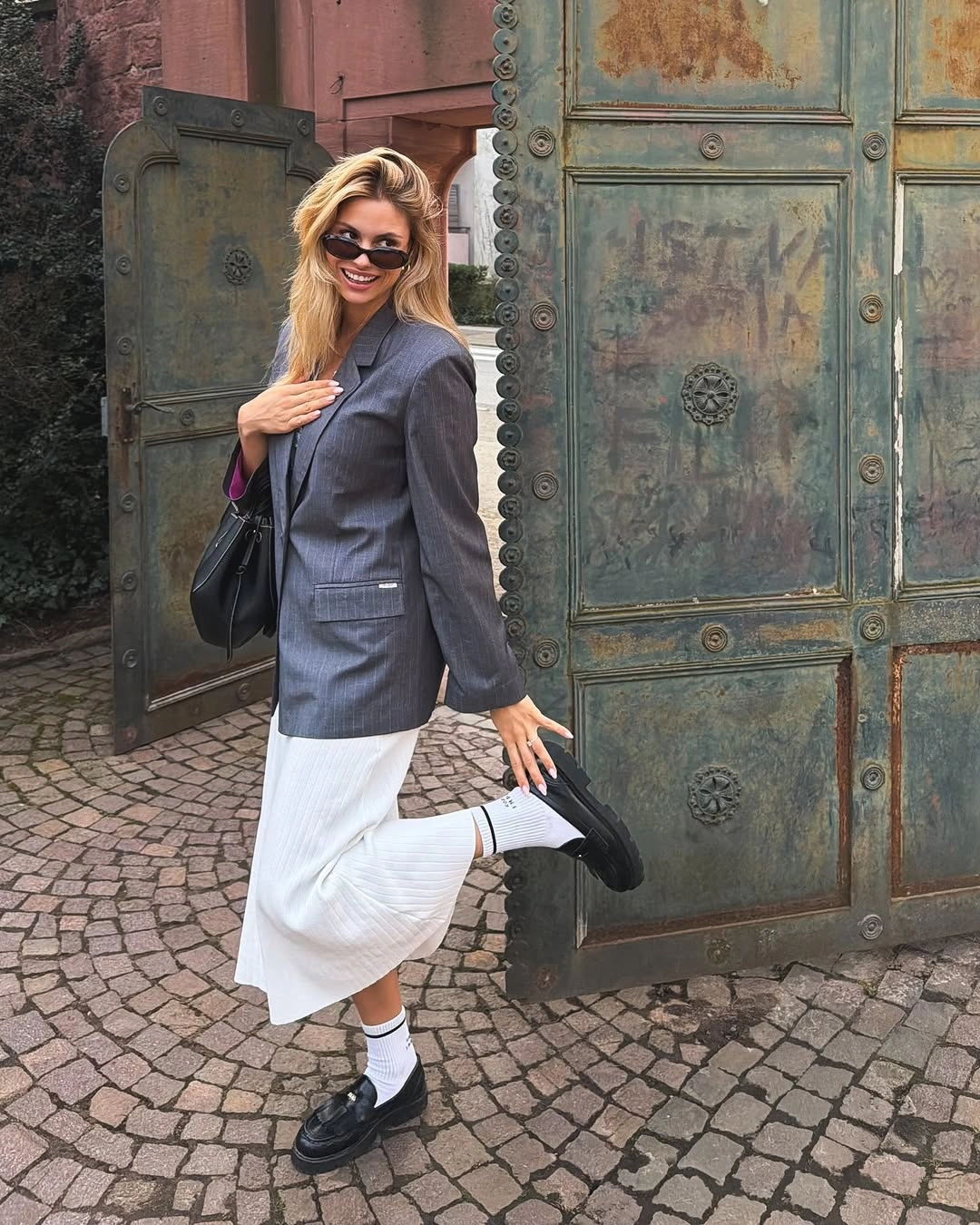
Photo via Instagram
White socks and black loafers shift the finish away from conventional dress shoes, and that small styling change makes the outfit read more polished casual than strictly formal. The loafers are visually substantial enough to balance the long blazer, but the exposed socks create a deliberate break between the white skirt and dark footwear rather than a seamless formal line.
This is a useful example of blazer-and-midi-skirt business casual styling that stays deliberately short of formal suiting. The socks and loafers preserve a more casual note at the ground, while the pinstripes keep enough tailored language in the upper half to make the combination feel intentional.
4. Crisp Shirting Pushes Denim Toward Polished Casual
The oversized white button-up does most of the structural work in this outfit, with a crisp collar, broad body, and longer hem creating a strong upper silhouette without a blazer. Because the shirt is roomy rather than closely fitted, the polish comes from its clean shape and pale color instead of from a narrow, conventionally tailored outline.
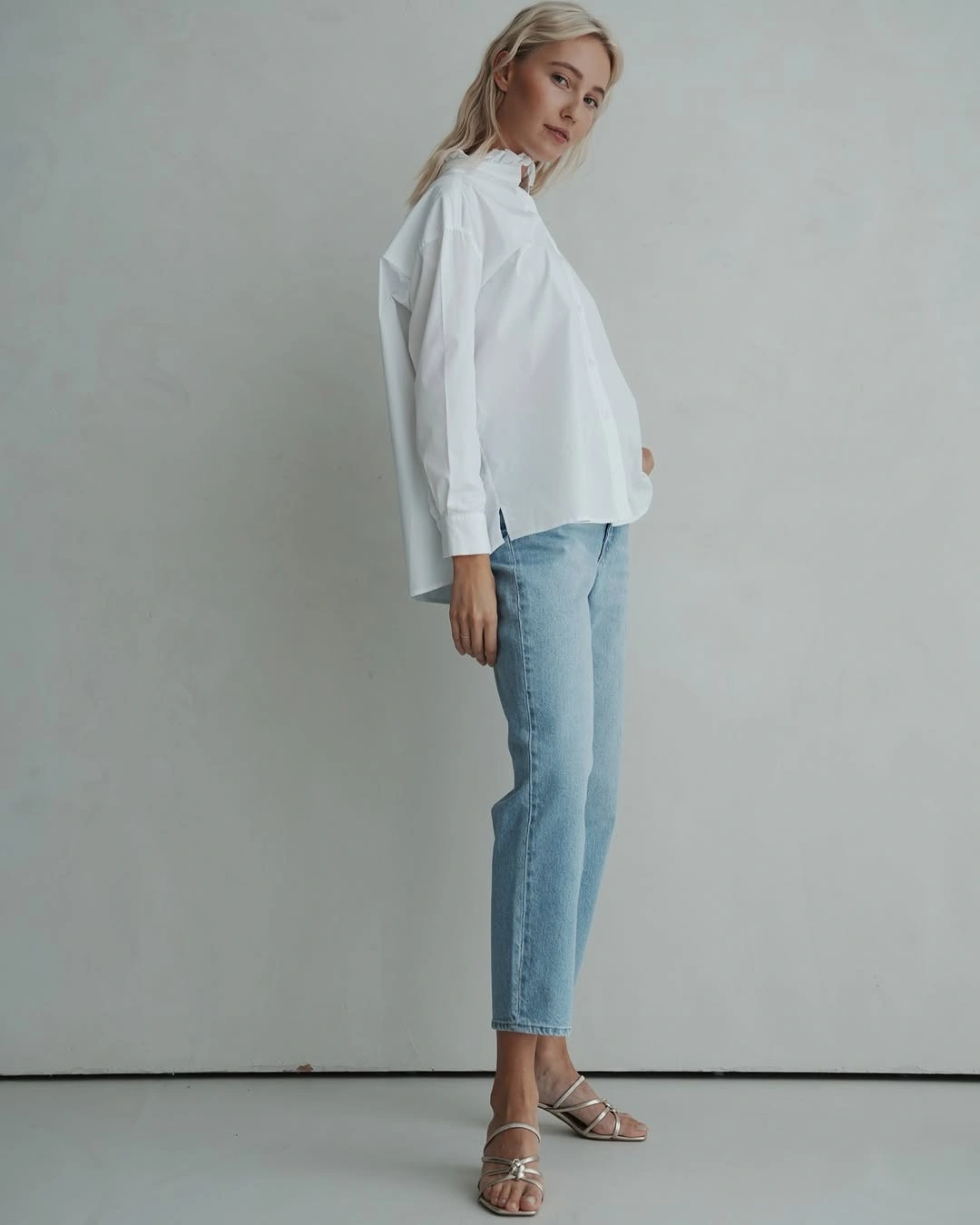
Photo via Instagram
The light blue jeans end above the ankle, which keeps the lower half visually lighter and gives the slim metallic strappy heels plenty of space to show. Those delicate heels raise the finish, but the denim remains clearly casual, so the combination lands closer to polished casual than to an unambiguous winter business-casual formula.
Business casual outfits with jeans can move across a wide formality scale, and this one sits nearer the polished-casual side because denim remains the central lower-half signal. The white shirt and slim heels refine it, but the visible combination stays lighter and less structured than the clearer business-casual formulas built around tailoring.
5. Tonal Tailoring Makes Volume Feel More Controlled
From the back three-quarter view, the taupe-brown blazer and similarly colored wide-leg trousers read as one extended tonal field rather than as separate high-contrast pieces. The jacket falls long over the hips, and the trousers continue with substantial width below it, so the outfit relies on coordinated color to keep two relaxed volumes visually connected.
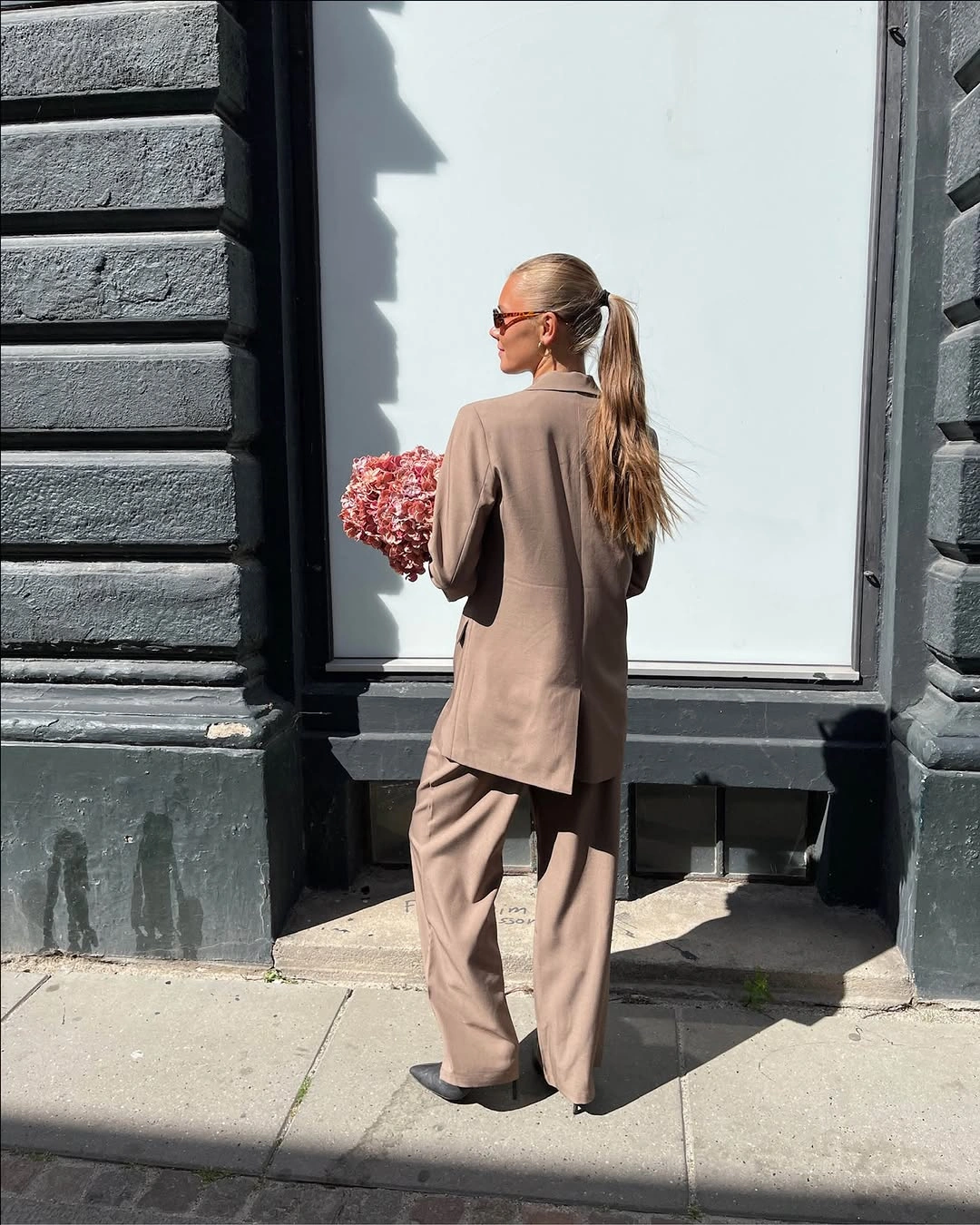
Photo via Instagram
Even with that amount of fabric visible in both the jacket and trousers, the proportions do not look rigid because neither piece appears narrowly shaped through the body or leg. The dark pointed shoes create a more exact finish at the floor, giving the wide trouser line a clear endpoint and adding a sharper note beneath the softer, roomy tailoring.
Relaxed business casual tailoring with wide-leg trousers works visually here because the close taupe-brown tones make the larger proportions read as one continuous idea. The pointed shoes keep that continuity from becoming vague at the bottom, adding a precise endpoint to the long vertical line.
6. A Relaxed Blazer Keeps Denim on the Casual Side
The black blazer is the clearest tailored element here, giving the shoulders and upper body a darker, more defined frame over the plain white crewneck T-shirt. Underneath, the loose blue jeans carry noticeably more volume through the leg, so the outfit never develops the continuous structured line that trousers would create beneath the same jacket.
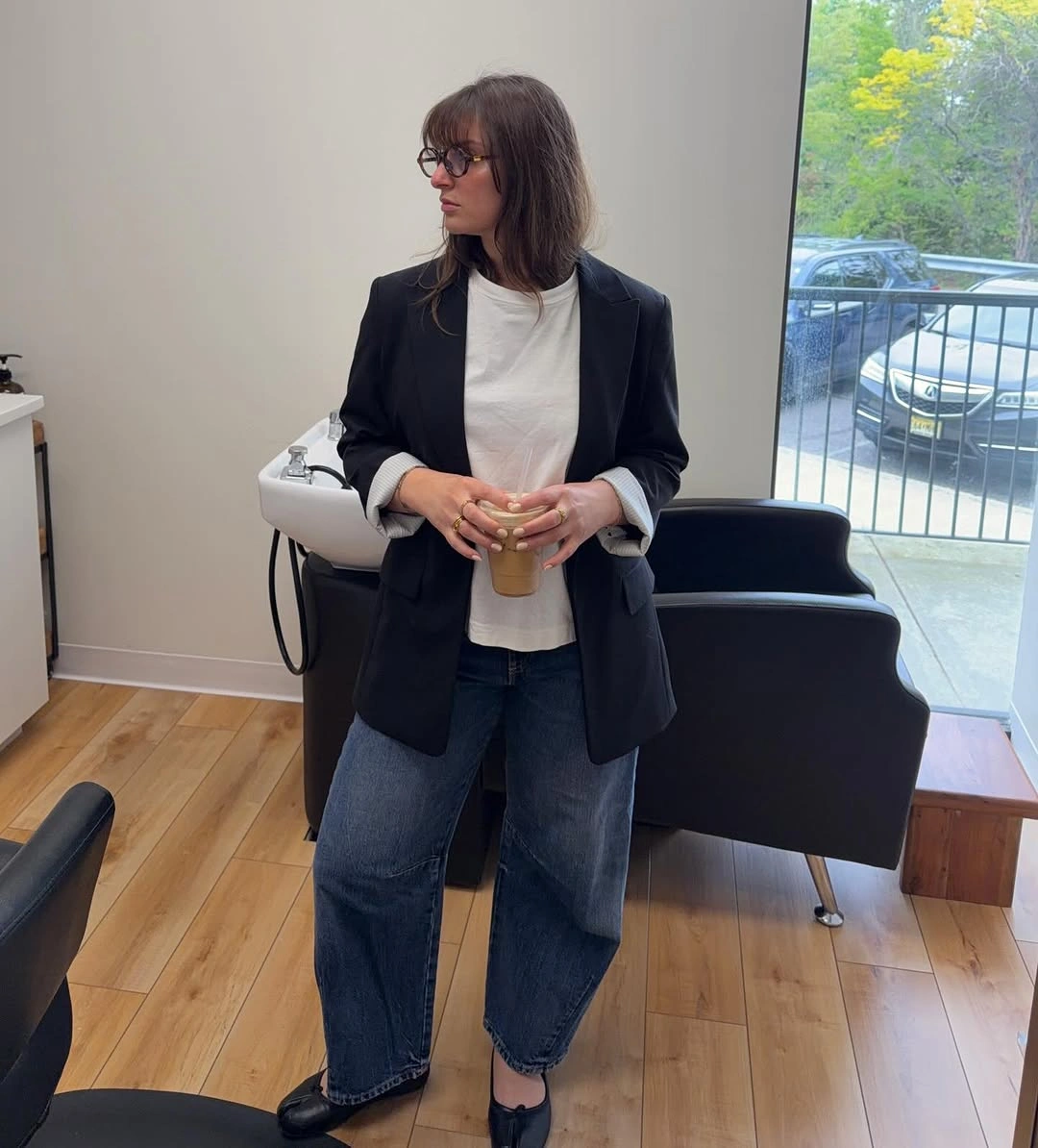
Photo via Instagram
The black Mary Jane-style flats repeat the blazer’s dark color at the bottom and give the wide denim a neat visual endpoint, but they do not cancel the casual character of the jeans and T-shirt. That distinction matters when considering business casual outfits with blazers and jeans: matching dark shoes can make the combination look considered without automatically raising every visible element to business casual.
This lands more convincingly on the polished-casual side of the formality dial because the relaxed denim and basic tee occupy so much of the silhouette. The blazer and flats add definition around those pieces rather than transforming them into formal workwear.
7. A Tucked Shirt Creates Clear Business Casual Structure
A light blue button-up tucked fully into camel wide-leg trousers creates one of the clearest business-casual structures in this group. The slim dark belt marks the waist precisely between the pale shirt and warmer trousers, so even though the legs are broad and fluid in shape, the middle of the outfit remains sharply organized rather than visually loose.
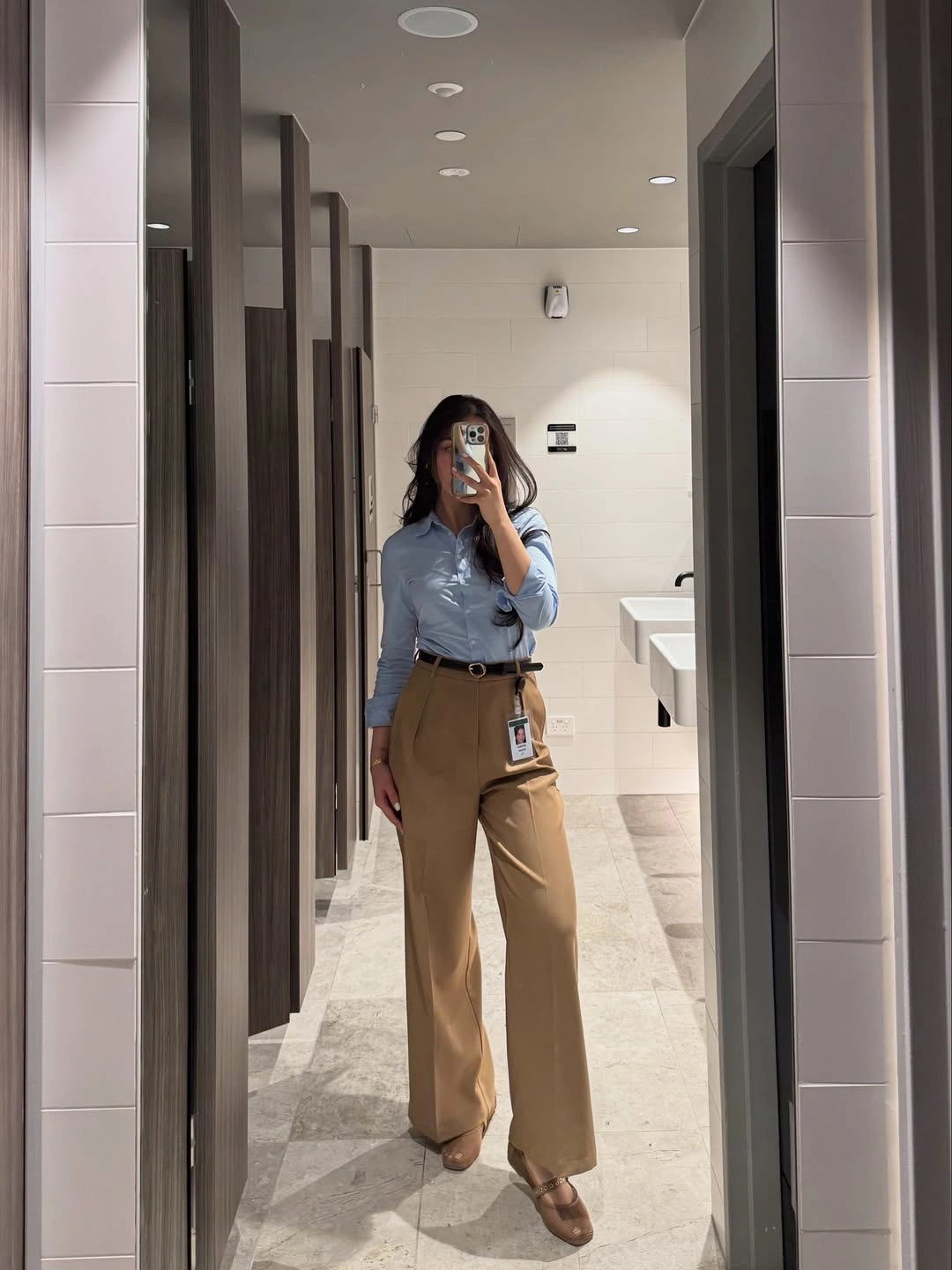
Photo via Instagram
The trousers fall in a long, uninterrupted line toward tan pointed shoes, which keeps their generous width from feeling bulky at the floor. Because the footwear stays close to the trousers in color and has a restrained pointed shape, it extends the lower silhouette instead of introducing a separate heavy contrast. A clipped badge is visible at the waist, but it does not establish anything about the wearer’s occupation or destination.
As a classic business casual shirt and trousers combination, the strength comes from the relationship between tuck, belt, trouser length, and shoe shape rather than from extra tailoring. The wide leg supplies ease, while the defined waist and pointed footwear preserve a visibly structured finish.
8. Pointed Burgundy Flats Refine Restrained Checked Tailoring
The brown-gray checked blazer carries most of the surface detail, while the light neutral top underneath leaves a clean, quiet area through the center of the outfit. Dark trousers narrow toward the ankle instead of continuing the broader scale of the jacket, creating a controlled shift from a more substantial upper layer to a slimmer lower silhouette.
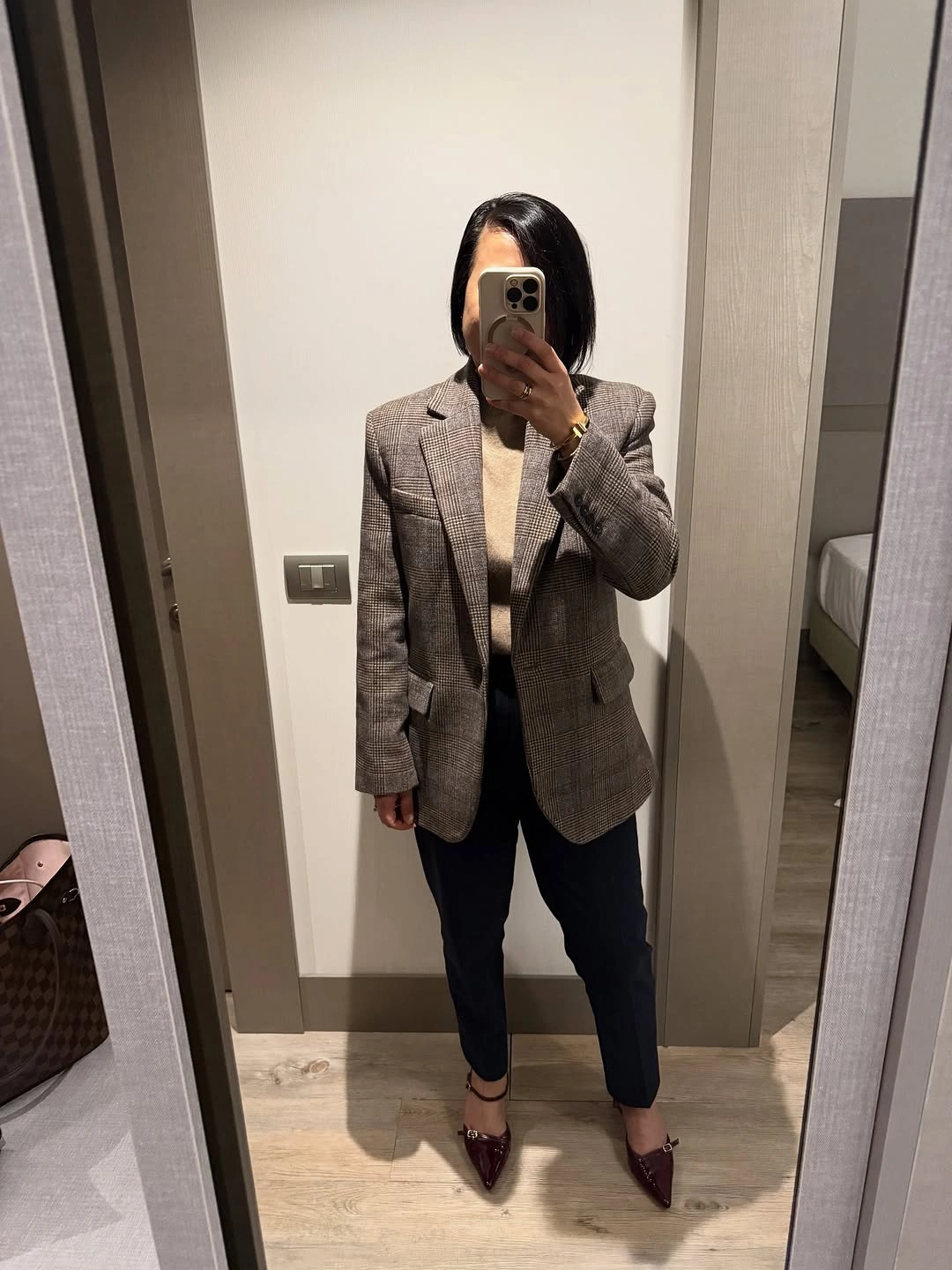
Photo via Instagram
Burgundy pointed slingback flats make a small but meaningful adjustment to that balance. Their shape is sharper than a rounded casual flat, and the deeper red tone sits comfortably beside the browns in the check without simply copying them. In business casual outfits with blazers and pointed flats, that kind of footwear can refine the final line without requiring a heel or another tailored layer.
The result reads clearly business casual because the checked blazer and tapered trousers already establish the main structure. The burgundy shoes fine-tune that formality through shape and color, giving the ankle-length trousers a precise finish rather than becoming the outfit’s main statement.
9. A Striped Shirt Can Carry the Structure Alone
A blazer is not necessary for visible business-casual structure when the shirt and waistband already create strong lines. Here, the pale blue striped button-up is tucked cleanly into high-waisted black trousers, making the collar, vertical stripes, and dark waistline work together as a defined upper-and-middle composition rather than relying on an additional jacket.
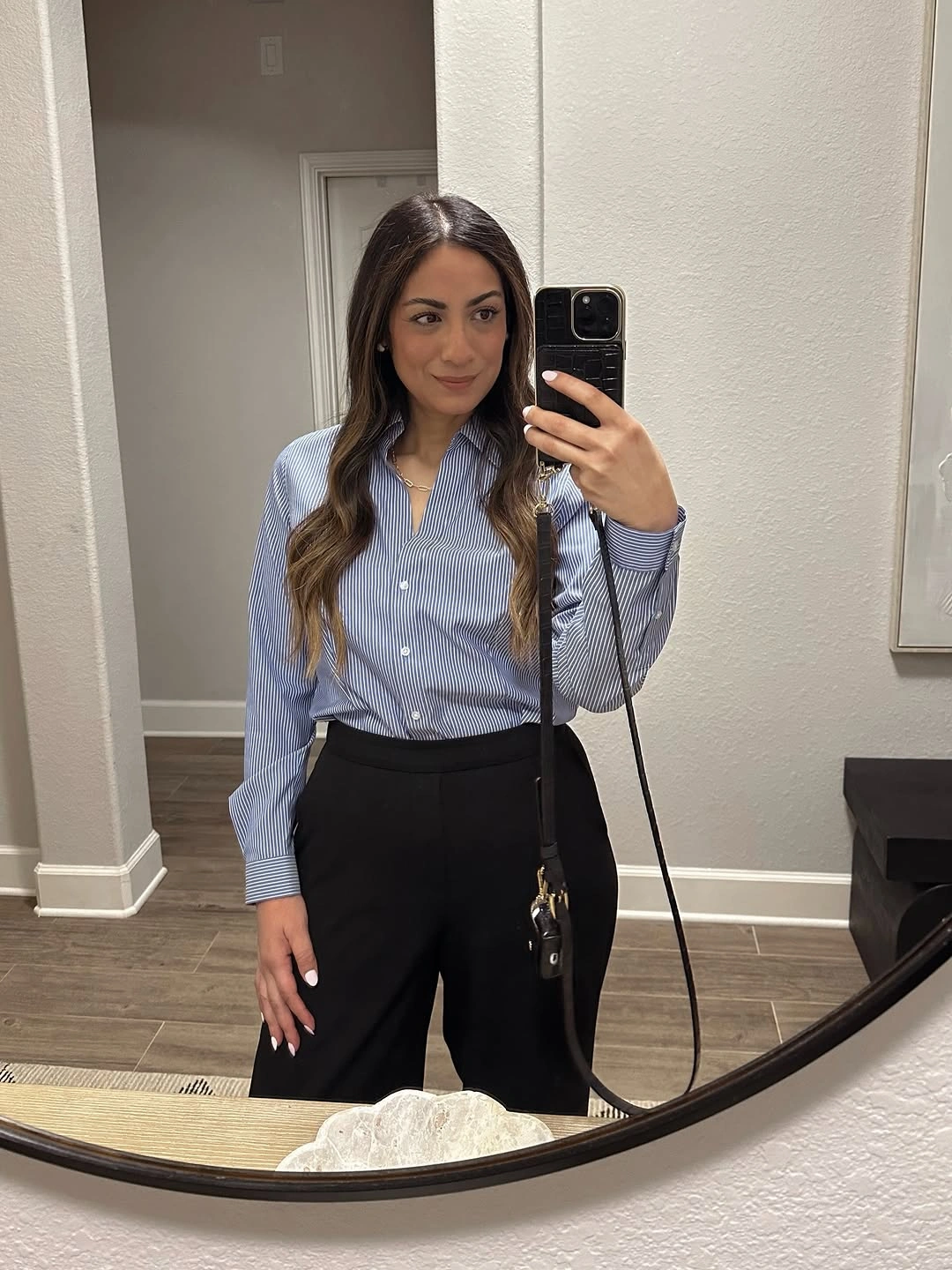
Photo via Instagram
The black trousers form a solid lower block beneath the lighter shirt, while the small black crossbody bag repeats that darker tone without adding much visual bulk. Its narrow strap crosses the shirt diagonally, introducing one extra line across the otherwise vertical arrangement. Because the frame does not show the footwear, the degree of polish at the bottom should remain unresolved rather than filled in by assumption.
This is a simple business casual shirt and black trousers formula in which the tuck does much of the visual work. The contrast between the pale striped shirt and strong dark waistband gives the outfit enough definition to read as intentional without adding another layer solely for formality.
10. Layered Checks Change the Scale of Tailoring
Instead of asking one blazer to provide all the structure, this outfit places two checked tailored layers at different scales. A more fitted brown checked blazer sits over a white crewneck top, while a larger double-breasted checked jacket is draped across the shoulders, extending the silhouette outward and creating a broader frame around the closer inner layer.
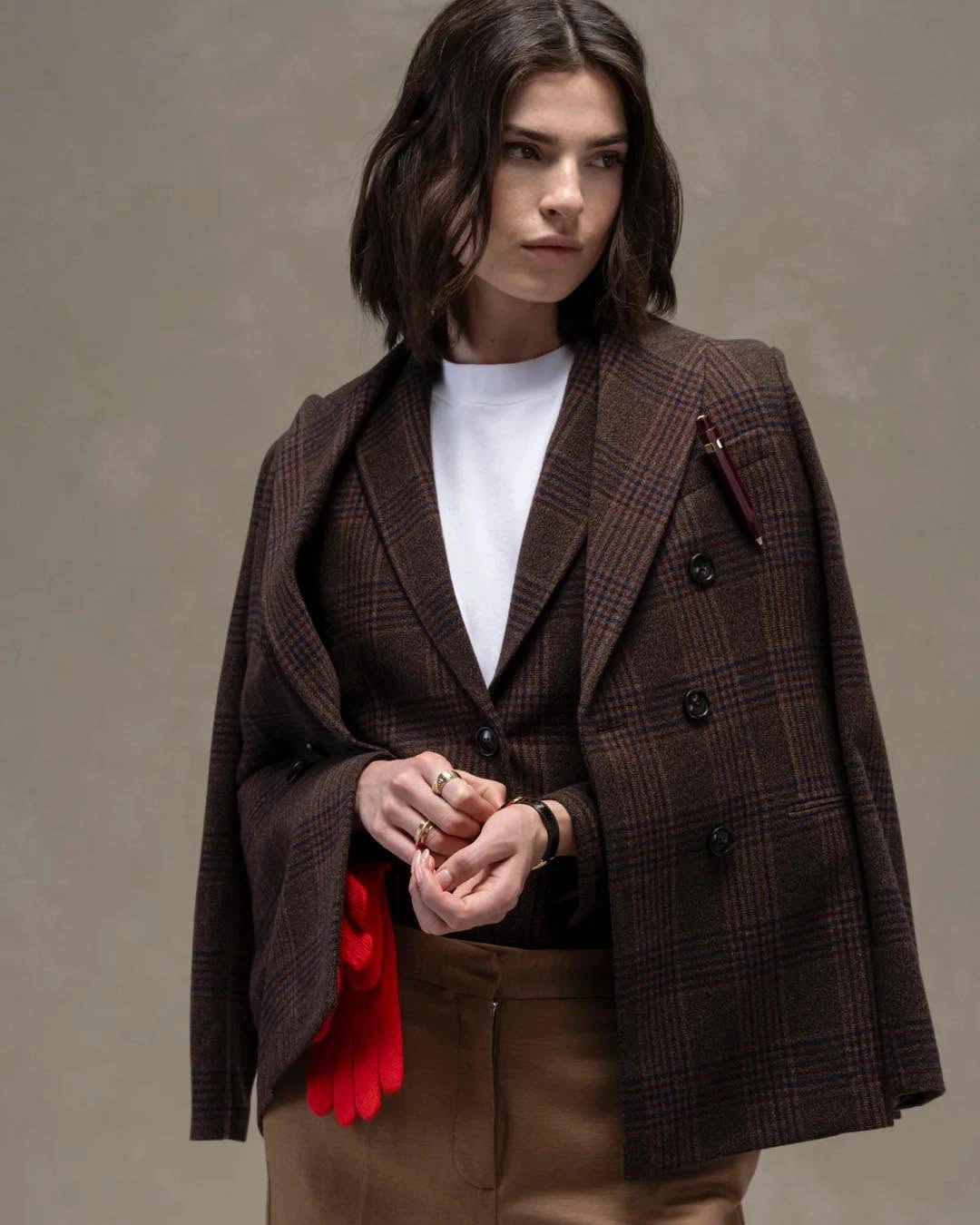
Photo via Instagram
The related brown checks and brown trousers keep the multiple tailored pieces visually connected even though their proportions are different. Bright red gloves appear within that restrained palette as a compact interruption rather than a competing garment-sized color block, so the eye can still register the contrast between the fitted inner blazer and the larger outer jacket first.
Layered business casual outfits with checked tailoring can feel quite different from a standard blazer formula because scale becomes part of the styling language. Here, the larger shoulder-draped jacket adds presence while the fitted layer underneath keeps a more defined center, allowing both relaxed and sharper tailoring to remain visible at once.
11. A Long Trench Meets a Sneaker Finish
The beige trench-length coat establishes a long, orderly frame around the outfit, while the pale pink high-neck top introduces a softer band of color between that outer layer and the dark wide trousers. Because the coat and trousers both carry noticeable length, the silhouette feels composed before the sneakers enter the picture.
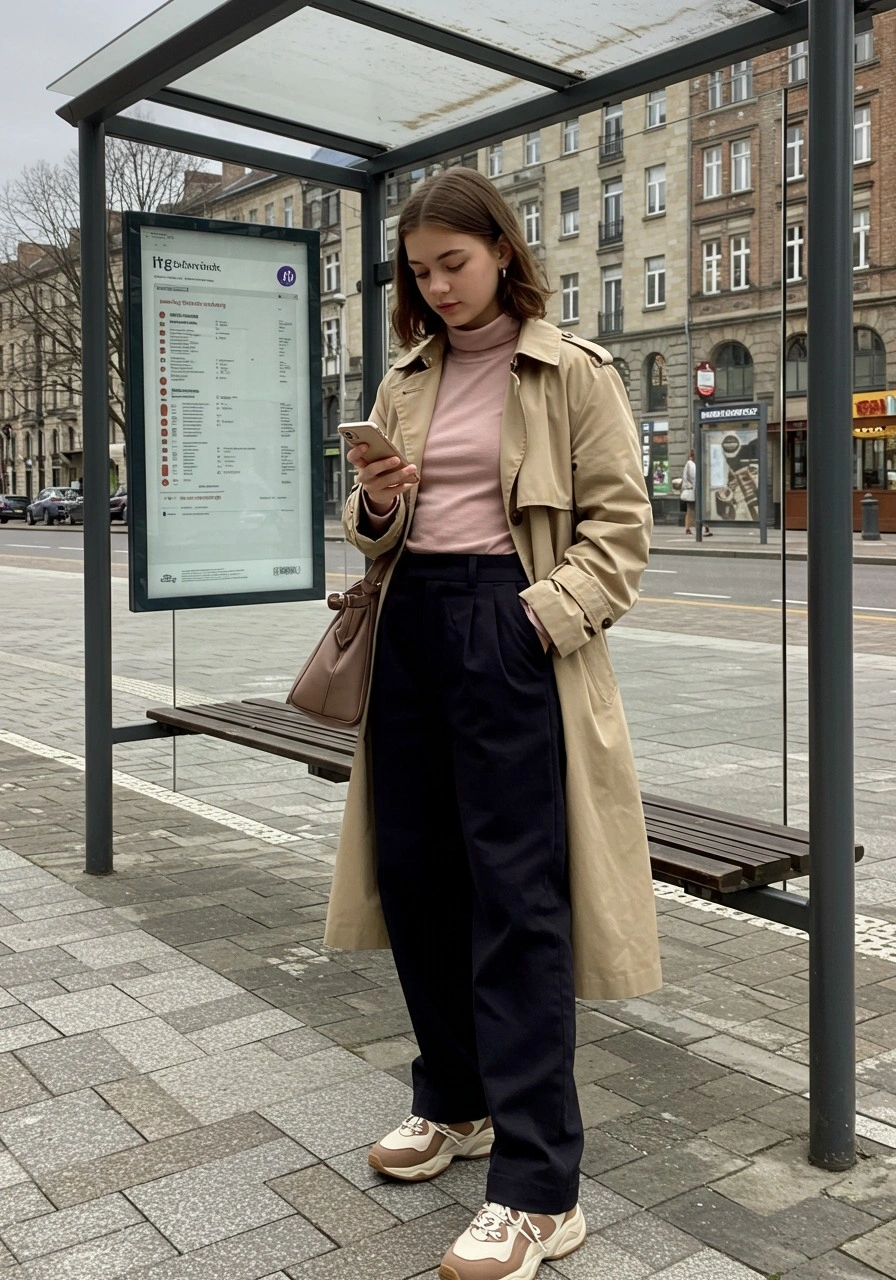
Photo via Instagram
Light sneakers change the formality more than another dark shoe would, interrupting the tailored-looking line with an unmistakably casual finish. The small brown crossbody bag stays visually compact against the longer coat, so the outfit lands near the border between layered business casual and polished casual rather than reading as fully tailored from head to toe.
The useful contrast is between the long, controlled outer silhouette and the more relaxed footwear underneath it. The sneakers keep the trench coat and wide trousers from becoming overly formal, while the pale pink top prevents the beige-and-dark palette from feeling severe.
12. Checked Tailoring Leaves Denim’s Formality Open
The brown checked blazer does most of the formal work here, adding pattern, lapels, and a clearer shoulder line over a simple black top. That dark center acts as a quiet bridge into the blue jeans below, which means the contrast between tailored jacket and casual denim stays easy to read instead of being softened by another patterned or brightly colored layer.
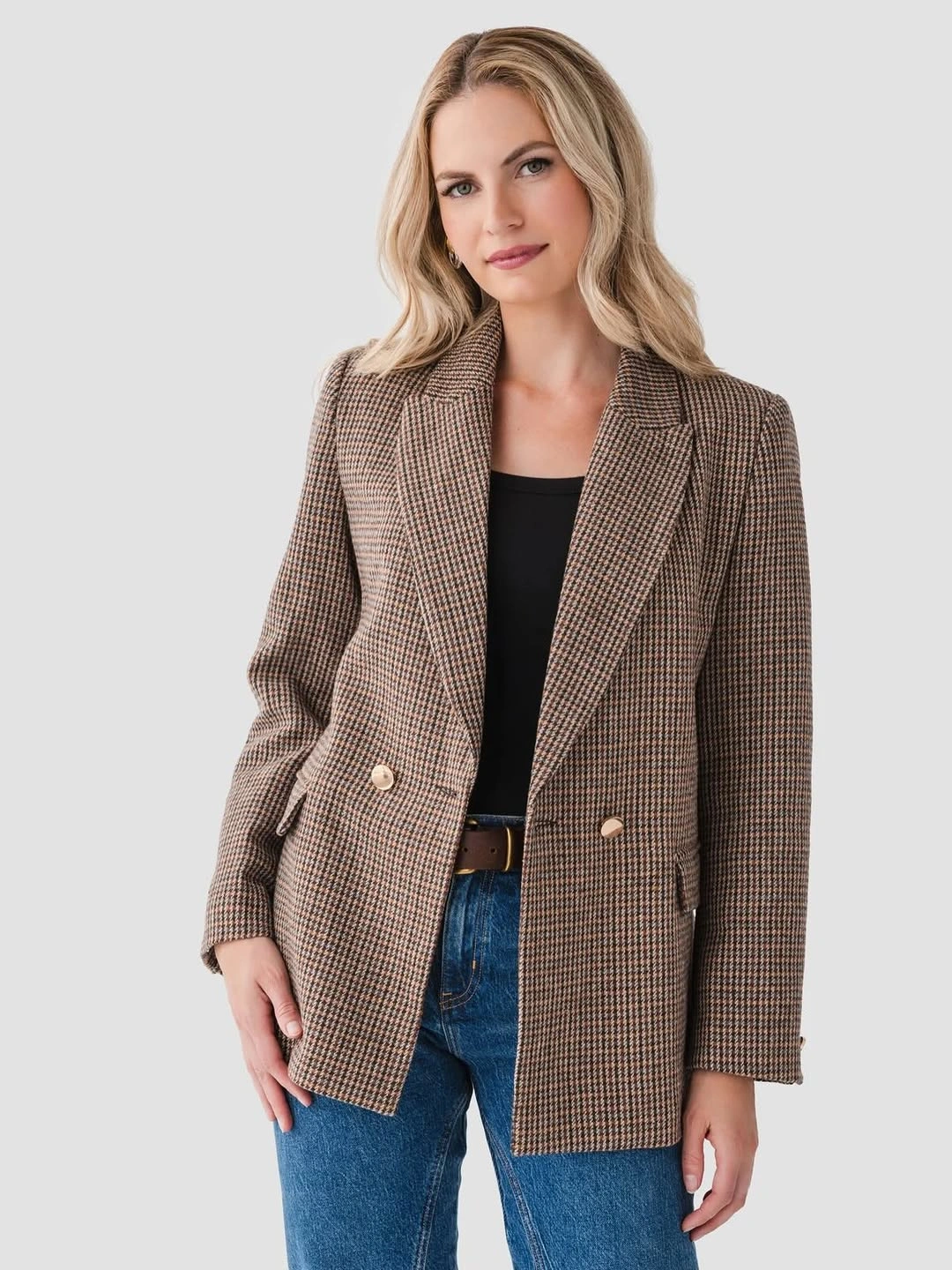
Photo via Instagram
A brown belt gives the jeans a more defined waist and echoes the warmer tones of the blazer, but the denim remains the dominant casual signal in the lower half. Since the frame cuts off before the lower legs and shoes, the final degree of formality cannot be settled from the visible evidence alone, making this a useful example of why footwear matters in blazer-and-jeans combinations.
Business casual outfits with jeans and a checked blazer can shift noticeably depending on what happens below the ankle, and that information is not available here. What is visible already shows the central tension clearly: structured checks above, straightforward denim below, and a dark top linking the two without disguising their different levels of formality.
13. A Pink Midi Dress Moves Beyond Business Casual
The long-sleeve pink midi dress creates a nearly continuous color column from shoulder to hem, with dark button detailing providing the clearest interruption along the side. Its close fit keeps the outline precise through the torso and skirt, so the overall effect feels more dress-oriented and controlled than the mixed separates that define most business-casual outfits.
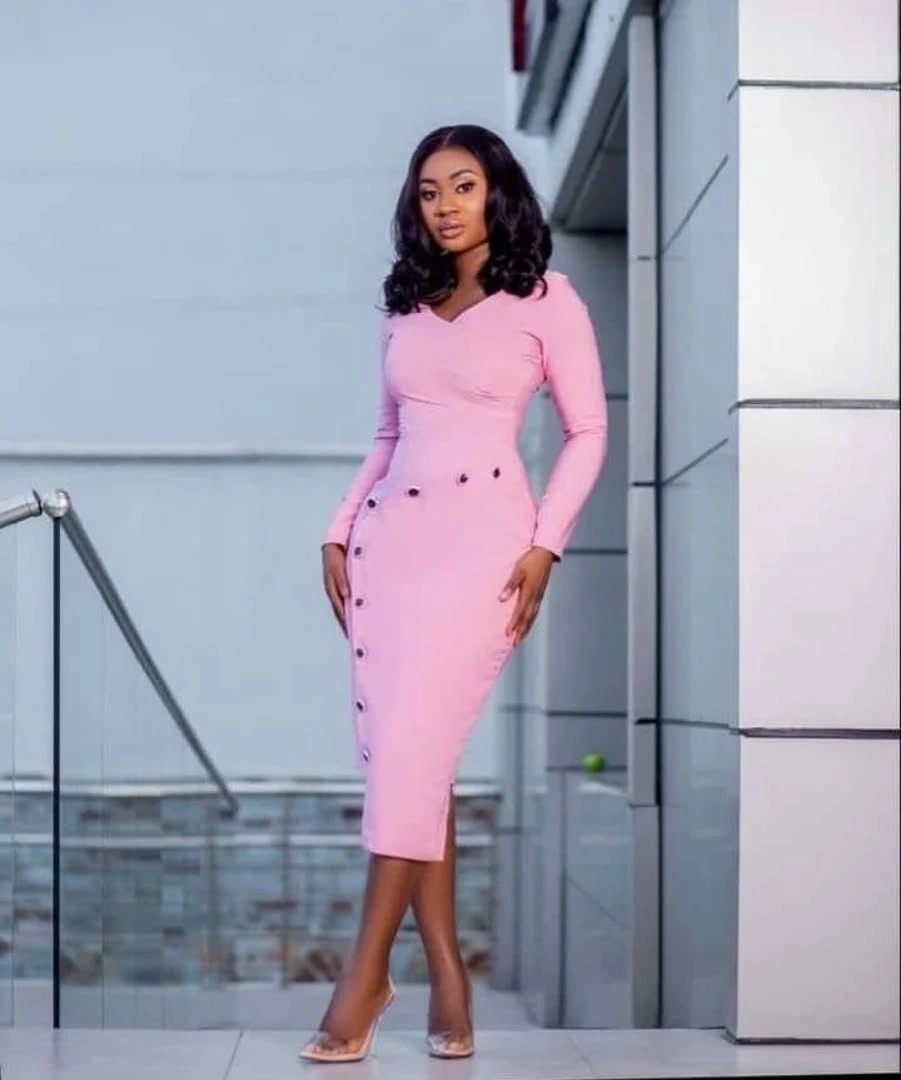
Photo via Instagram
Pale high heels extend that dressier impression by keeping the lower line narrow and elevated rather than grounding it with loafers, flats, or sneakers. With no obvious casual counterweight in the visible styling, the outfit sits beyond the strongest business-casual examples and closer to polished dresswear, even though it remains visually restrained in color.
The important distinction is that polish and business casual are not interchangeable categories. Here, the uninterrupted dress silhouette and high heels raise the formality together, leaving little of the deliberate high-low mixing that gives business casual its characteristic flexibility.
14. Patterned Shirting Lifts a Tonal Brown Base
The camel blazer works as a broad neutral frame, but the patterned tie-neck blouse prevents the upper half from becoming flat or overly uniform. Its mix of darker and brighter tones is concentrated around the neckline and center of the torso, drawing attention upward while the blazer keeps the print contained within a more structured outline.
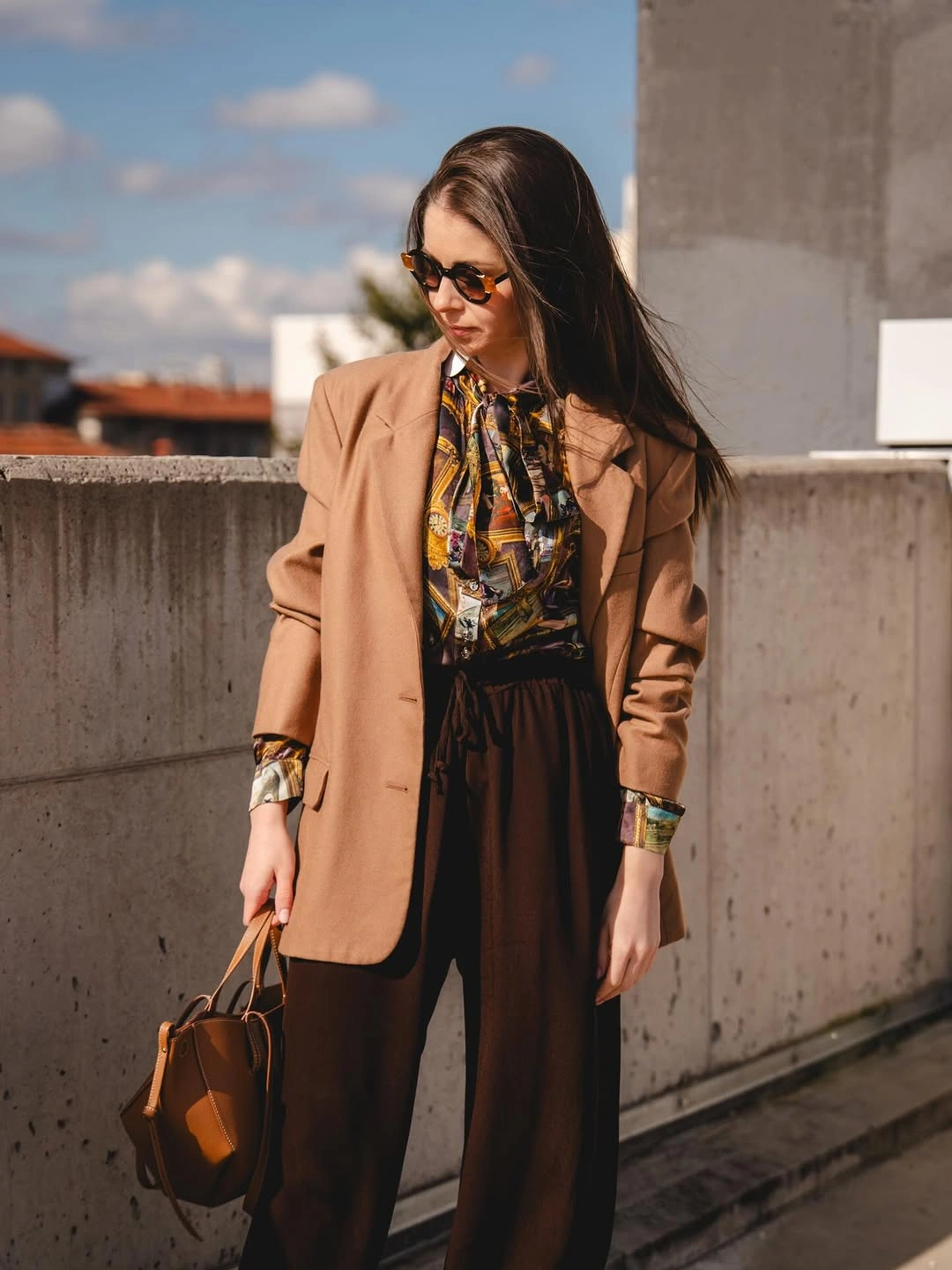
Photo via Instagram
Dark brown wide trousers and a structured brown handbag bring the palette back into a quieter register below, allowing the blouse to supply most of the visual movement. That balance gives stylish business casual with a patterned blouse and wide trousers a clear hierarchy: print near the face, structure around it, and deeper tonal continuity through the lower half.
The print works because it occupies a defined area rather than competing with every other piece for attention. Against the camel and dark brown foundation, the blouse introduces complexity while the wide trousers preserve an easy, less rigid version of tailored proportion.
15. Oversized Stripes Let the Shirt Lead
Here, the shirt carries the authority that a blazer often supplies. The navy striped button-up is oversized through the body, yet the large white collar and broad white cuffs create such crisp contrast that the upper half still feels deliberate rather than loose, with the stripes adding another vertical rhythm across the darker field.
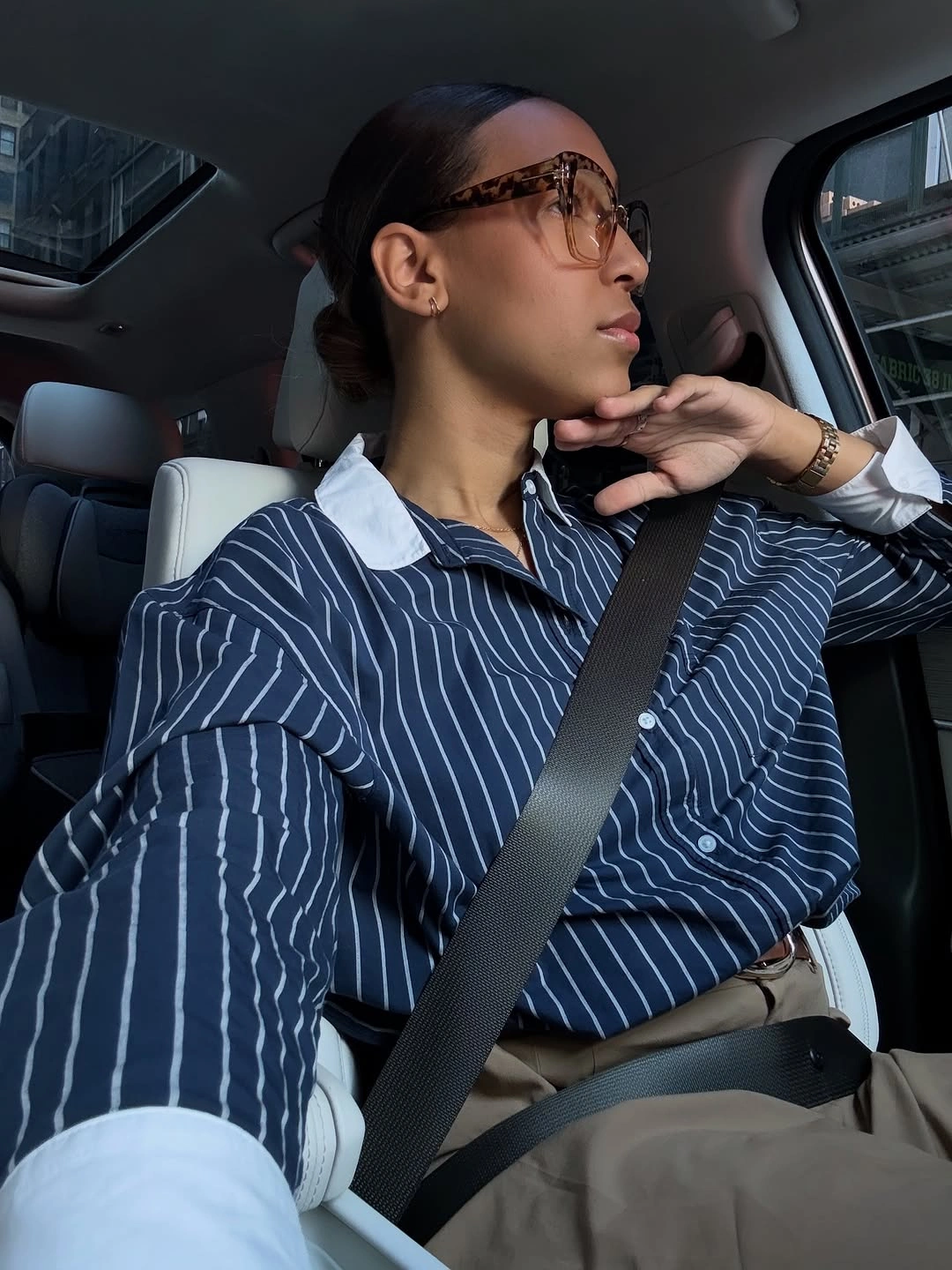
Photo via Instagram
Taupe trousers are visible at the waist, giving the navy-and-white shirt a muted neutral base without competing with its exaggerated collar and cuffs. Because the lower legs and shoes are outside the frame, the most useful reading stays with the upper proportion: generous shirt volume, sharp pale details, and a clear waist transition into the trousers.
As a business casual shirt-and-trouser outfit, its strongest idea is that structure can come from scale and contrast rather than an added jacket. The oversized cut keeps the shirt relaxed, while the prominent white collar and cuffs give that volume enough definition to hold the outfit together.
16. Refined Stripes Put the Collar in Focus
Fine blue-gray stripes give the shirt a quiet vertical rhythm, but the oversized pointed collar is what gives the upper half its strongest shape. The collar spreads broadly across the shoulders and chest, making an otherwise restrained striped surface feel more deliberate, while the round gold-tone buttons create a second line of visible detail down the front.
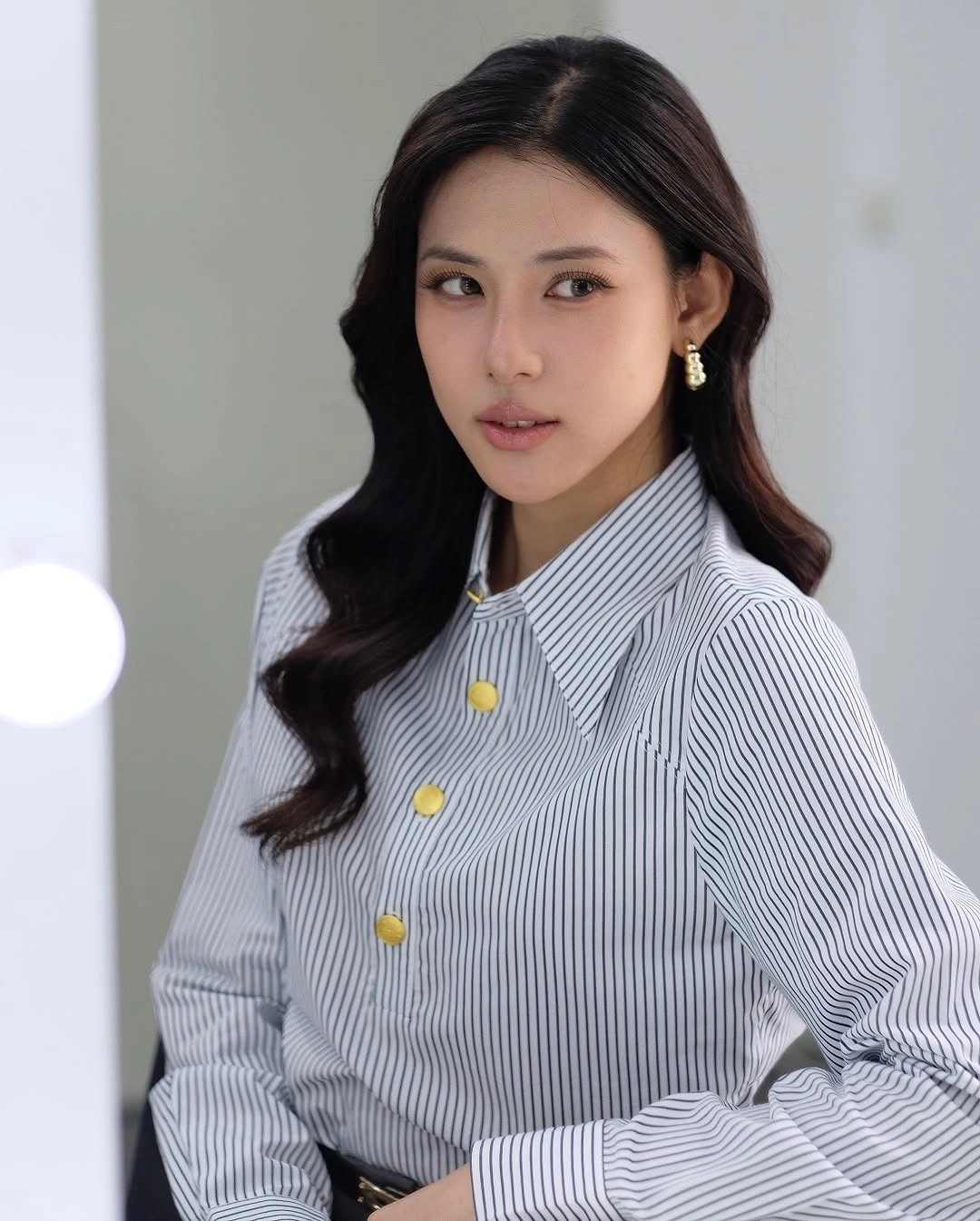
Photo via Instagram
Those buttons stand apart from the narrow stripes without overwhelming them, so the shirt gains polish through small differences in scale rather than strong color blocking. The combination of a broad collar, orderly stripe pattern, and prominent closures shows how much structure a single shirt can carry, but the cropped framing does not provide enough evidence to judge the formality of the complete outfit.
Only the upper-half styling is visible here, so trousers, skirt, footwear, and any additional layers should remain outside the interpretation. What can be read confidently is the shirt itself: understated stripes made more distinctive by an enlarged collar and clearly visible gold-tone buttons.
17. A Cropped Jacket Lets the Long Skirt Lead
The pale gray patterned jacket ends high enough that the long cream skirt remains the dominant proportion instead of becoming secondary to an extended blazer. A cream sleeveless top continues into the skirt with very little color interruption, creating an elongated central column while the shorter jacket places pattern and structure mainly around the shoulders and upper torso.
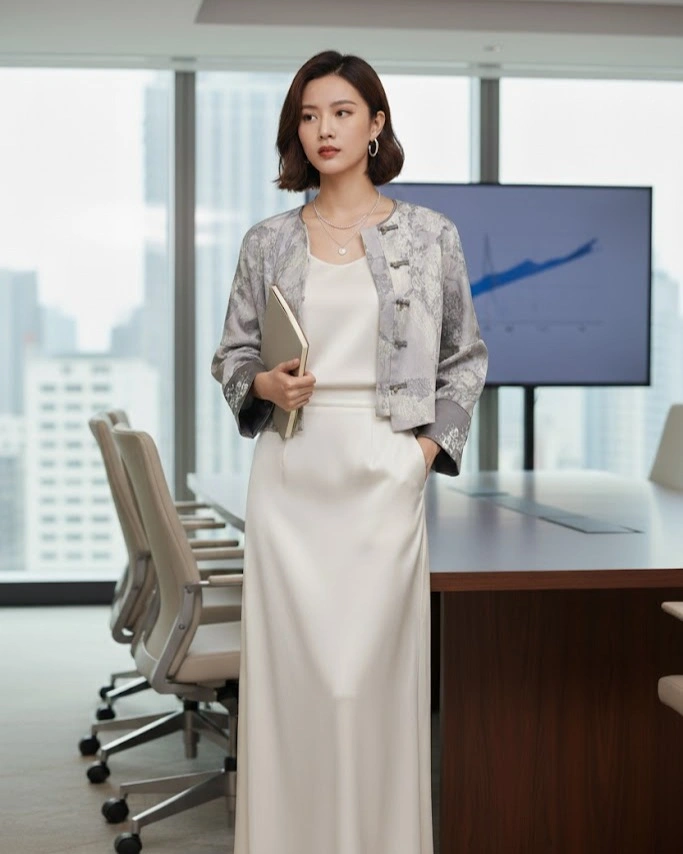
Photo via Instagram
That contrast in length gives the outfit a dressier kind of restraint: the jacket is compact, while the cream lower section falls almost uninterrupted toward the floor. The pale gray pattern remains close in value to the cream pieces, so the effect depends less on sharp color contrast and more on the visible relationship between a short upper frame and a much longer skirt line.
For business casual skirts in an office-like setting, this offers a notably quieter alternative to blazer-and-trouser proportions without proving anything about the wearer’s occupation. The long skirt controls the silhouette, while the cropped jacket adds enough definition above it to keep the tonal combination from reading as one continuous block.
18. A Long Navy Coat Carries the Structure
Because the long navy coat covers much of the underlying outfit, it becomes the strongest visible source of structure by default. Its dark color occupies most of the silhouette from shoulder to below the knee, while a small area of muted green at the center breaks that navy field before the dark loose trousers continue the vertical movement underneath.
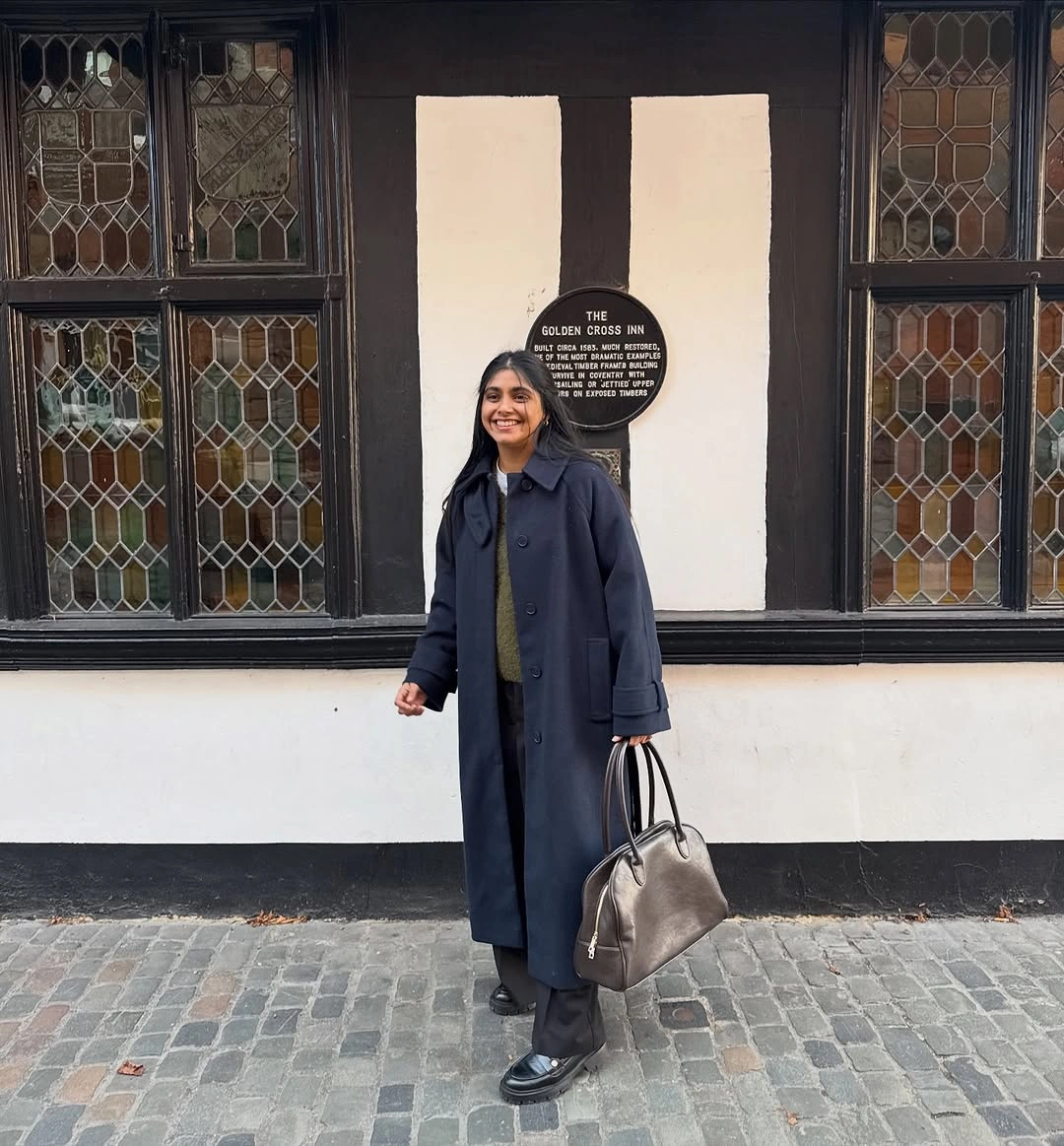
Photo via Instagram
The trousers maintain a broad, relaxed line rather than narrowing sharply below the coat, so the lower half feels continuous instead of tightly tailored. Black loafers give that long dark silhouette a defined finish at the ground, and the large gray structured tote adds another substantial shape beside it without requiring any assumptions about the layers concealed by the coat.
Business casual layering with a long coat and loafers can read polished even when most of the outfit underneath is not visible. Here, the coat supplies the dominant formality cue, while the loose trousers, substantial tote, and loafers determine how that structure continues below and beside it.
19. Burgundy Framing Sharpens the Shirt-and-Tie Center
A light blue button-up and dark patterned tie establish a distinctly sharper center than the open-neck shirts and simple tops elsewhere in the range. The tie creates a narrow vertical line down the torso, while the buttoned collar gives the upper half a menswear-inspired structure that remains clearly visible inside the long burgundy coat.
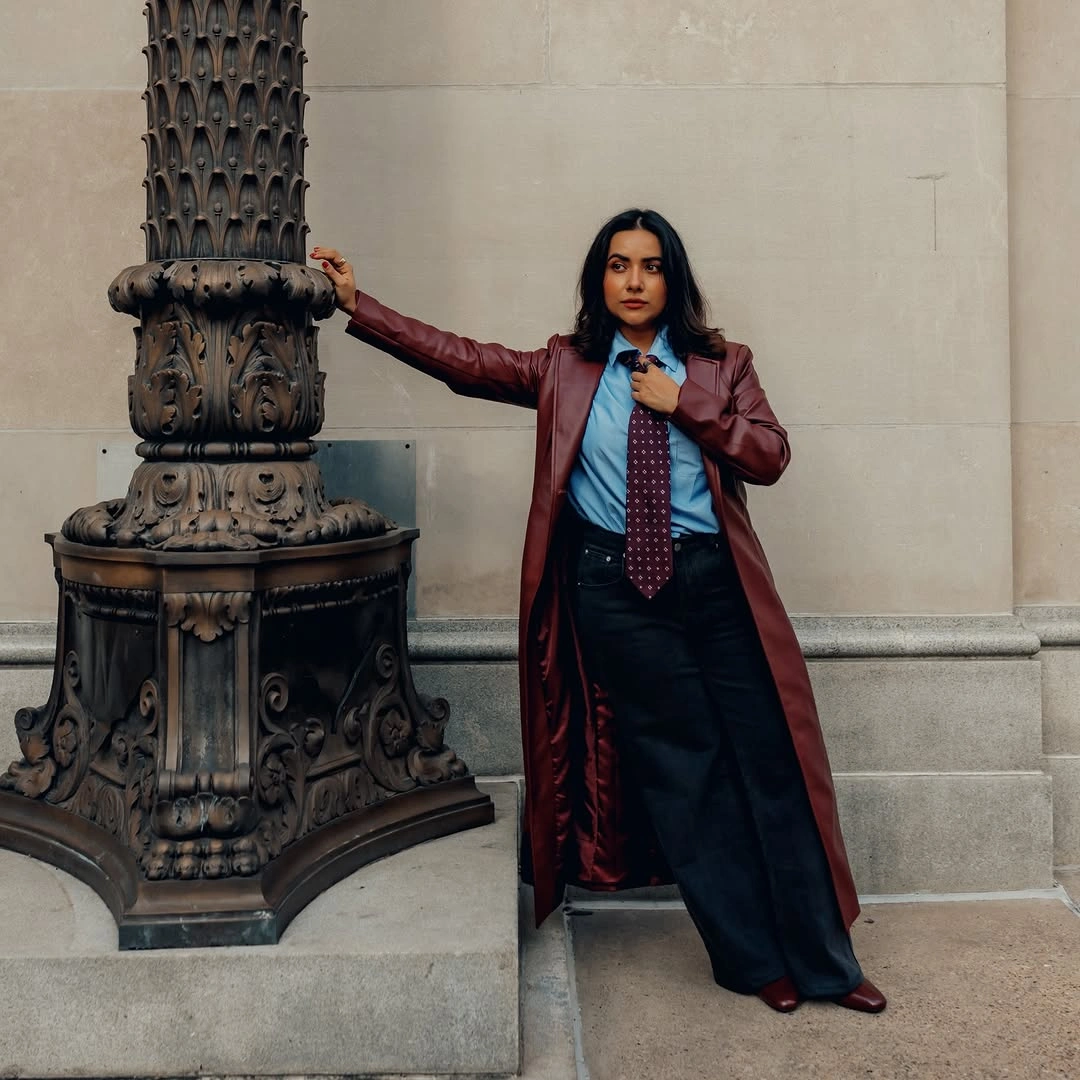
Photo via Instagram
The glossy burgundy outer layer and similarly colored pointed shoes create matching endpoints around that blue-and-black center, but the black trousers keep the silhouette from becoming narrowly formal. Their generous width adds breadth below the shirt and tie, so the outfit combines a precise neckline with a much more expansive lower shape rather than repeating one strict tailored line from top to bottom.
Sharply tailored business casual with a tie and long coat sits close to the more formal end of the spectrum, and the tie is a major reason this combination reads differently. The wide trousers temper that sharpness through scale, while burgundy at the outer layer and shoes gives the entire composition a clear visual frame.
20. Ruffles and Pointed Pumps Dress Up Straight Jeans
The white blouse gives these straight blue jeans a more dressed-up starting point than a basic tee would, with ruffled detailing creating visible texture down the front before the shirt tucks into the waistband. That tuck defines the transition into denim clearly, so the casual lower half sits beneath an upper piece that carries more decorative structure without needing a blazer.
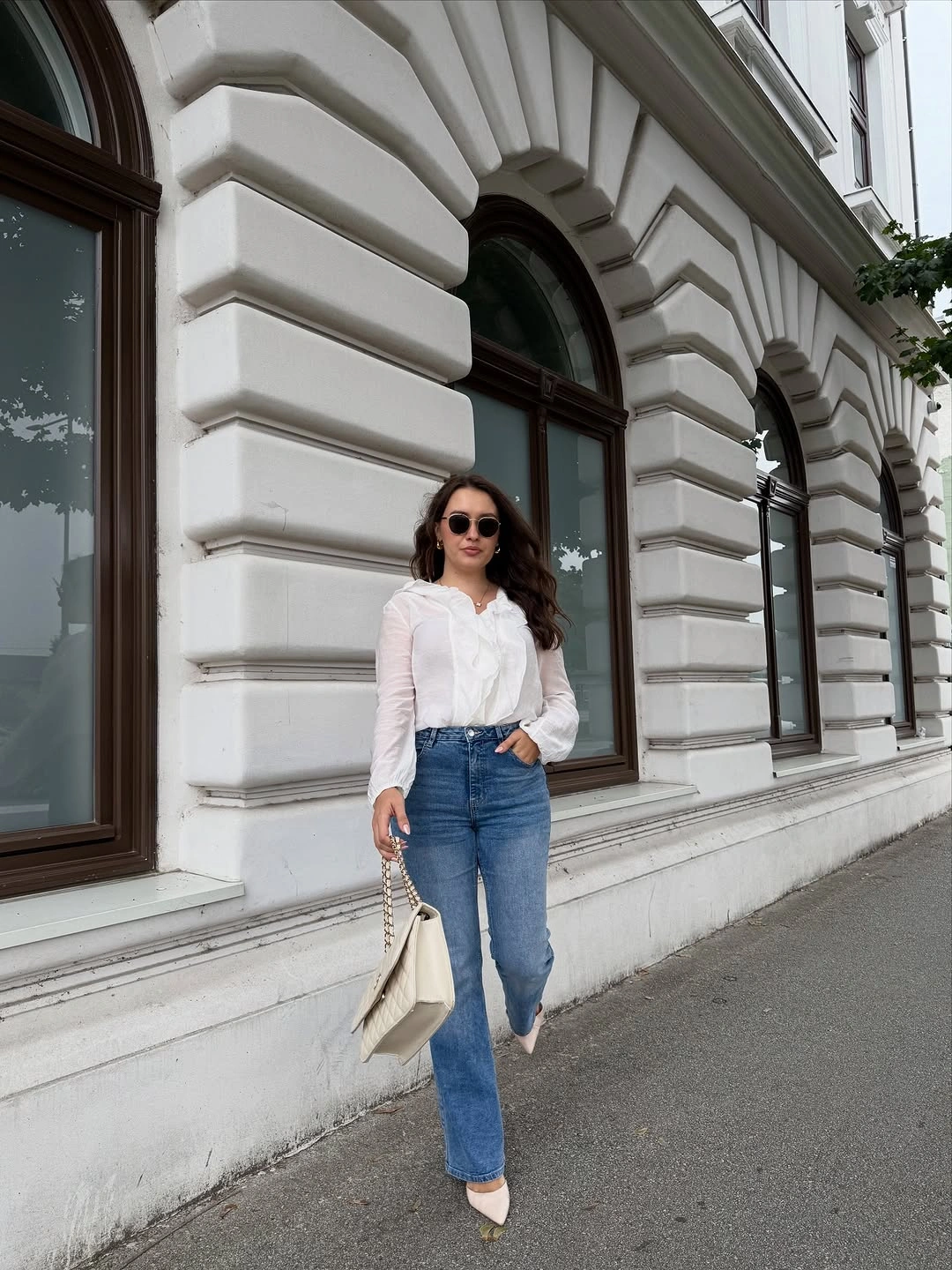
Photo via Instagram
Cream pointed pumps and a similarly pale structured handbag reinforce that more polished direction from two different parts of the outfit. The pumps narrow the finish at the feet, while the bag adds a crisp shape beside the body; together they raise the formality more decisively than casual flat footwear would, yet neither changes the fact that blue denim remains central to the silhouette.
This makes a convincing case for business casual outfits with jeans and pointed pumps because several visible elements pull the denim toward a more refined finish at once. The jeans still provide the casual foundation, while the ruffled blouse, defined tuck, pointed shoes, and structured bag shift the overall balance toward business casual.
21. Dark Tailoring Keeps the Silhouette Clear and Direct
The black blazer and matching trousers create a straightforward tailored frame, with the muted rose blouse visible through the center rather than forming a sharp contrast against the darker pieces. That restrained color change keeps the jacket and trouser relationship easy to read, making this one of the clearest examples of professional-casual blazer and trouser styling without relying on extra layers or decorative detail.
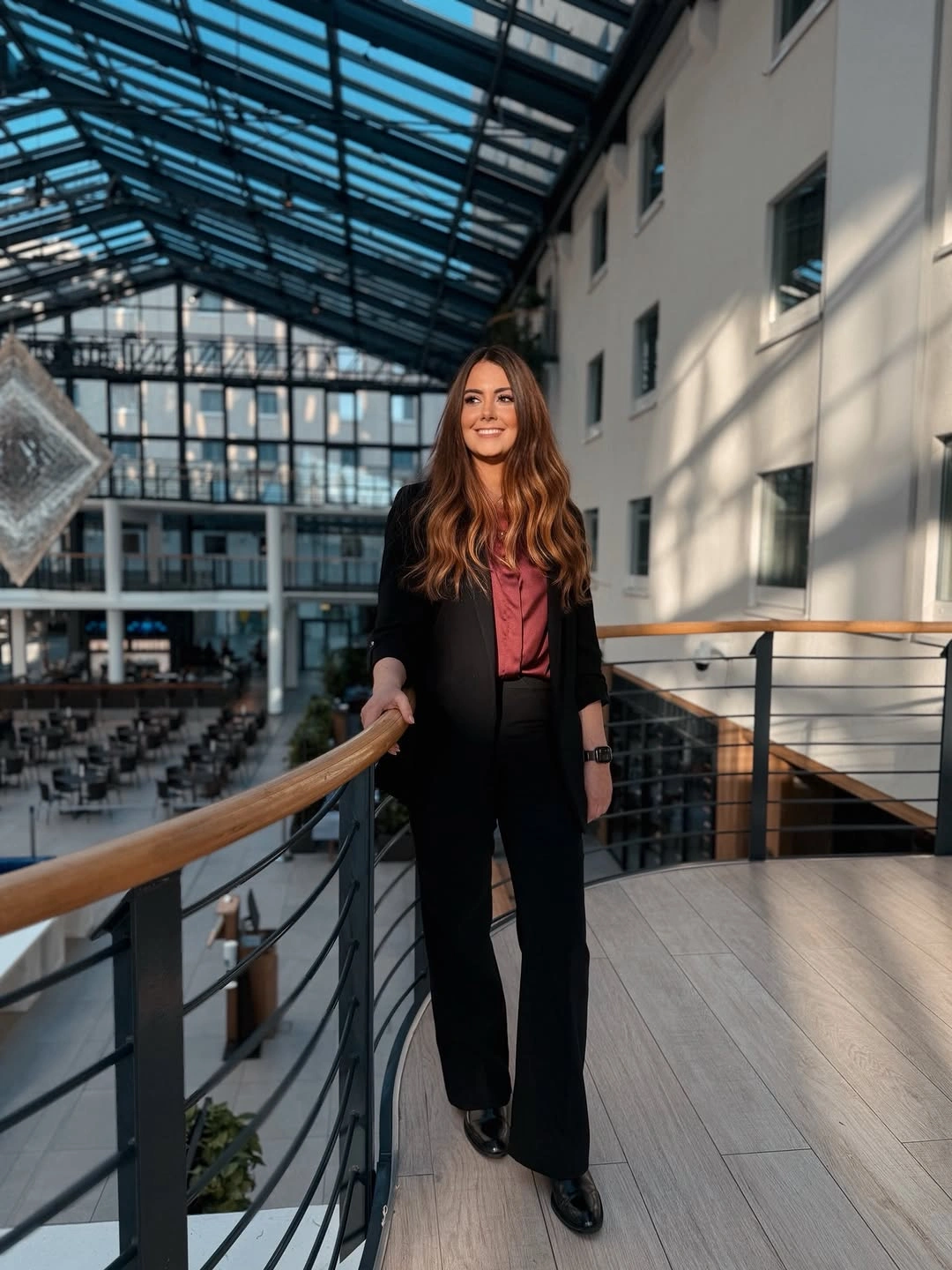
Photo via Instagram
The trousers widen slightly toward the hem, so the lower silhouette has more movement than a narrow tapered cut while still staying connected to the blazer above. Low black shoes preserve that dark continuity at the floor instead of introducing a separate color break, which lets the subtle flare become the main proportion change within an otherwise consistent tailored outline.
This combination sits comfortably within business casual because its strongest signals work together rather than competing for attention. The rose blouse softens the black frame, while the slight trouser flare keeps the tailoring from feeling overly rigid.
22. Oversized Charcoal Tailoring Makes Proportion the Main Story
The oversized charcoal blazer establishes a broad upper silhouette, extending well beyond the closer line of the dark inner top and making volume the first thing the eye registers. Instead of narrowing below that larger jacket, the charcoal trousers repeat the same generous scale, so the outfit builds its presence through proportion rather than through color contrast or visible pattern.
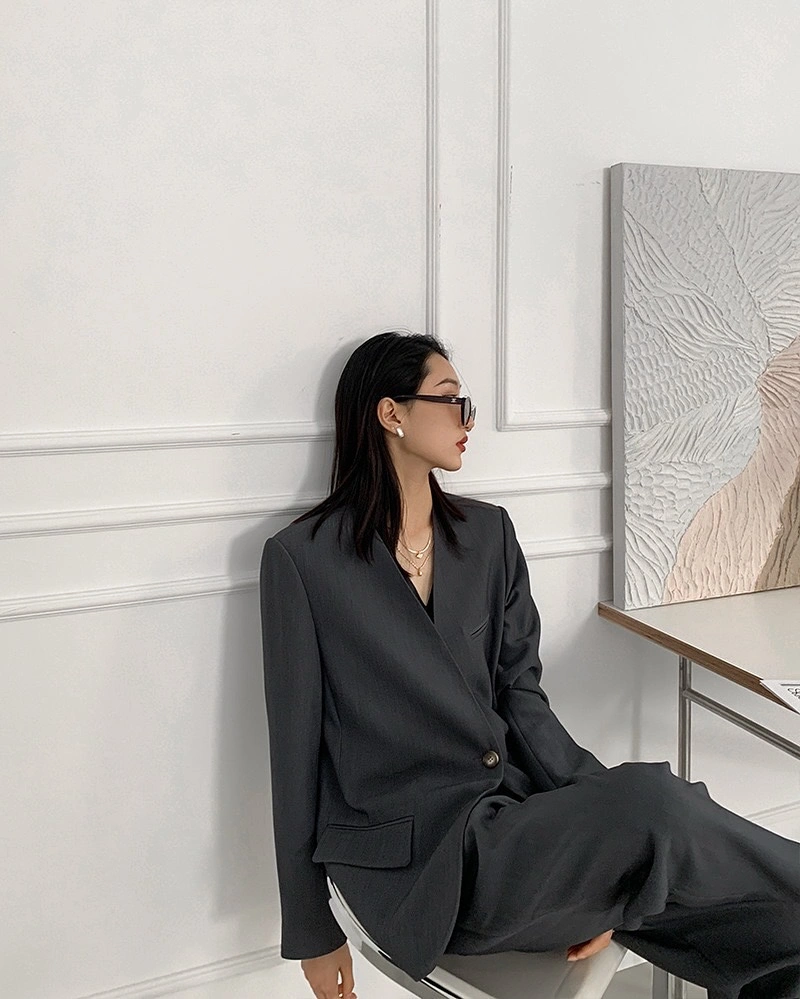
Photo via Instagram
Keeping the blazer and trousers close in tone allows those amplified shapes to read as one connected idea instead of two competing oversized pieces. The very wide trouser line reinforces the relaxed scale of the jacket, which makes this form of business casual tailoring feel less conventional than fitted suiting while still retaining the visual structure of coordinated separates.
Relaxed business casual tailoring with oversized proportions works here because the charcoal palette gives the eye space to notice shape first. The broad blazer and wide trousers feel deliberate together, even without relying on sharper color changes or a narrowly defined silhouette.
23. Soft Knitwear and Pleats Lower the Formality
The pale yellow crewneck sweater creates a gentle focal area above the long white pleated skirt, with very little tonal weight separating the two light sections. Because the sweater has a simple rounded neckline and relaxed outline, the upper half feels softer than the blazer-led combinations, while the pleats below introduce vertical movement that keeps the long skirt from appearing visually static.
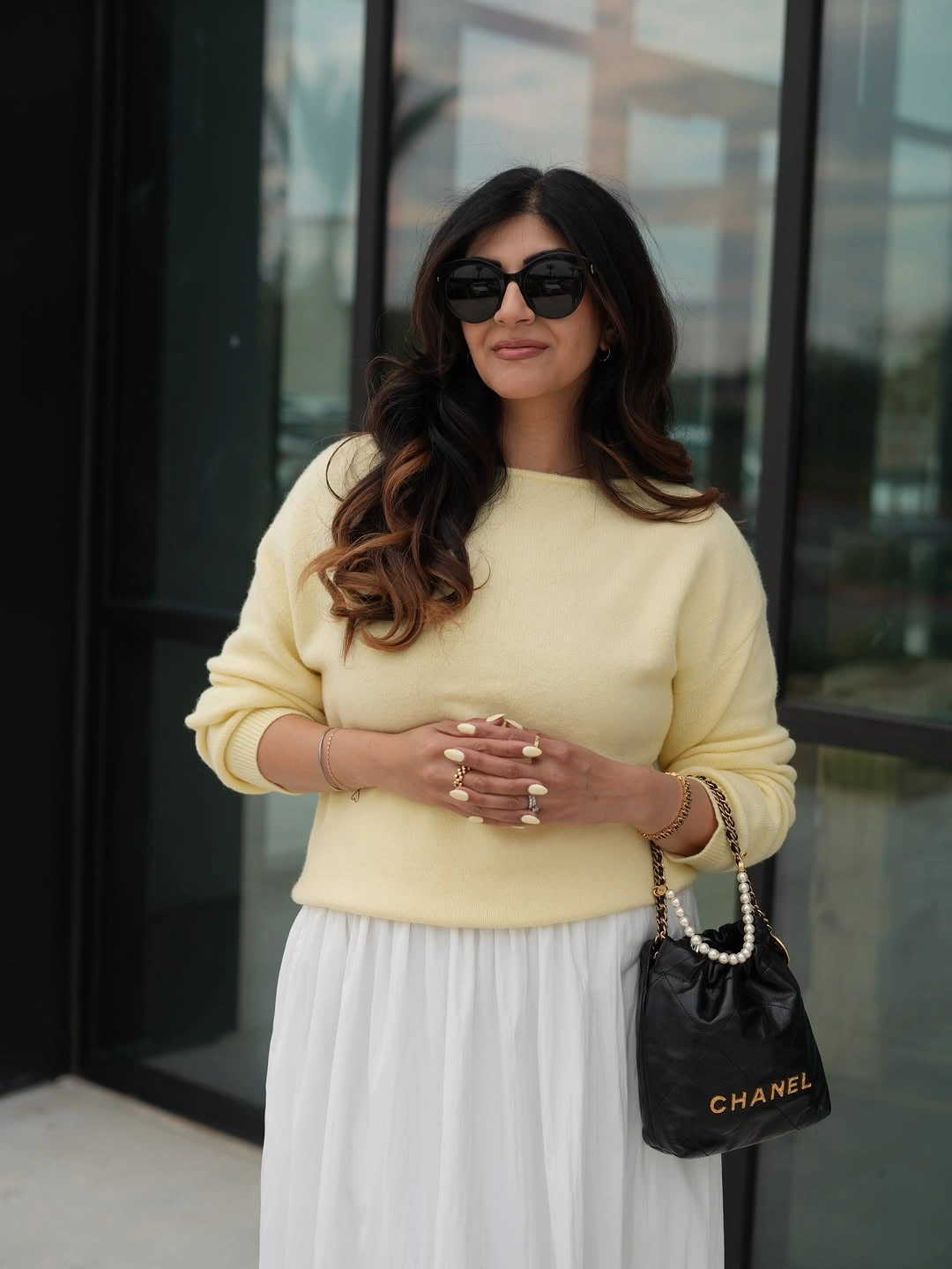
Photo via Instagram
A small black handbag with a decorative handle provides the clearest dark counterpoint, but it remains compact enough that the pale sweater and white skirt still control the overall impression. With the footwear outside the frame and no additional outer layer visible, the full degree of formality cannot be settled confidently, so the styling reads closer to polished casual or business-casual-adjacent than to explicit tailoring.
Soft business casual skirt and sweater styling can rely on proportion and movement rather than sharp structure, and that is the useful idea here. The long pleats give the lower half definition, while the pale knit keeps the finish easy and understated without pretending that the unseen parts make the outfit more formal than the visible evidence supports.