Polka dots look simple until scale enters the conversation. A tiny circle can act like texture, while a larger one becomes a graphic mark with enough presence to change the whole mood of the hand. That difference is why polka dot fall nails can feel unexpectedly grown-up instead of merely cute. The pattern becomes convincing when the empty base has as much intention as the dots themselves.
Use dot size as a volume control. Short nails usually need fewer, more separated marks; longer shapes can carry a denser rhythm only when there is a clear border at the edge. If two ideas both want attention, choose one as the lead and let the other stay quiet. Honestly, contrast is useful only when it makes the spacing easier to read, not when it asks every fingertip to compete.
1. Mint Almonds With Clean White Dots
Mint green almond nails use small white dots on two accents, while the other nails stay plain and glossy, giving the cool color a playful but controlled break. The dots are evenly spaced enough to read as a pattern, yet there is still plenty of mint visible between them. On the tapered shape, the white marks look light rather than crowded.
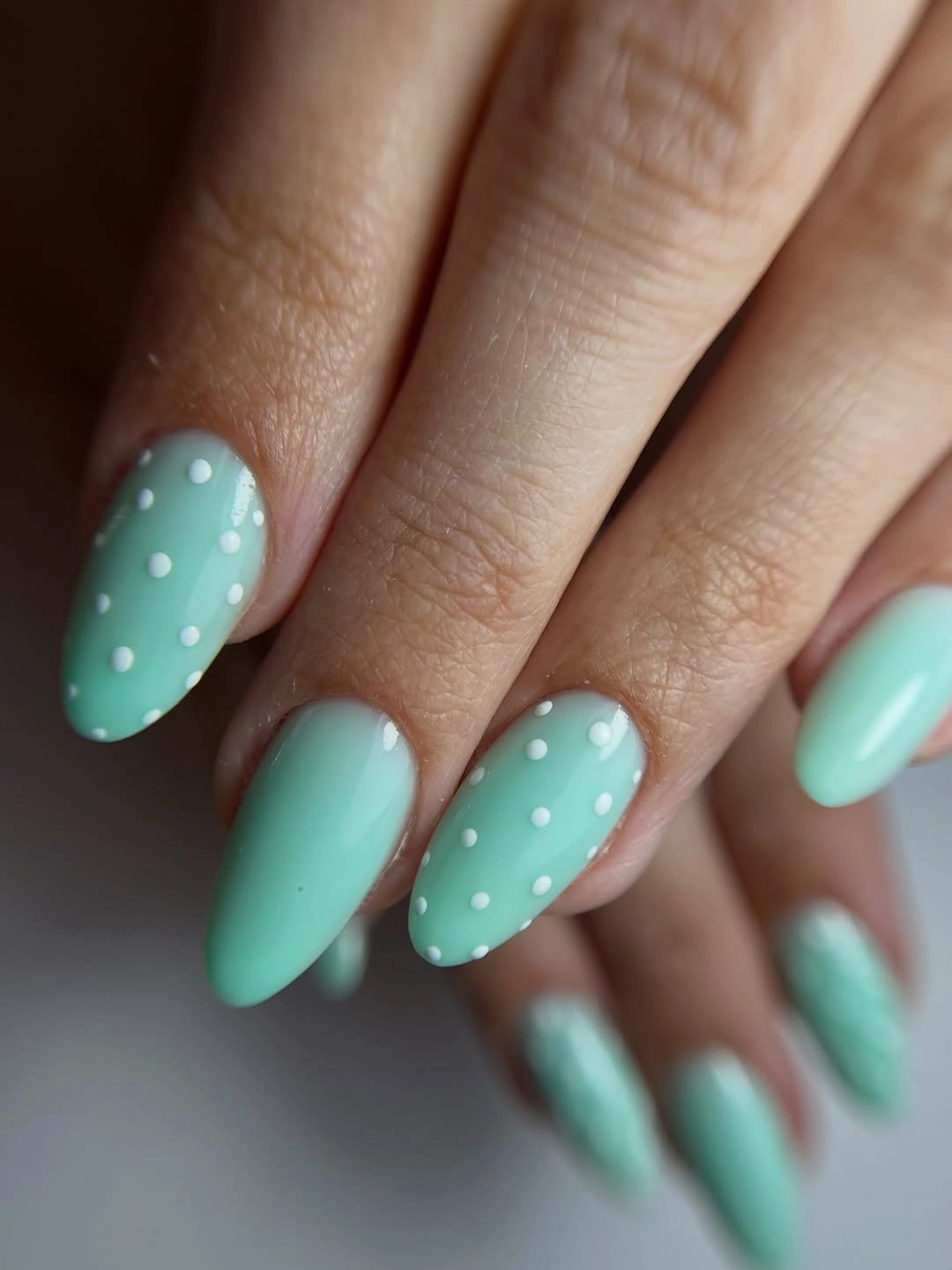
Keeping the dots on only part of the hand is the reason this manicure stays calm. A full set of mint and white circles could tip toward novelty, but the solid nails let the color have its own moment. For a fall-leaning version, soften the mint toward sage and keep the white dots just as small. It still feels neat beside a neutral outfit.
White dots will show best when their edges remain round and separated, so they are not the choice for someone who wants a deliberately distressed finish. The glossy mint itself is straightforward to refresh, which makes the patterned accents the only detail needing extra precision. It is fun, but it does not ask the color to compete with extra shapes or glitter.
2. Black and White Dots With Red Framing
Black-and-white dotted squares are mixed with pink and red accents, including a red edge that gives the varied palette a surprisingly clear order. The darkest dotted nail works like an anchor, while the lighter white dot nail stops the black from taking over. This is a lot in the best way, yet the repeated circle motif keeps the different bases connected.
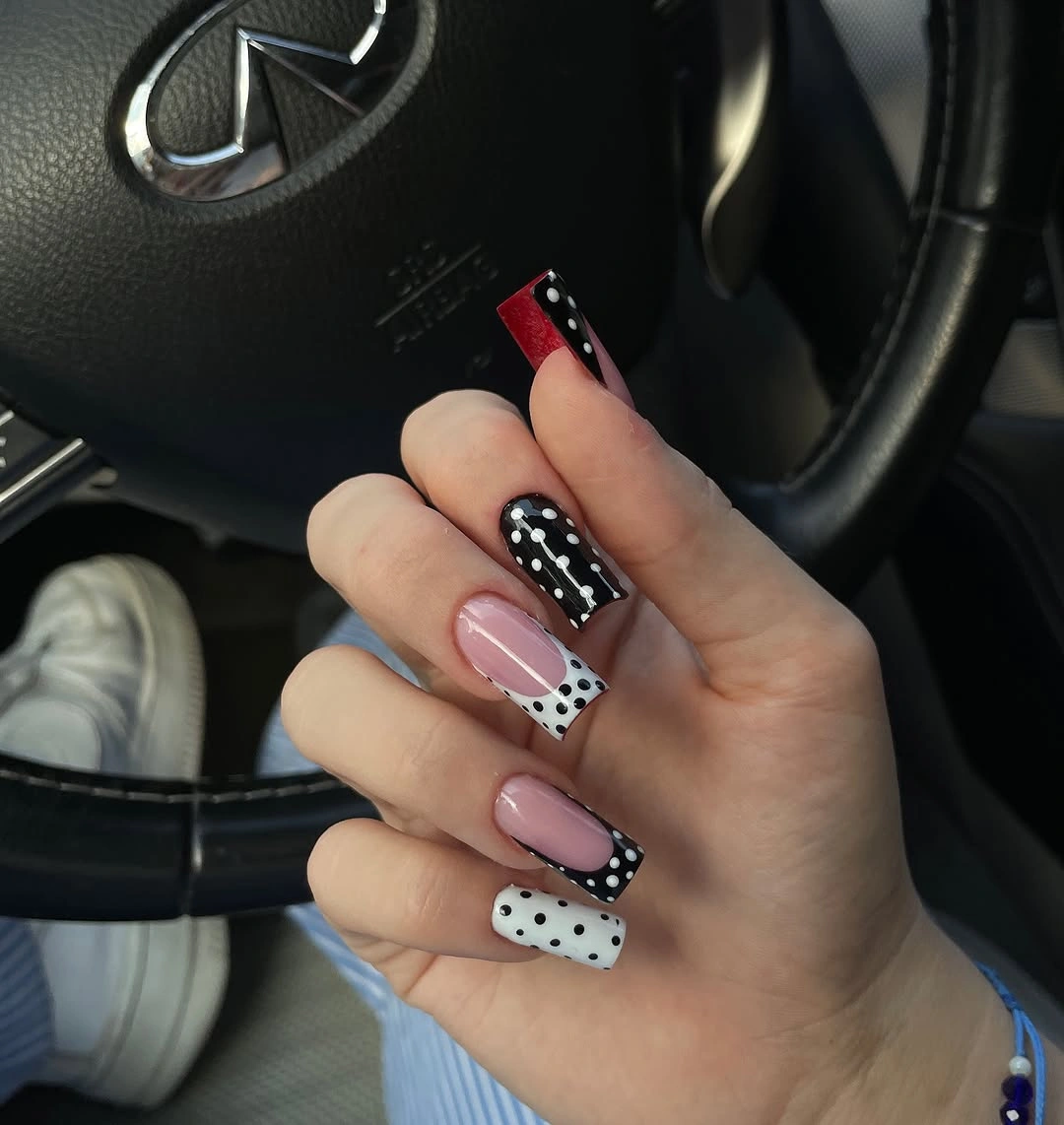
Mixed-color dots work when at least one rule is repeated, and here that rule is the contrast between dark circles and a lighter surface. The red border supplies another small link without becoming a whole separate pattern. If four colors feel busy, remove either the pink or the red and keep the black-and-white dot relationship as the main focus.
Because this set changes from finger to finger, planning the order matters more than making every nail identical. A short or medium square gives each color block enough width for the dots to stay legible. The fair tradeoff is that it reads more expressive than neutral, so it pairs best with clothes that leave the nails room to be the standout detail.
3. Long Pink Squares With Sharp Black Dots
Soft pink long squares are covered with small black polka dots, a high-contrast choice that turns an otherwise gentle base into a graphic statement. The dot scale stays consistent across the extended nail plates, so the pattern feels deliberate rather than scattered. The squared tip gives the whole design a slightly mod feel without adding another color.
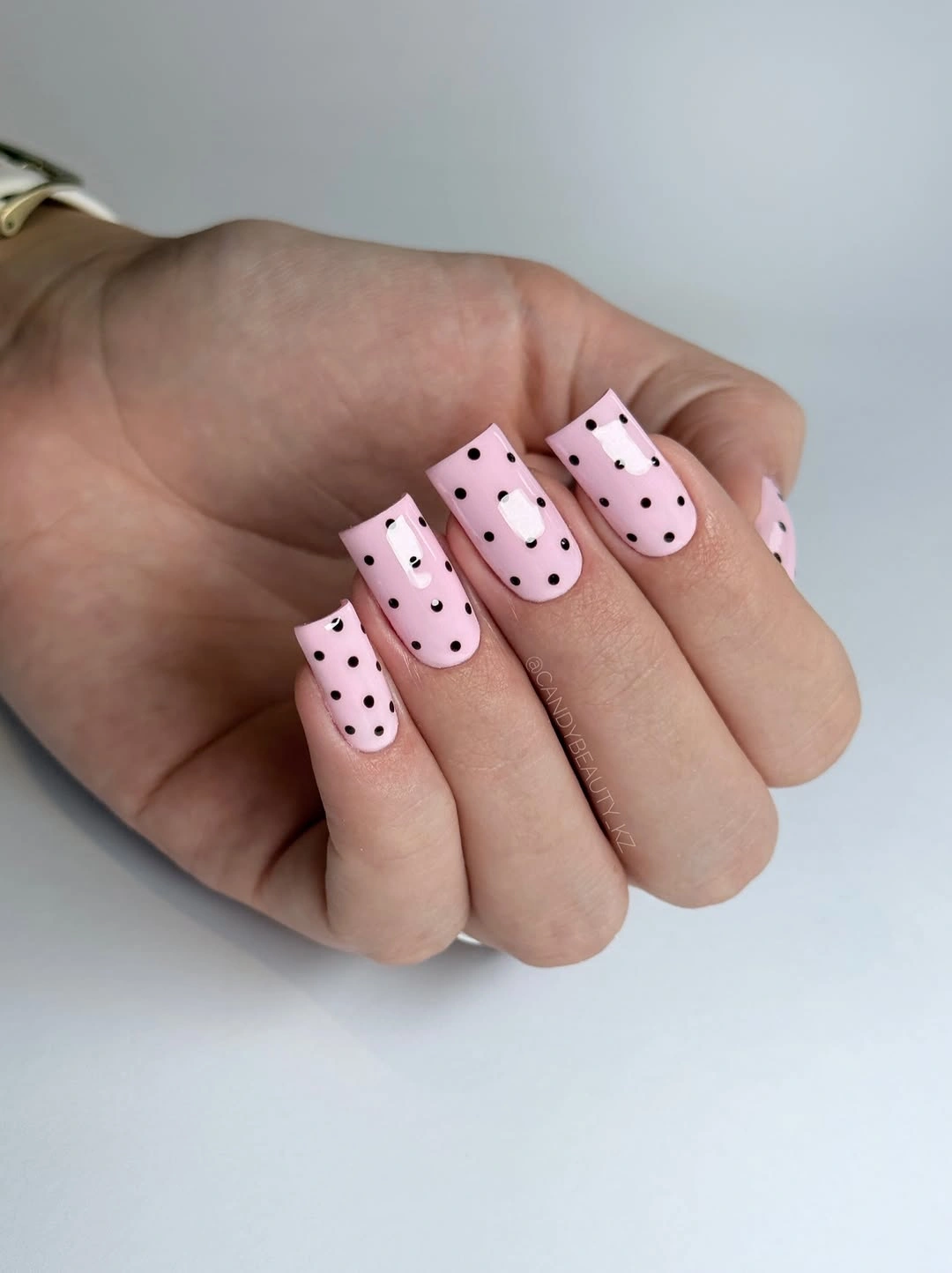
Black dots against pink are easy to understand from a distance, which makes this useful for someone who wants visible art without complicated linework. The design does not need an accent finger because the repeated mark is already strong enough. A dusty rose base would make the contrast feel more muted, while the same dot size would preserve the clear graphic rhythm.
Long squares give every circle room, but they also make a densely dotted surface more noticeable in everyday gestures. Leave a little pink margin around the sidewalls and tip so the pattern has a clean frame. This is not the quiet option, but its simple two-color logic keeps it from turning chaotic.
4. Pale Pink Squares in a Dot Grid
Pale pink square nails carry evenly repeated black dots across most of the surface, making the pattern the entire design rather than an occasional accent. The glossy base keeps the pink bright enough to hold its own against the dark circles. Regular spacing creates a tidier mood than the more irregular spotted versions, almost like a small printed textile.
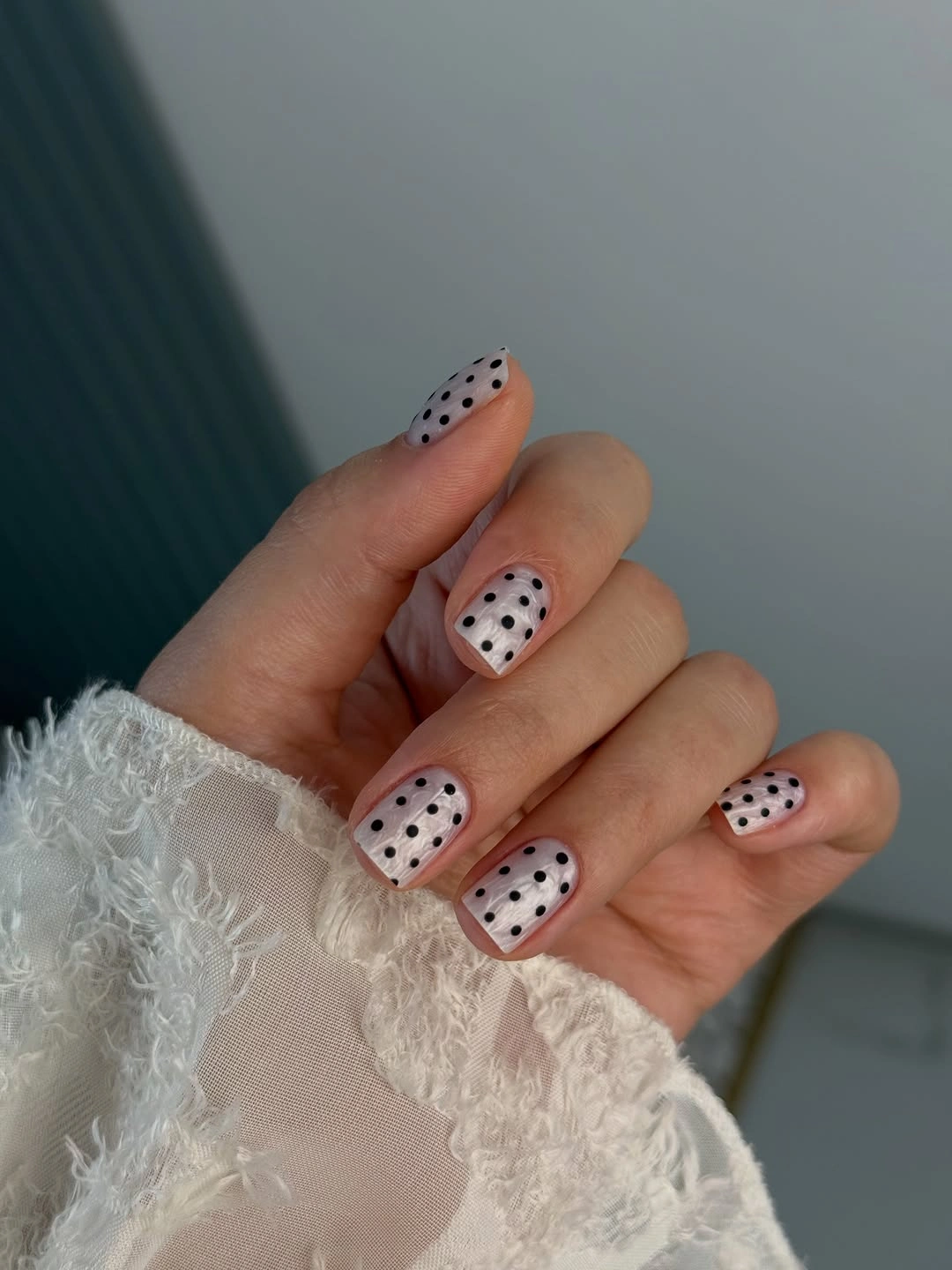
The strongest choice here is restraint in color: black and soft pink are enough. Adding a third shade would dilute the clean grid feeling, while keeping the dots similar in size lets the eye move across the hand without snagging on one oversized mark. A shorter square version would deliver the same idea with a more casual footprint.
Perfectly repeated dots reward careful application, since an off-center circle becomes more obvious beside a regular neighbor. That makes the pattern less forgiving than a freeform speckle, although it also looks especially polished when done well. Its charm comes from the discipline of the layout, not from trying to disguise the simplicity of polka dots.
5. Reverse Burgundy and White Polka Dots
Blush almond nails carry burgundy dots, while burgundy nails carry white dots and small pale painted details, reversing the color relationship from nail to nail. The alternating contrast gives the set a playful rhythm without forcing every surface to look the same. Warm burgundy keeps the pattern grounded enough for a fall manicure even with the sweeter bow-like accents.
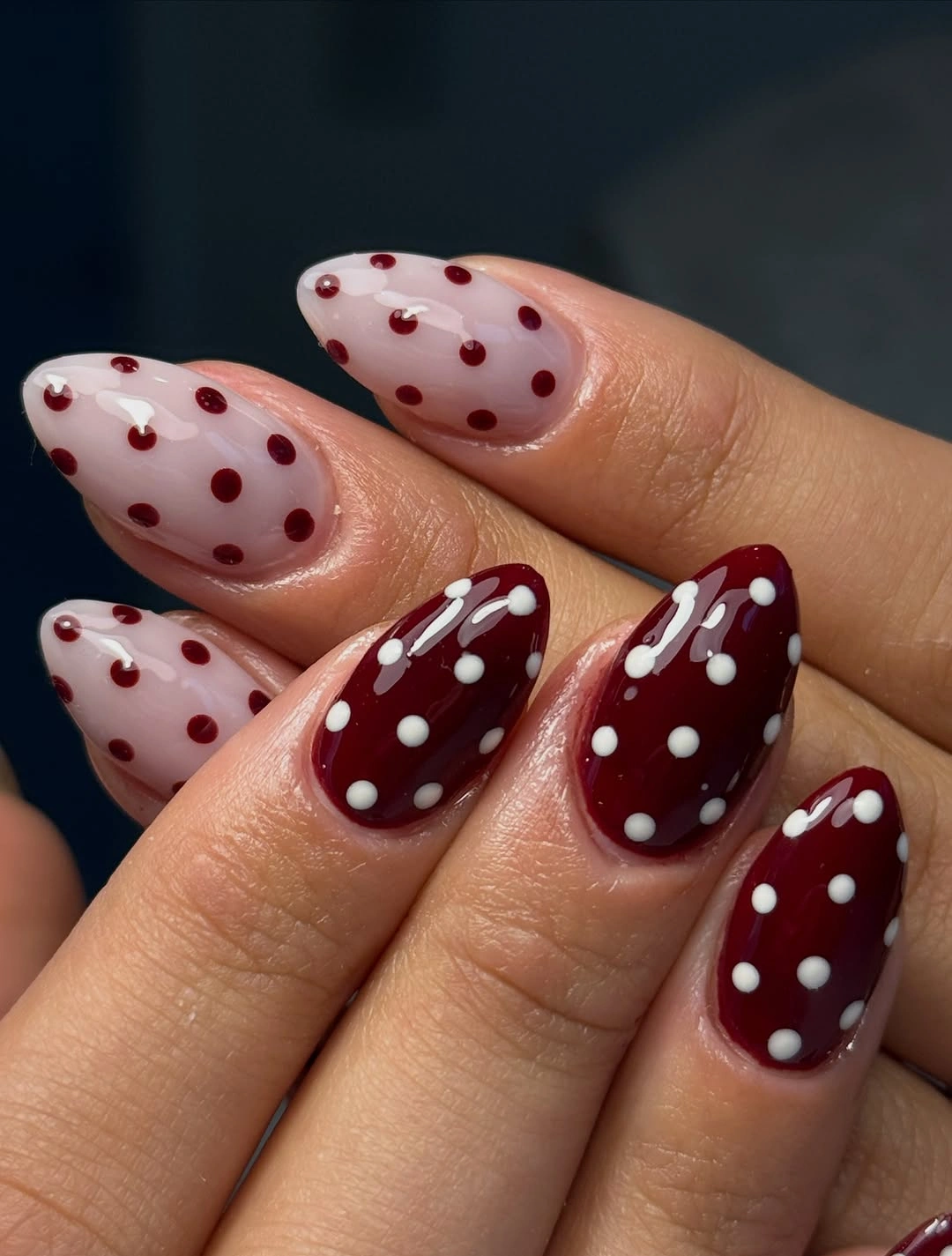
Color reversal is a strong move because it makes two shades feel equal instead of treating one as a background forever. If the little white details feel too ornate, leave them off and let the opposing dot colors do all the work. The almond shape helps the dots look softly placed rather than trapped in a rigid square grid.
Two-dot colors mean more visual information, so keeping both hues close to the same size is important. Burgundy is also a practical choice for the darker base because it feels less stark than black beside blush pink. The result is expressive, but the palette stays focused enough that the pattern still reads clearly at a glance.
6. Chocolate Frames and a Blue Dot Accent
Nude almond nails use dark chocolate curved tips, while a pale blue accent is dotted in brown, combining a French-style frame with one small patterned surprise. The brown outlines give the light colors a warmer edge, and the blue nail prevents the set from becoming entirely neutral. It feels tailored first, playful second.
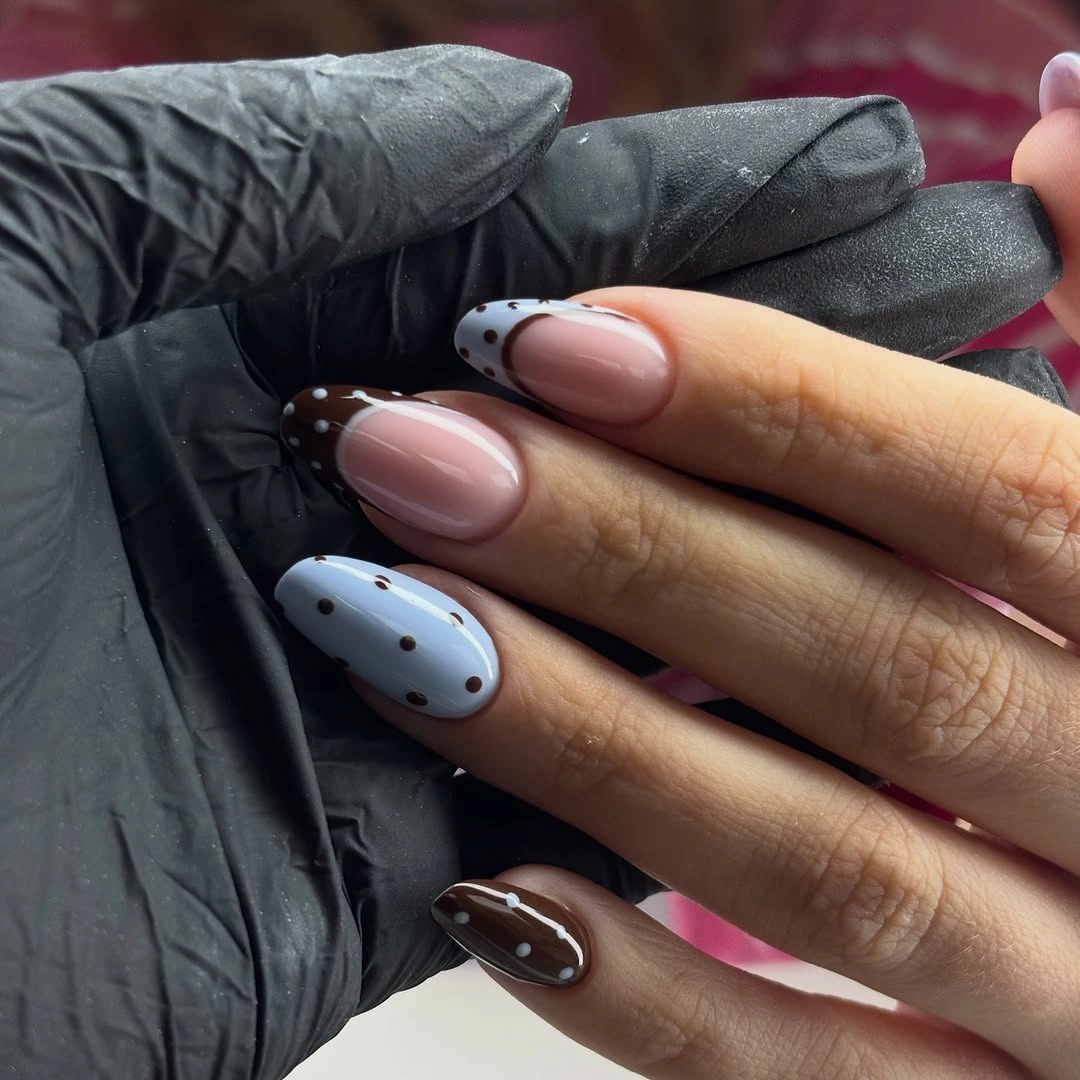
The dotted accent succeeds because it is a single panel inside a design already organized by the brown tip line. That means the circles add texture without needing to appear on every nail. For a more muted version, switch pale blue for cream and use the same chocolate dots, or keep the blue and reduce the French edge to two nails.
Thin dark frames need a steady curve to look intentional, but they also make the nail shape appear more defined. The blue accent has less room to hide uneven dots, so spacing should stay generous near the cuticle. This one makes a good argument for mixing polka dots with one other device, provided the pattern knows when to stop.
7. Neutral Taupe With Tiny Black Speckles
Taupe almond nails are scattered with small black dots, creating a restrained spotted surface that reads much quieter than a black-and-white set. The neutral base carries a slight warmth, so the dark marks feel more like texture than a loud print. It is one of the easier ways to bring polka dots into a minimal wardrobe.
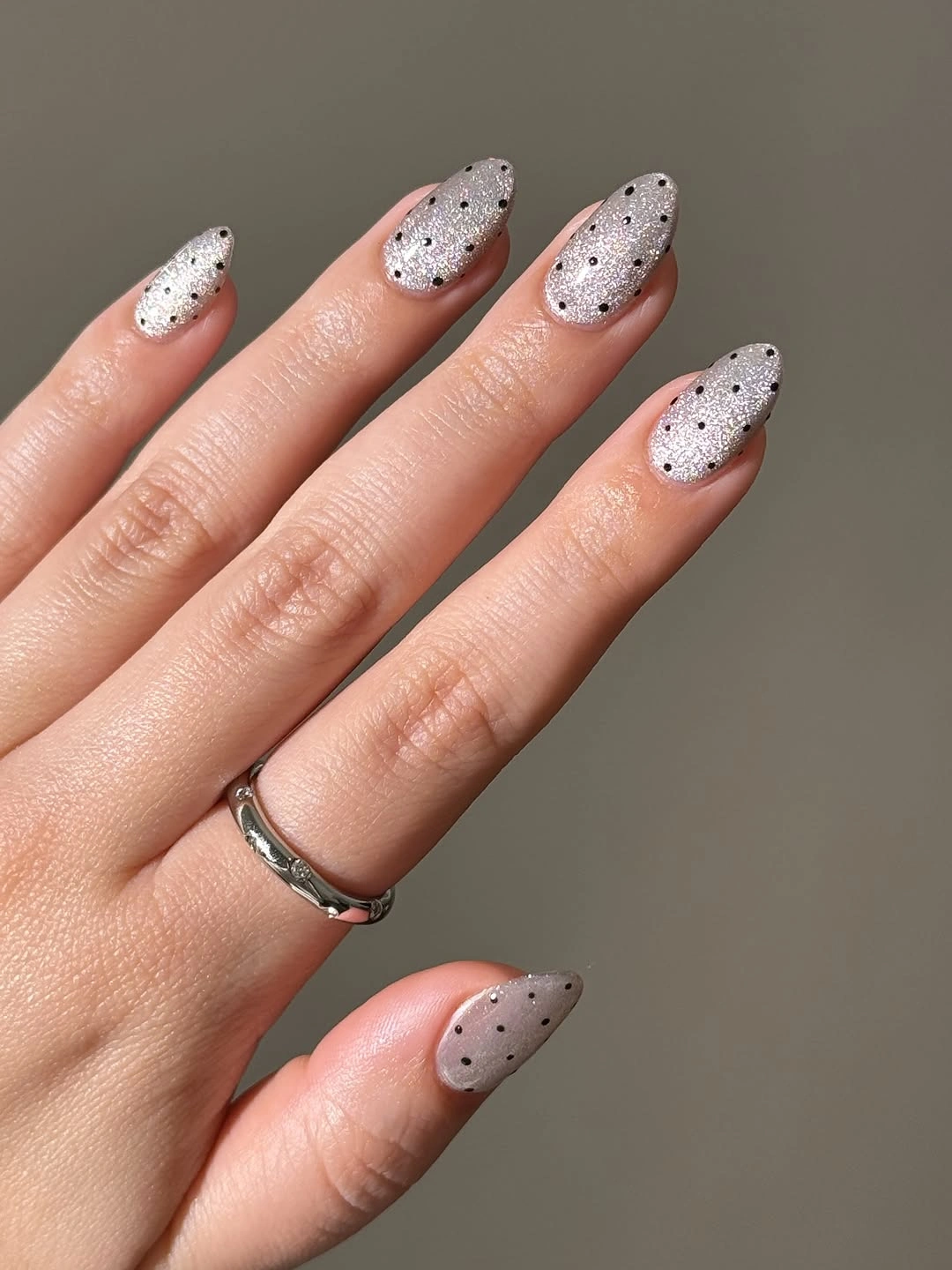
The dots are small enough that the taupe remains the dominant color, which is exactly why this version feels grounded. You could make the pattern even softer by using deep brown spots instead of black, especially if you like a low-contrast fall palette. There is no need for an accent nail because the small marks already add just enough variation.
On an almond shape, scattered dots should not collect too heavily at the tip or the taper will look visually weighted. The neutral background is forgiving for everyday wear, while the black spots may need a touch-up if a single edge chips. It is understated in a good way, proving that polka dots can be texture rather than a full personality.
8. Navy Short Nails With White Dots
Short rounded-square nails in deep navy are punctuated by small white dots, using a classic high-contrast pairing with a color that feels cooler and heavier than black. The compact shape makes the navy look neat, while the circles keep the dark field from becoming too serious. Against the yellow knit, the blue reads especially crisp and intentional.
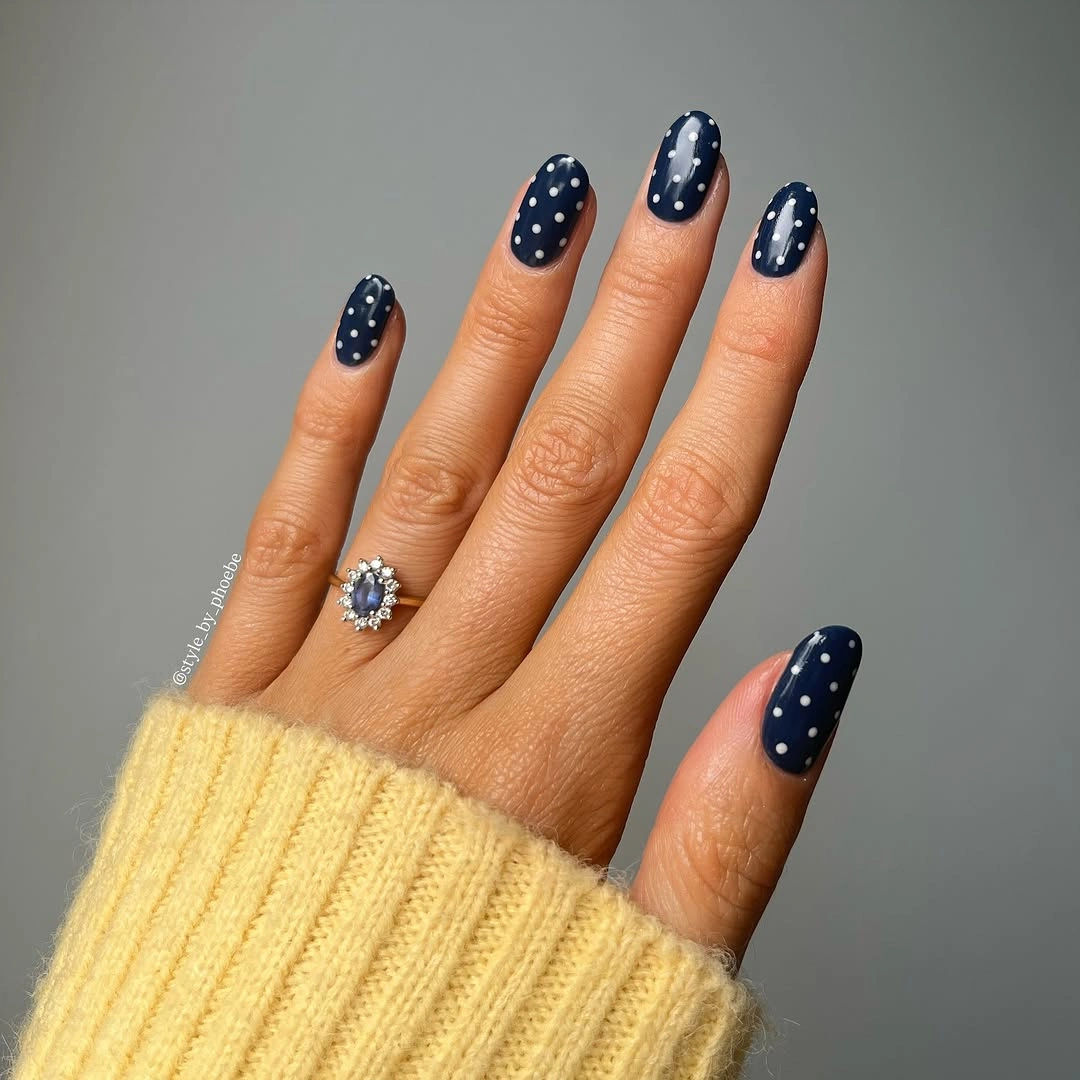
Navy gives white dots a more fall-ready weight than a bright summer blue would, and the short length keeps the pattern from feeling costume-like. This is the easier pick for someone who wants a dark nail but still wants visible detail near the fingertip. A matte navy would make the result softer, though the glossy surface helps the white circles stay visually sharp.
High-contrast dots show small chips more readily than a monotone manicure, so a careful top finish helps preserve their round edges. The good news is that the pattern is simple enough to keep consistent during a refresh. It has a playful surface, but the navy base makes the overall mood more composed than sugary.
9. Five Bright Bases, One Dot Language
Red, yellow, green, black, and white rounded nails each use contrasting dots, turning the hand into a small color study rather than a one-palette design. Every nail has its own base, yet the repeated circular mark gives the mix a shared language. It is maximalist, yes, but the dots make the separate shades feel related instead of accidental.
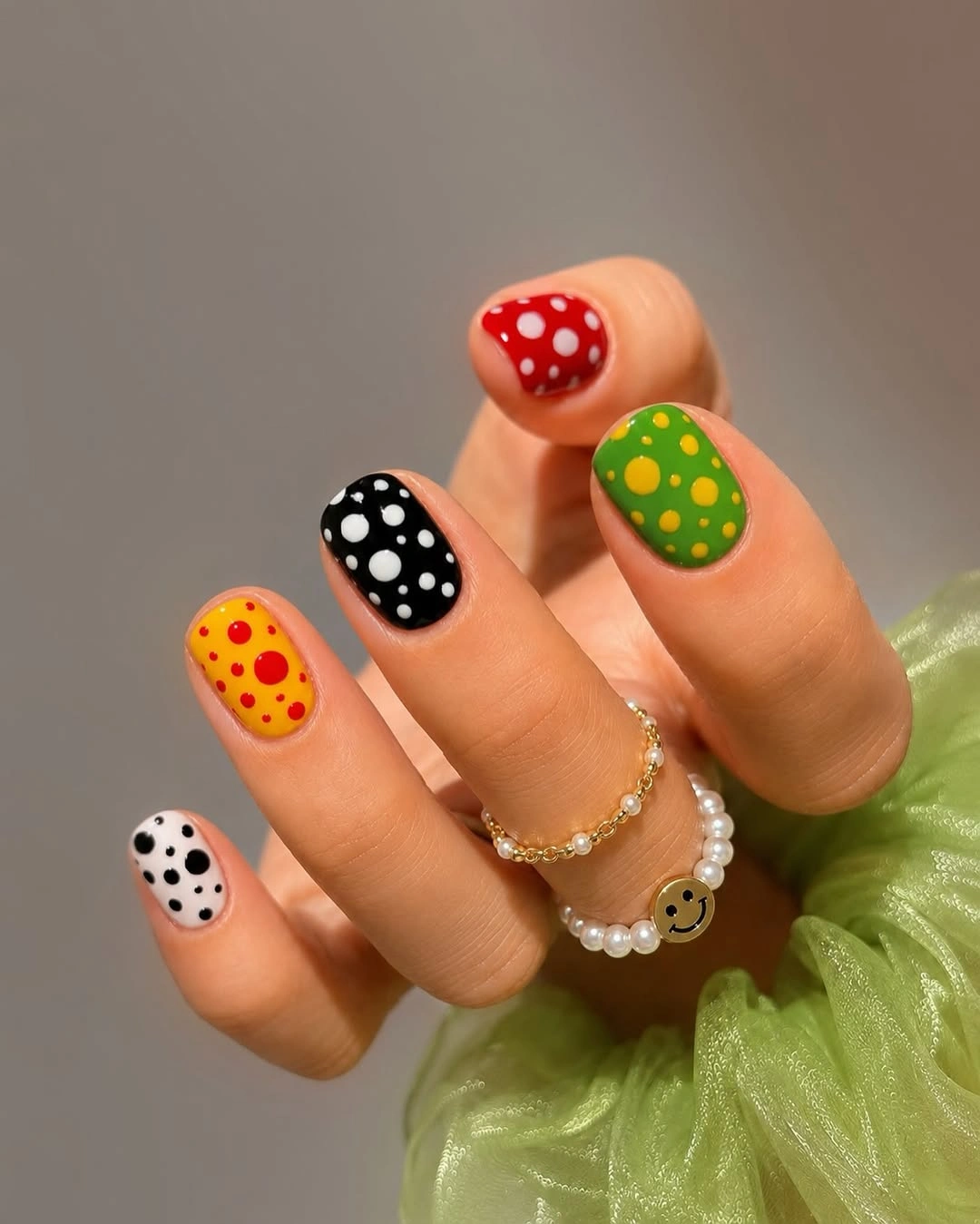
This approach works best when the dot colors have strong contrast against their bases, because low-contrast circles would disappear inside an already varied arrangement. To simplify it, choose three colors and repeat one base twice rather than assigning a different color to every finger. The short rounded shape is helpful here because it keeps the overall effect compact.
A multi-color set needs a little confidence, and it will naturally pull attention away from other accessories or prints. The maintenance advantage is that no single color has to match perfectly across every nail. It is a lot, but the clear repetition of dots means the design is still more organized than a random mixed manicure.
10. Muted Mixed Colors With Tiny Contrasting Dots
Teal, mint, blush, and deep green appear across medium almond nails, with small contrasting dots giving every shade a similar visual texture. The palette has both soft and dark notes, but nothing feels disconnected because the dots repeat at a modest scale. Gold rings add warmth nearby without needing to enter the nail design itself.
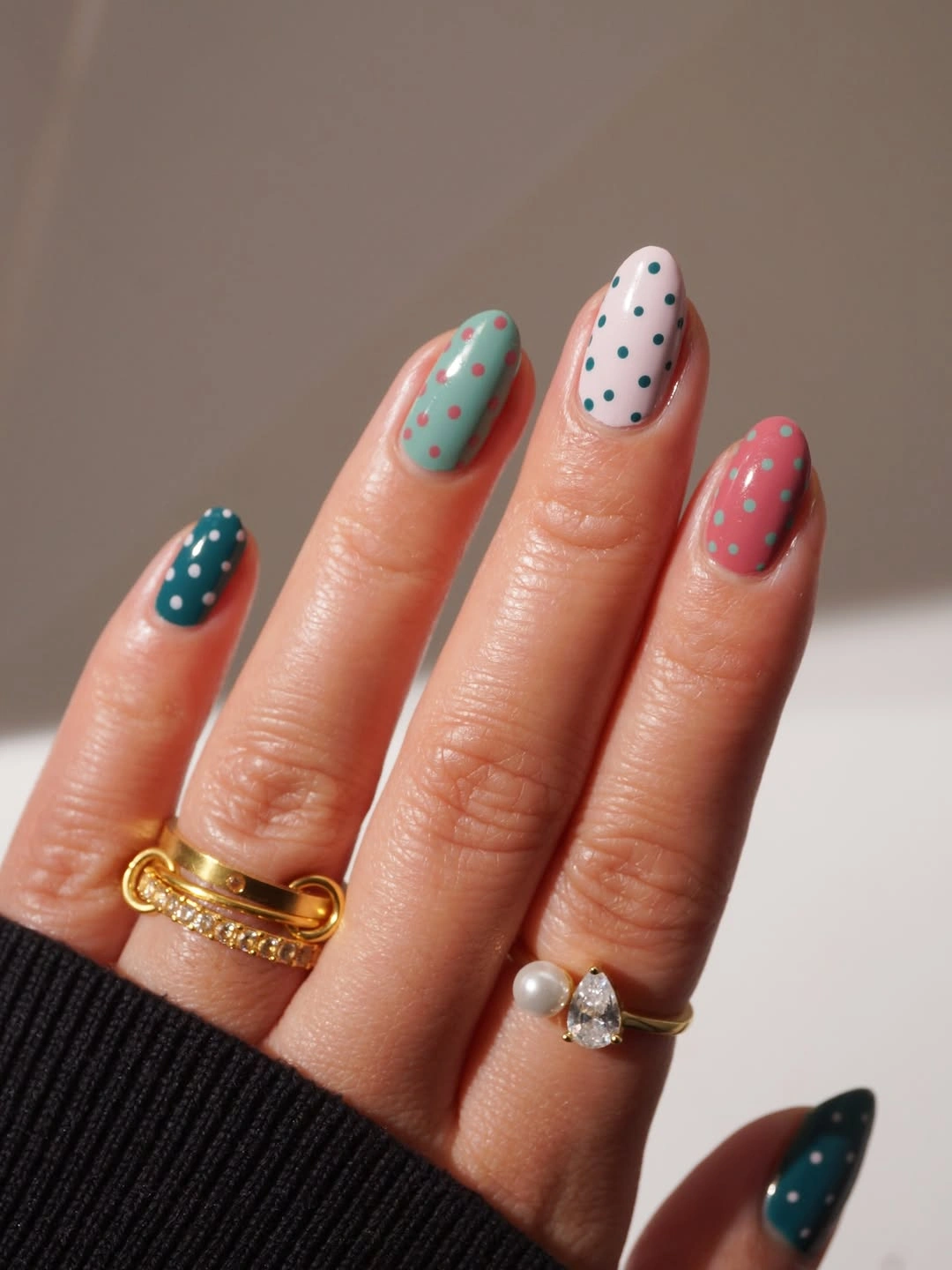
The appeal is the low-key color mix rather than any single dramatic accent. Dots are used as a unifying texture, so the eye notices the relationship between cool green and blush before it notices one particular nail. If you want fewer colors, keep teal and blush and let the deep green appear only as a dot color instead of a full base.
Medium almonds have enough room for this scaled-down pattern without making each dot look too tiny to read. The tradeoff is that a mixed palette asks more thought when choosing the color order, since adjacent shades can either blend beautifully or flatten each other. Here the shifts in depth keep it expressive but still grounded.
11. Pale Blue Squares With Bold Black Dots
Short pale-blue square nails are topped with bold black dots, a simple contrast that looks especially crisp because the base is cool and the shape is compact. The dots have enough size to be noticed immediately, but the spaces between them keep the nail from appearing filled. It is graphic without relying on a long silhouette for impact.
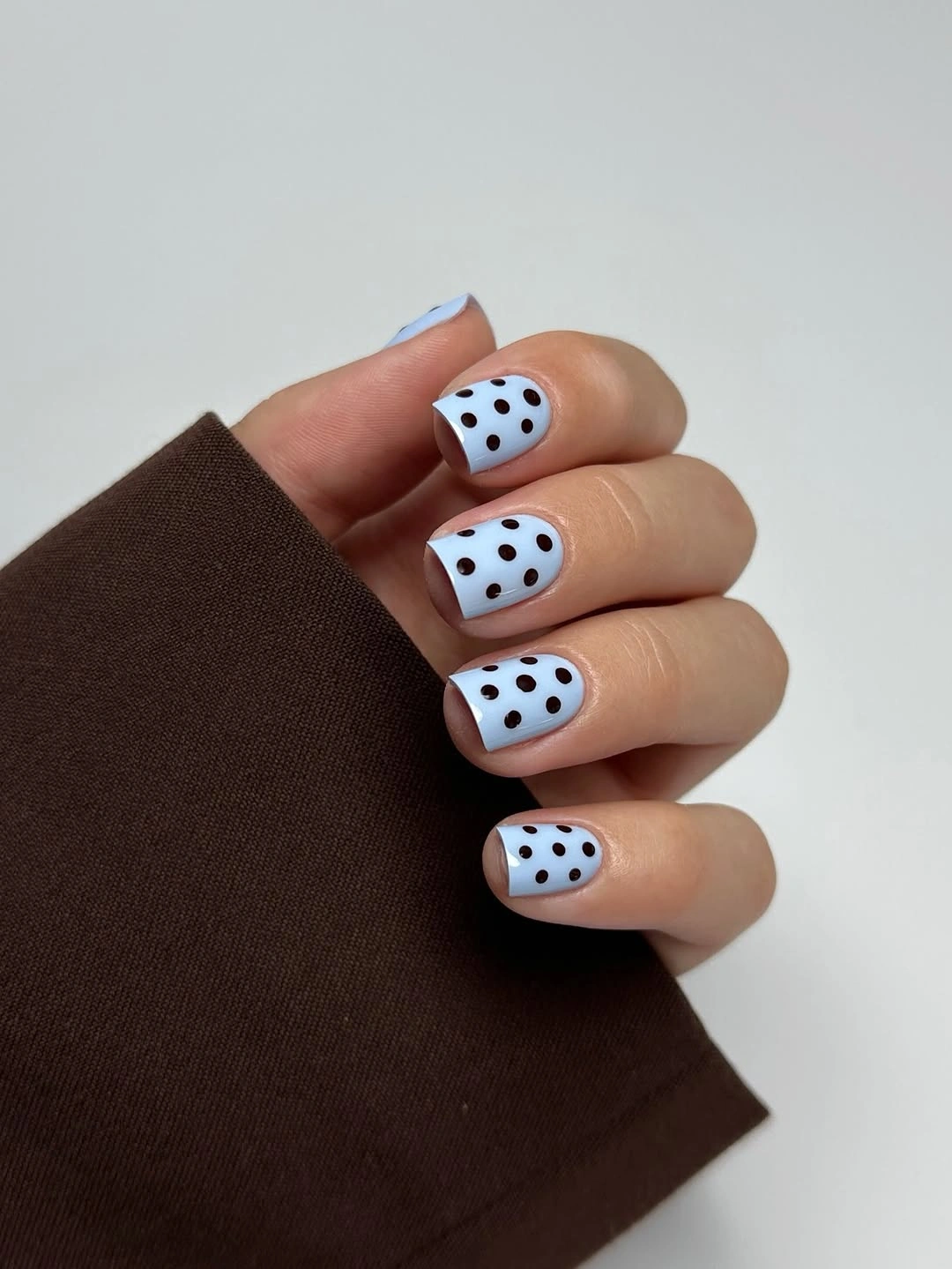
Short squares make this pattern feel direct and clean, which is useful if you like the clarity of black dots but do not want the extra length of a statement nail. A softer gray-blue base would lower the contrast slightly while keeping the same modern effect. The design has only two parts, and that simplicity is exactly what makes it work.
Dot placement near the corners should leave a little blue border, otherwise the squared outline can start to look visually crowded. Because the black marks are so visible, the manicure benefits from keeping their size consistent across the hand. It is not trying to be delicate, but it is carefully edited rather than busy.
12. Pale Green Dots With One Pink Floral Break
Pale-green almond nails have fine black dots, while one pink accent carries a flower-like drawing, giving a dotted pattern one softer interruption. The black marks make the green look clearer, and the pink accent stops the full hand from becoming one continuous repeated surface. The long almond shape keeps both elements looking light around the fingertips.
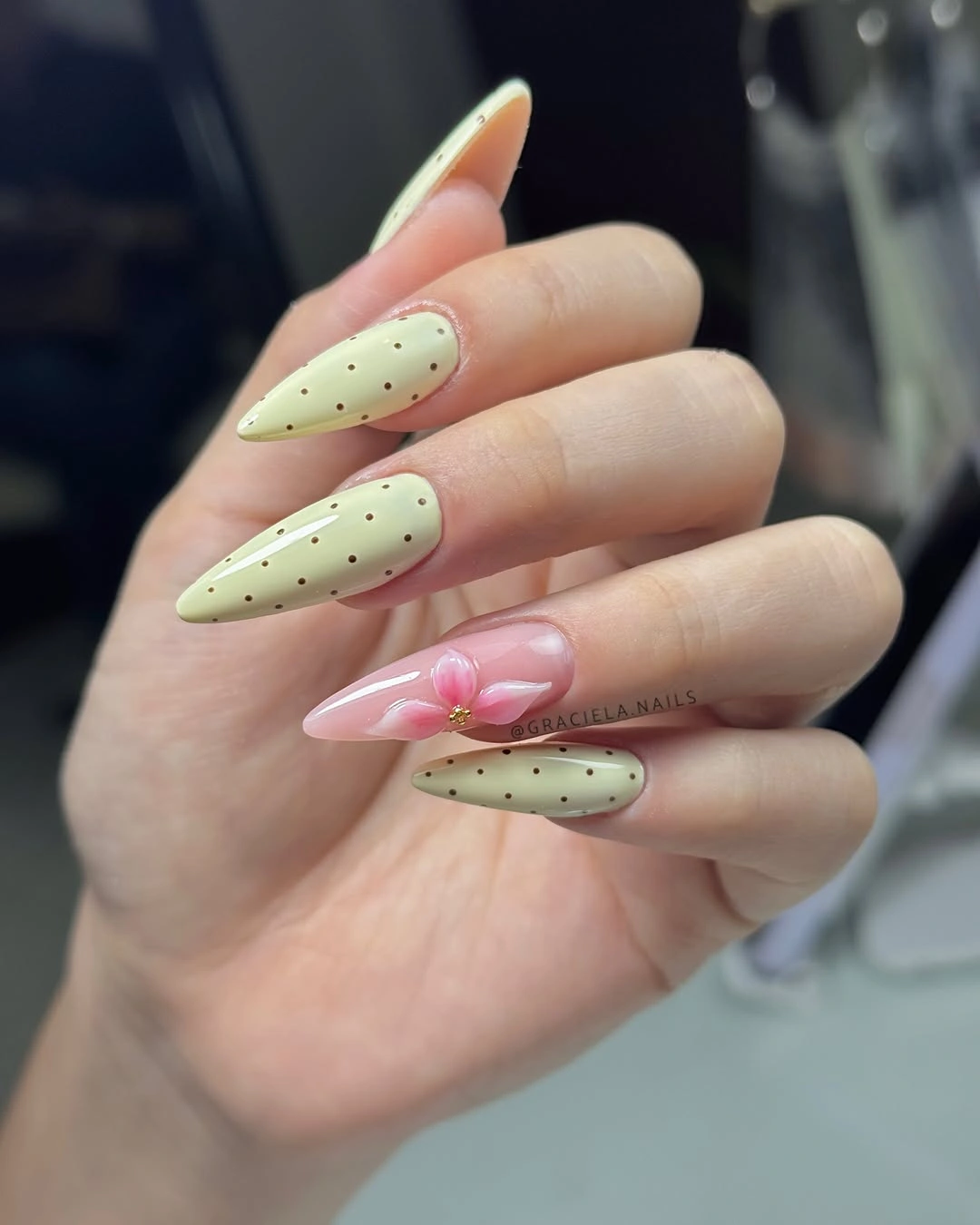
The floral nail earns its place because it does not repeat the dotted design exactly; it changes the rhythm without changing the playful mood. One accent is enough, since adding flowers to every nail would compete with the tiny dots. A pale yellow or cream base could replace the green if you want the same sweet contrast with less coolness.
Very small dots rely on clear spacing, particularly over a pale base where any uneven grouping stands out. The floral accent may take more precision to refresh, but the remaining dotted nails are simple and provide a stable backdrop. This set feels whimsical without becoming cluttered because the design switches gears only once.
13. Brown Dots Along a Blush Oval
Blush oval nails combine dark brown dots with brown dotted edging, placing the pattern both inside the nail and along selected curves. The mix gives the circles more direction than a standard all-over scatter, and the warm brown feels softer than black against pink. The glossy finish makes the colors look smooth and slightly richer.
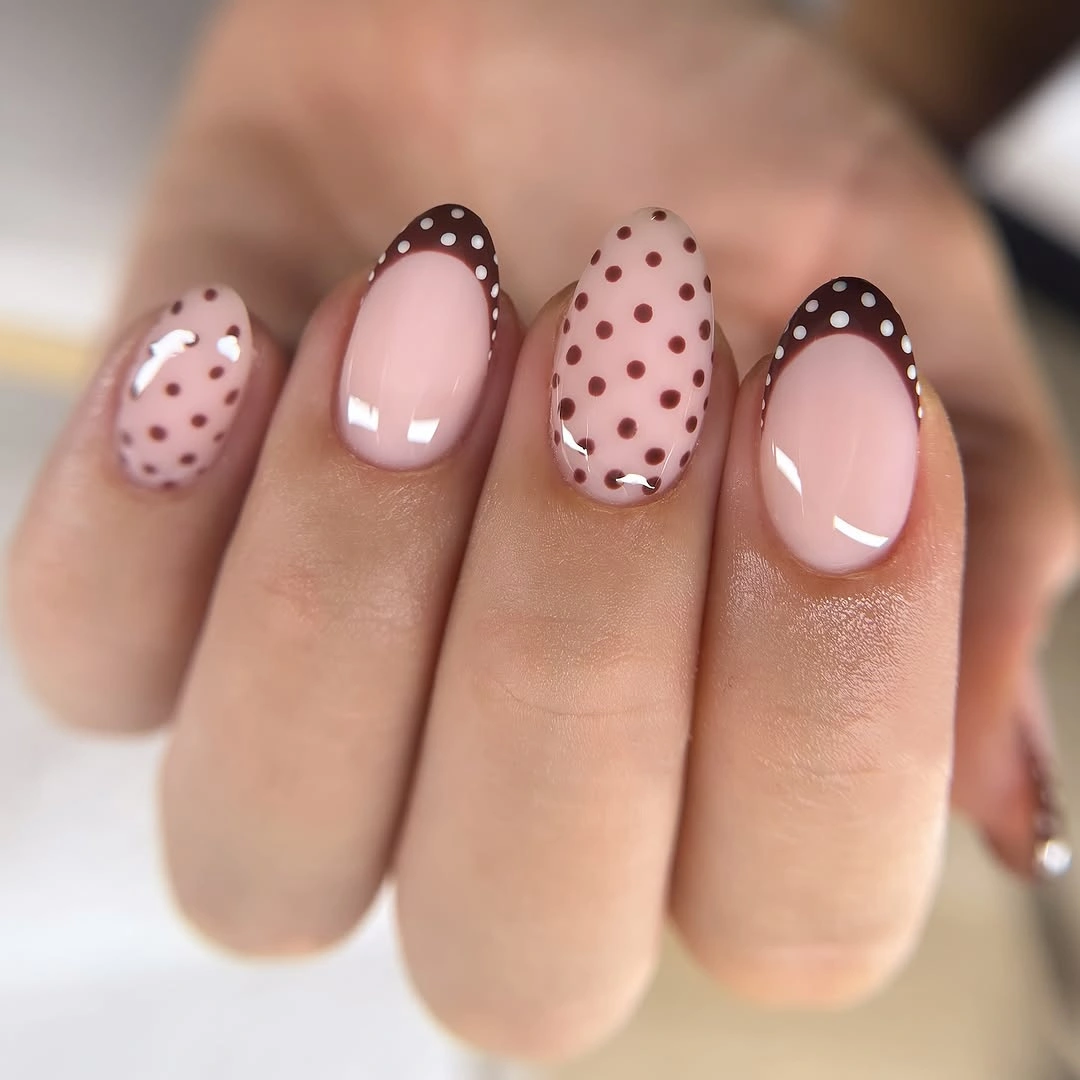
A dotted outline is an interesting alternative to a full French tip because it suggests the edge without drawing one hard line. The brown dots inside the blush area echo that border and keep the two placements connected. If you prefer a more minimal result, use the dotted edge on one or two nails and leave the rest as plain blush solids.
Edge-focused dots are visible at the part of the nail that sees the most daily contact, so they may need attention sooner than dots placed near the center. Their payoff is a lively frame that still leaves plenty of soft pink open. The idea is clever because it uses one motif in two positions without pretending those positions are identical.
14. Olive Tips With a Single Yellow Dot Nail
Pale pink almond nails use olive-green curved tips, while one companion nail is covered with tiny yellow dots, pairing a grounded fall color with a brighter patterned detail. The olive keeps the French edge seasonal, and the yellow dots add a small spark without turning the entire hand sunny. The base remains visible enough to keep everything light.
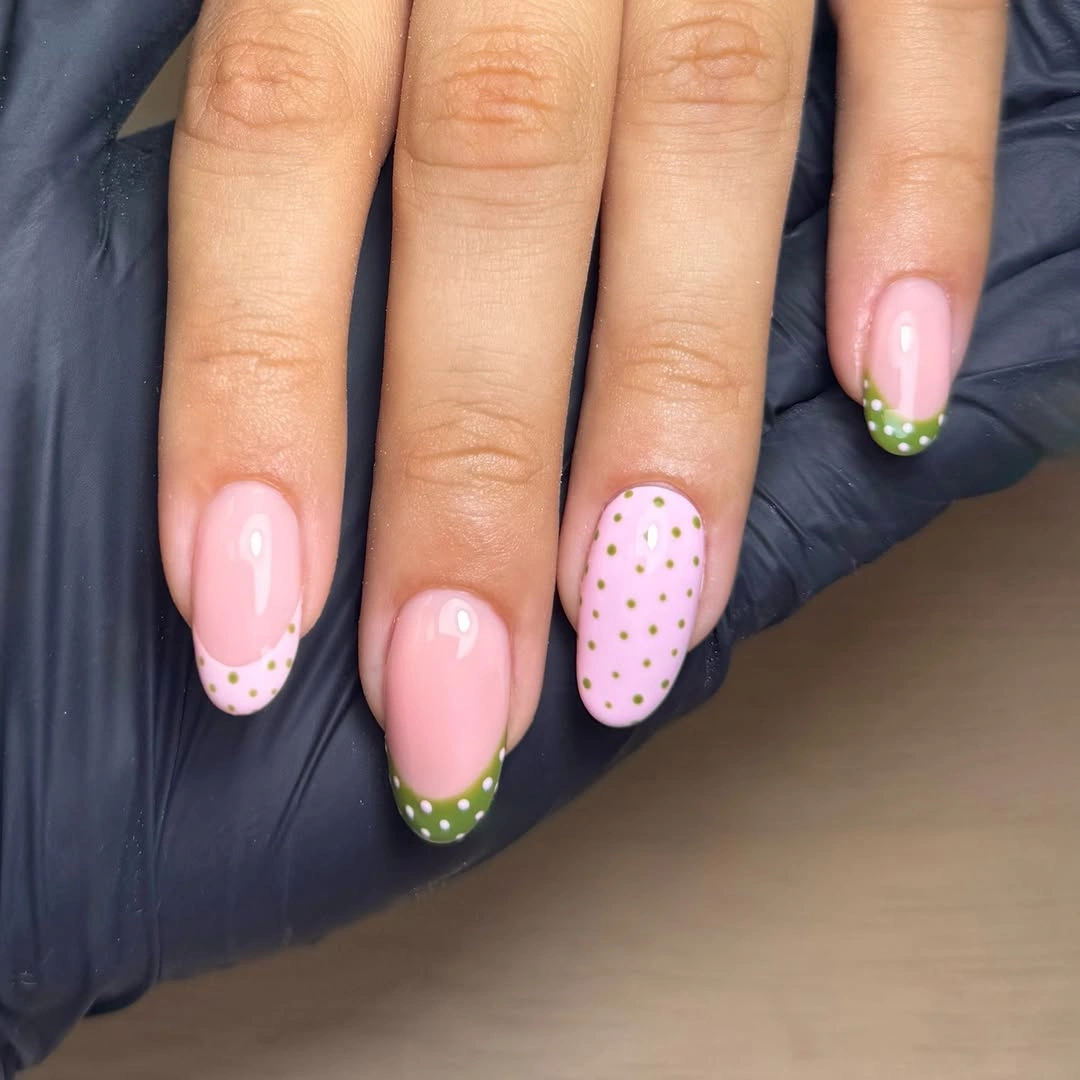
The two design devices are separated on different nails, which is why they do not compete. Olive has the stronger visual weight, while the yellow dot nail feels like a cheerful side note. For a more muted direction, change yellow to cream and let the olive tips carry almost all of the contrast. The hierarchy stays clear at a glance.
French edges can be forgiving at the cuticle as the nails grow, while tiny dots need more attention if they sit close to the tip. The almond shape makes the olive curve feel natural rather than like a band cutting across the nail. It is a playful pairing, but it is not overloaded because the palette never wanders beyond pink, green, and one warm accent.
15. Cobalt and Yellow Dots With a Nude Pause
Bright cobalt and yellow almond nails use white dots, while one nude nail carries a yellow dotted panel, creating a bold primary-color arrangement with a small neutral pause. The high-saturation bases are undeniably expressive, but the repeated dots make them feel like parts of one system. The nude section is important because it stops the color from becoming a solid wall.
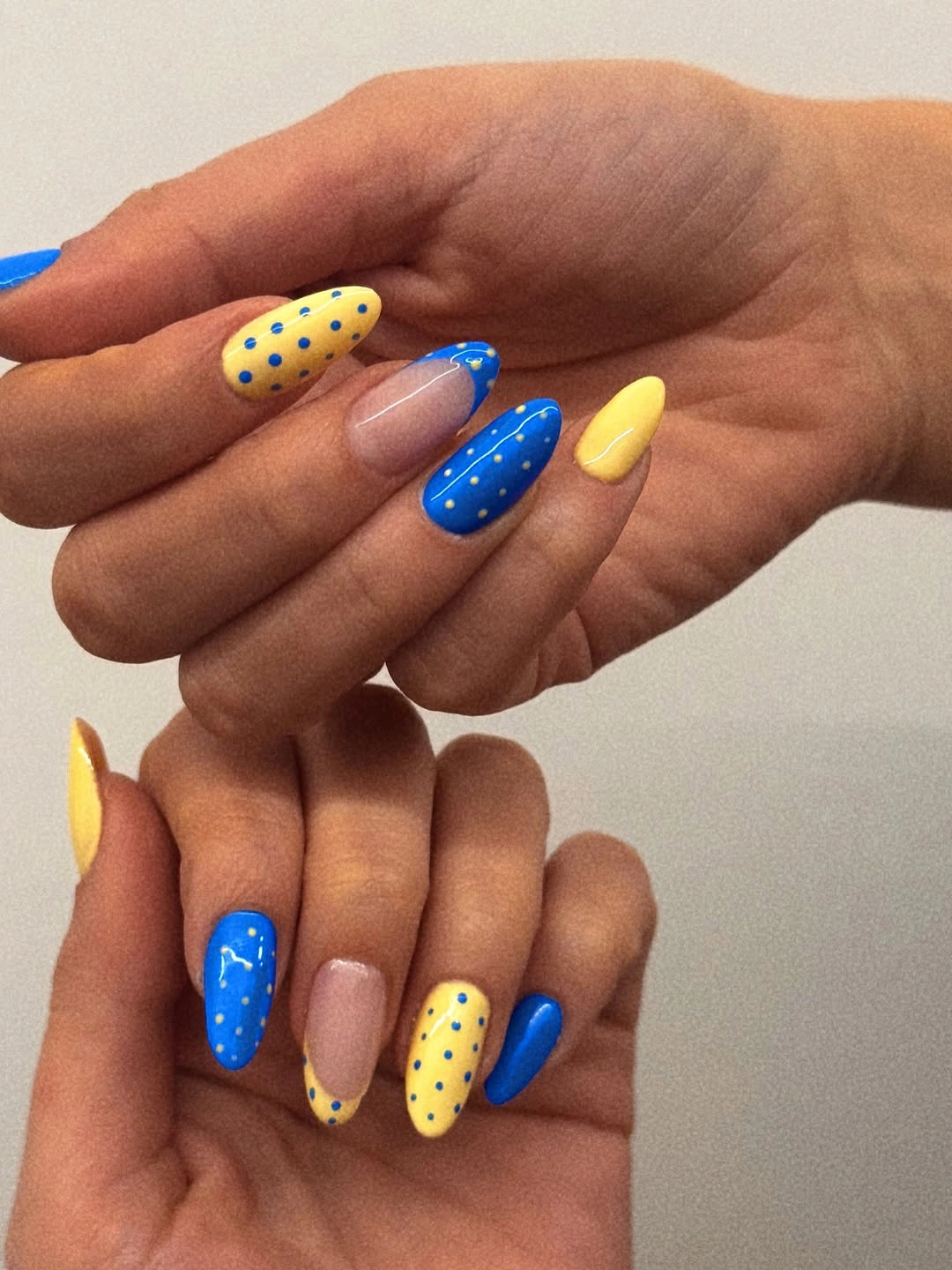
This is not the quiet option, and it does not need to be. The strongest choice is letting the dots stay white across the blue and yellow, so the pattern remains readable even as the bases change. If the primary colors feel too loud, keep the nude accent and use a muted navy with mustard instead. That keeps the palette in a clear order.
High contrast means every circle and edge will be visible, so clean shape work matters more than in a soft neutral design. The payoff is immediate energy without complicated illustration. It feels cheerful, but the repeated white dots and one neutral interruption keep the bright colors from going completely off-script.
16. Blue Dotted Tips on Nude Stilettos
Nude pointed nails carry cobalt dotted tip panels and small white flower-like accents, leaving the center of each long stiletto open. The dots cluster toward the free edge, so the pattern feels more like a decorative border than an all-over surface. Blue provides the main contrast, while the pale floral touches soften the pointed shape.
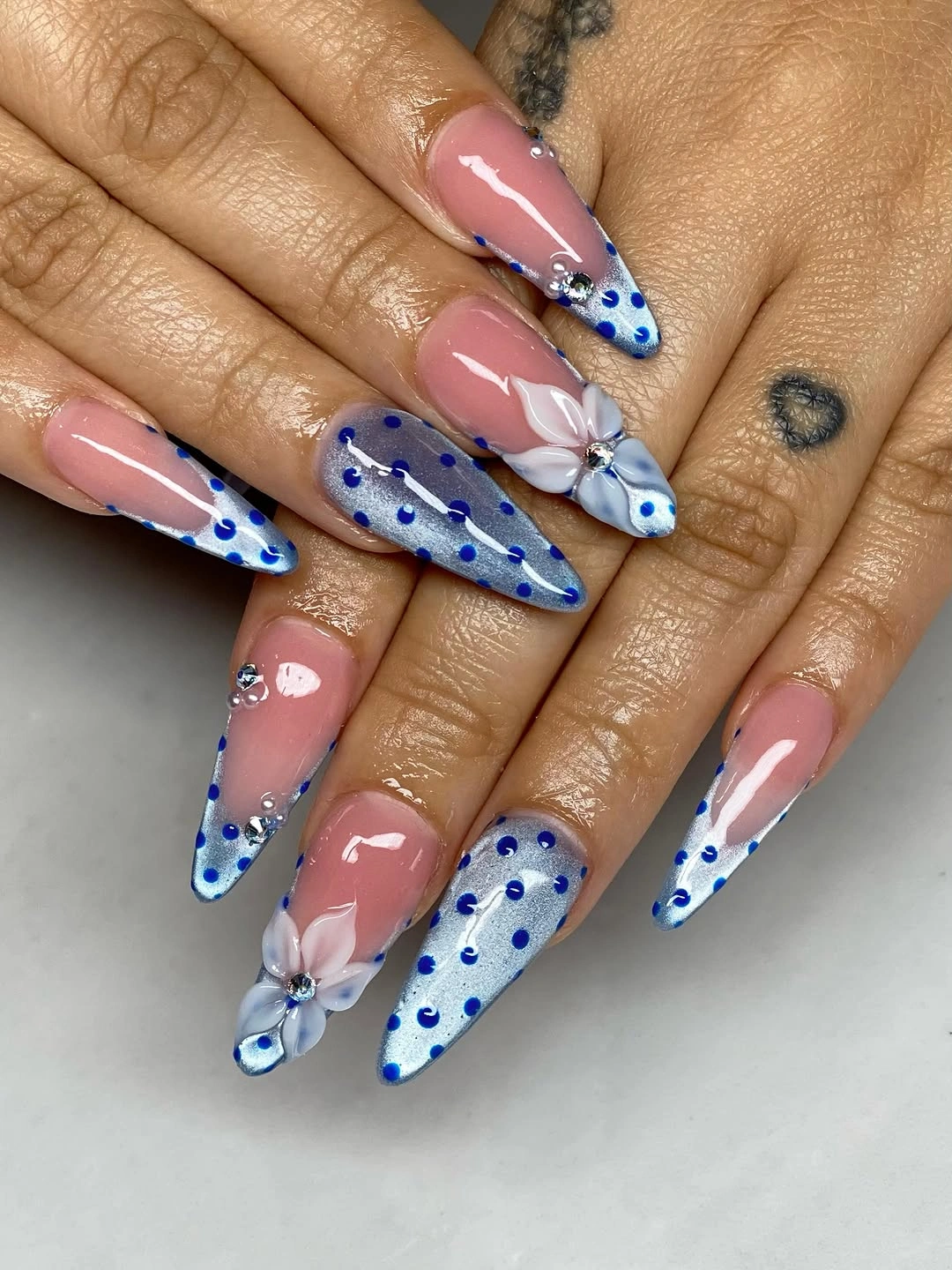
Tip panels are a useful way to wear a busy dot pattern on long nails because they reserve a large area of nude space. The cobalt is strong enough to be noticed, but it does not cover the whole silhouette. A medium almond with shallower blue panels would be the more practical version for anyone who likes the composition but not the stiletto length.
The pointed outline already asks for a careful routine, and fine tip detail adds another element that needs to remain crisp. Still, the nude base makes cuticle growth less conspicuous than a full blue nail. The design feels expressive because the dots are concentrated where the eye expects a French edge, not scattered without direction.
17. Navy and Pale Blue Dots With Blush Solids
Navy and pale-blue dotted nails alternate with plain blush nails, creating clear visual breathing room around the darker pattern. The dot colors reverse from navy to pale blue, which gives the set subtle variation without introducing a new motif. The medium oval shape keeps the different tones soft at the edges.
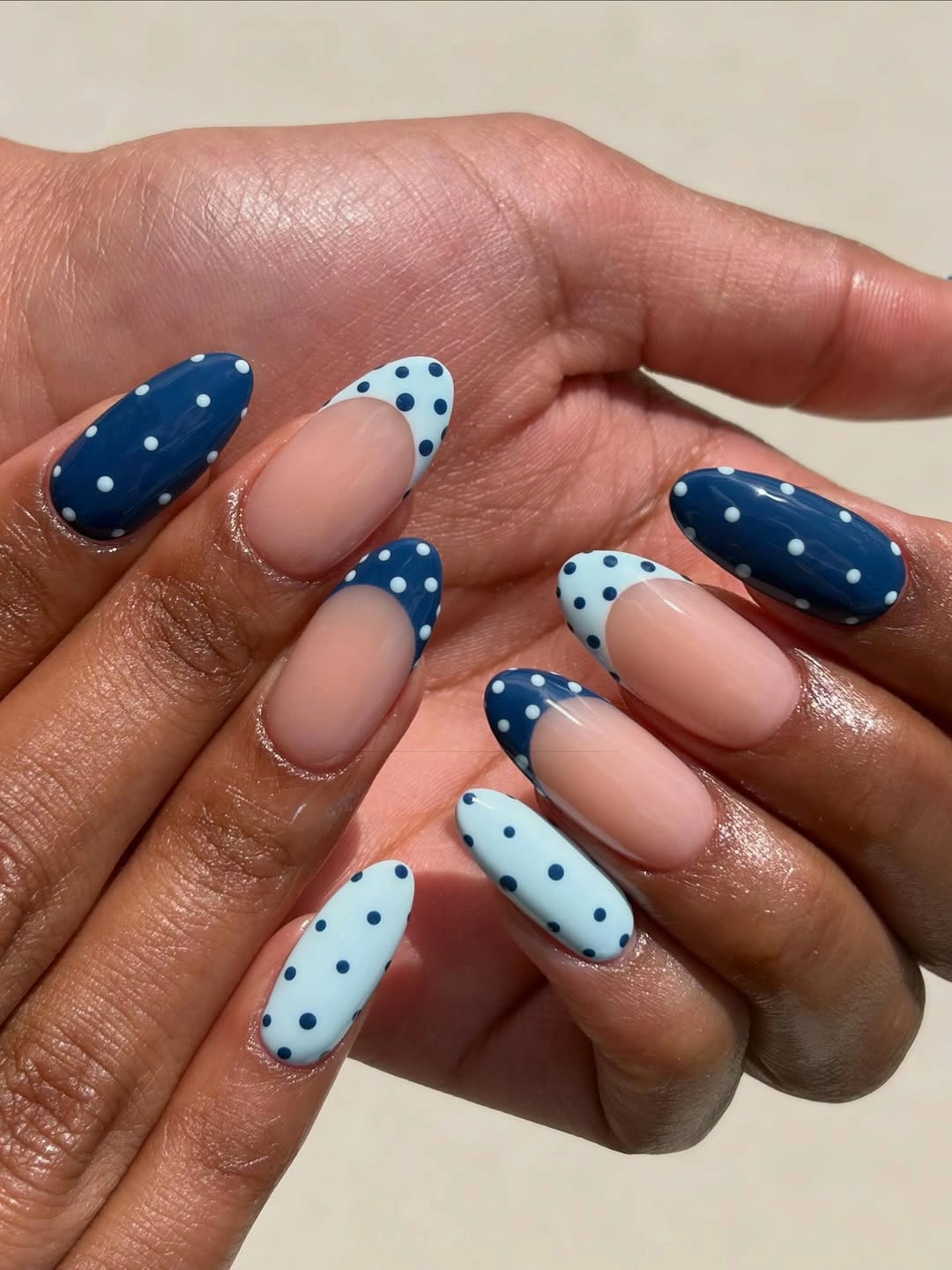
Plain blush nails do more than fill space here; they give the dotted blues a chance to read as accents rather than a full printed surface. That contrast in density is a smart way to make a mixed manicure feel calm. For more balanced combinations of patterned and plain nails, these fall accent nail designs show how a simple pause can sharpen the focal nails.
Switching dot colors across two blue bases is subtle enough to reward a closer look without making the order hard to follow. The oval shape is forgiving if you want a medium length, though the high-contrast dots will still benefit from even spacing. It has personality, but it knows when to leave a nail completely plain.
18. Burgundy Dots and a Tiny White Bow
Burgundy, pale pink, and white nails use dots in opposite colors, with one small bow-like motif adding a delicate finish to the patterned group. The deep burgundy keeps the palette rooted in fall, while the lighter nails create contrast around the small white marks. Each detail is visible, but the limited color range stops it from becoming too sweet.
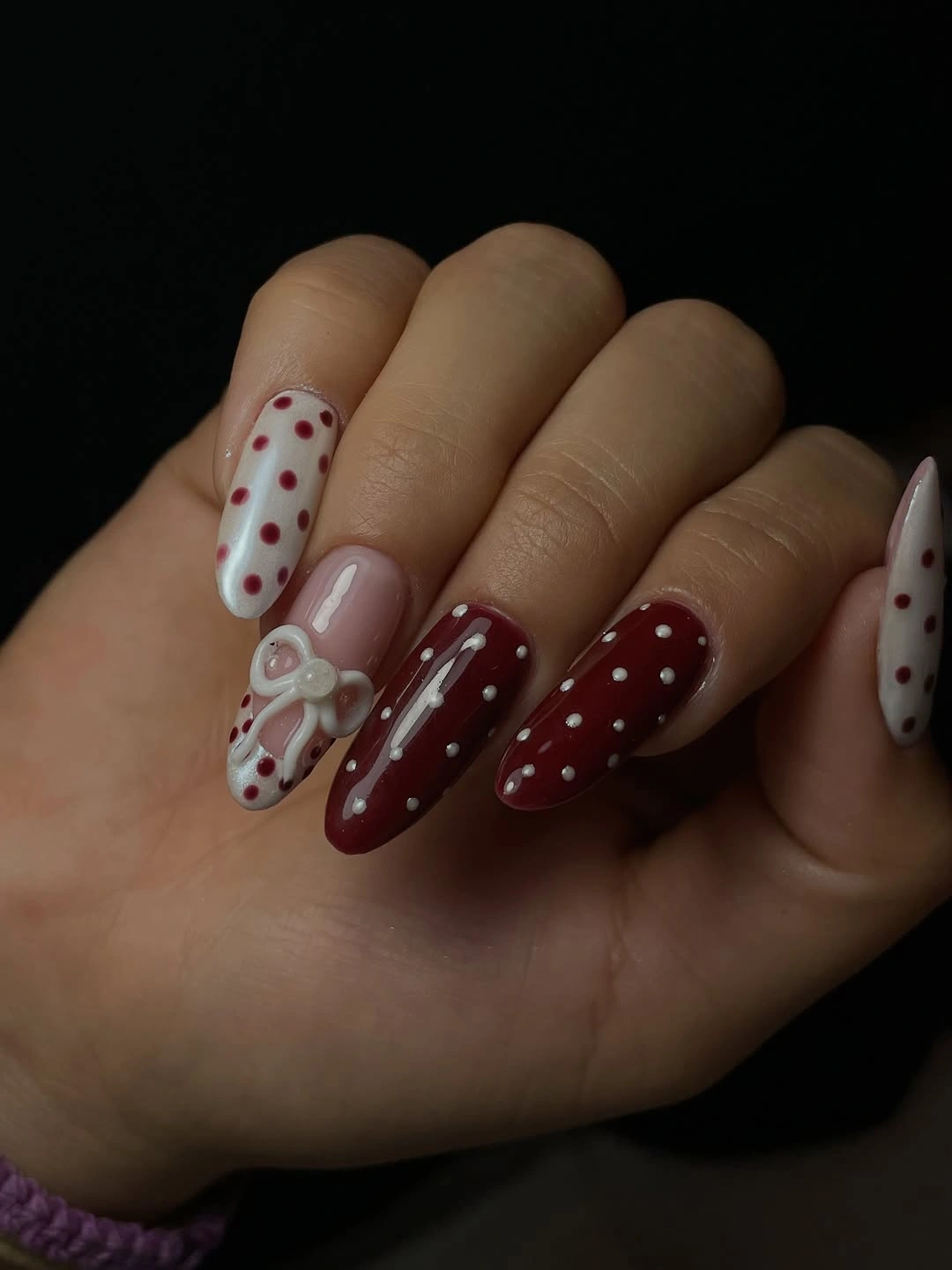
The bow is a tiny focal point, not an excuse to cover every nail with extra art, and that restraint matters. Reversed dots already provide plenty of movement between burgundy and white. If you prefer a more grown-up version, remove the bow and keep one white dotted nail next to two solid burgundy nails.
Small pale motifs need clean edges against a dark base, while the rest of this pattern is relatively simple to maintain. The almond shape gives the bow and circles room without making them look cramped. This set leans playful, but the burgundy depth keeps the overall result from floating into a purely springlike mood.
19. Soft Blue Dots on Blush Short Nails
Short blush nails use pale-blue and white dot placements with a small white graphic accent, creating a gentle pattern that sits close to the fingertip. The soft colors reduce the contrast, so the dots read as a textured layer before they read as a bold print. Rounded-square edges keep the compact manicure looking tidy.
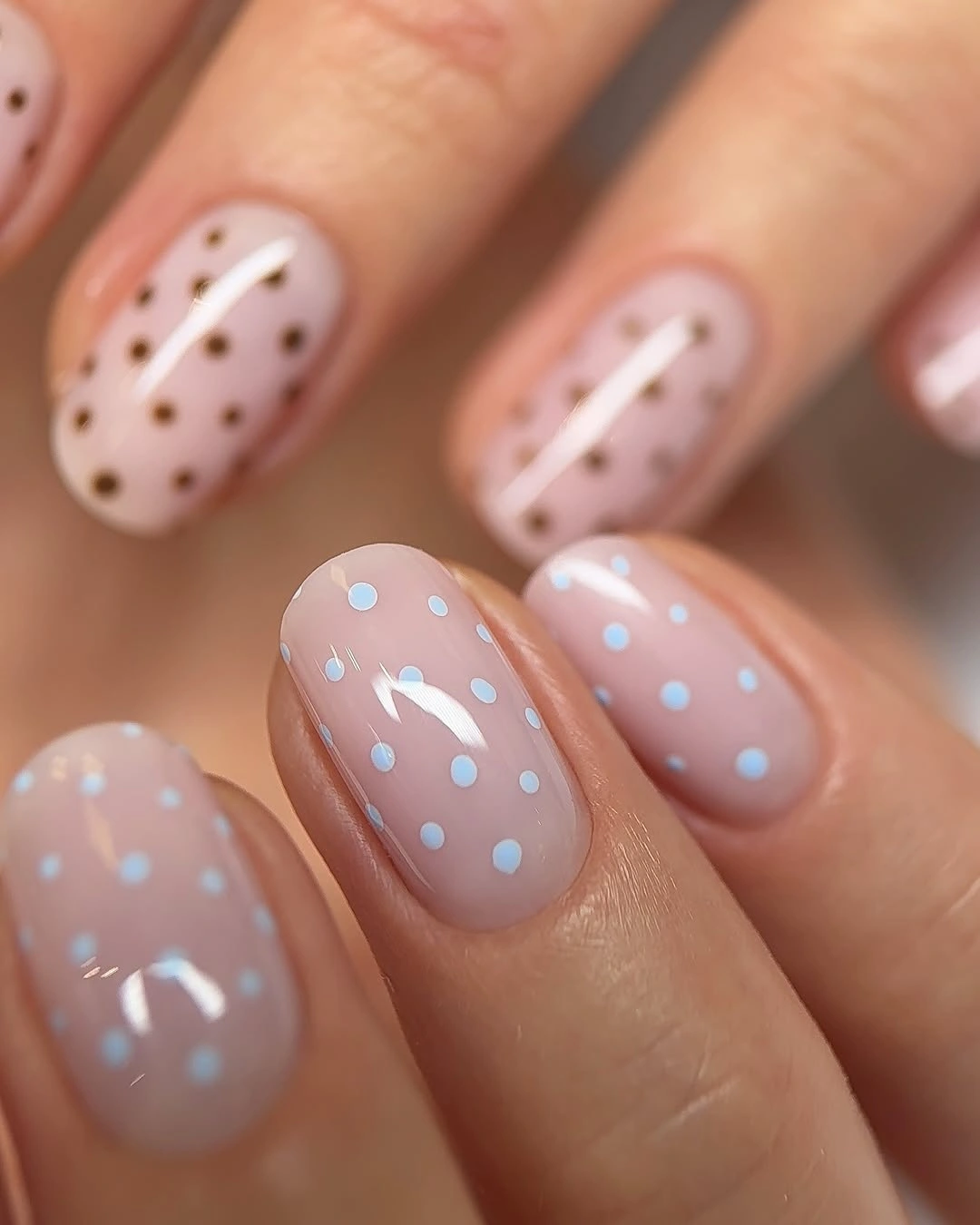
This is the easier pick if you like polka dots but want them to stay almost whisper-level. Pale blue has enough difference from blush to be seen, yet it does not create the visual snap of black or navy. A tiny white graphic accent gives the set one special moment without breaking its quiet color family.
Short nails offer less room for too many dots, which is why the open blush spaces are doing important work. The pale shades are forgiving with everyday wear, though their soft edges need to stay clean to avoid looking faded. It feels gentle and considered, showing that the pattern can be subtle without becoming invisible.
20. Cocoa Dots With Small Metallic Details
Cream nails with dark brown dots are paired with cocoa accents carrying small raised metallic decorations, combining a warm neutral print with one more dressed-up element. The colors work together because both cream and brown belong to the same soft earth-tone range. The metallic points add focus, but the polka dots remain the repeating idea across the hand.
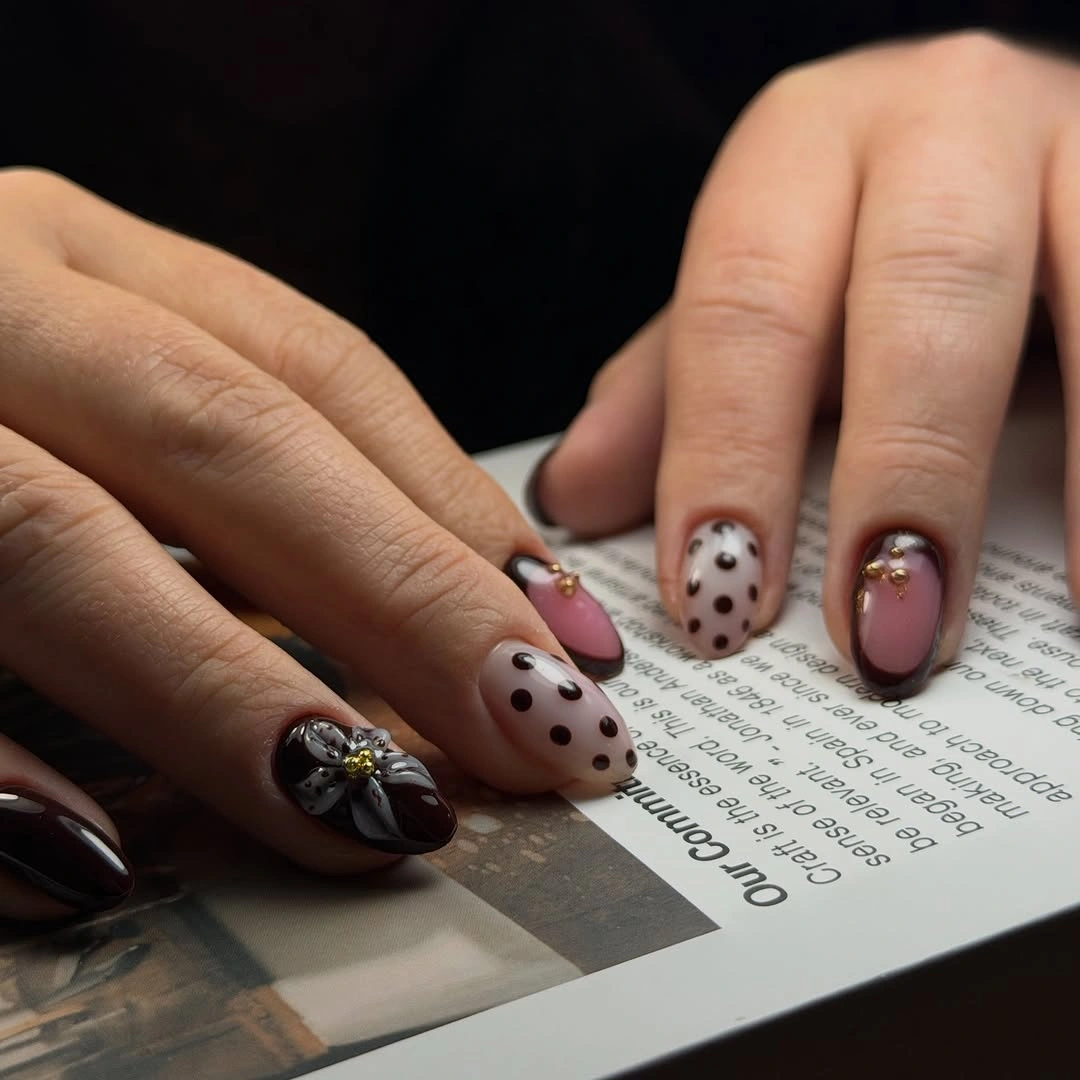
Warm brown dots are a strong fall alternative to black because they create contrast without a harsh edge against cream. The small raised details should stay limited to one or two nails, otherwise the simple spotted motif would lose its clarity. If a smooth surface is more important to you, trade the metal accents for a thin painted gold line.
Raised details may catch more easily than flat dots, so they are the part of this manicure that asks for the most care. The cream and cocoa sections themselves are easy to adapt to a shorter oval or square shape. It has a cozy palette, but the neat dot scale keeps it grounded rather than overly themed.
21. Large Black Dots on Soft White Ovals
Soft white short oval nails use larger black dots with generous empty space around each circle, making the pattern feel bold but surprisingly breathable. The dots are not squeezed into a tight grid, so the white base remains visible as an active part of the design. That spacing is what gives the simple contrast its clean, graphic impact.
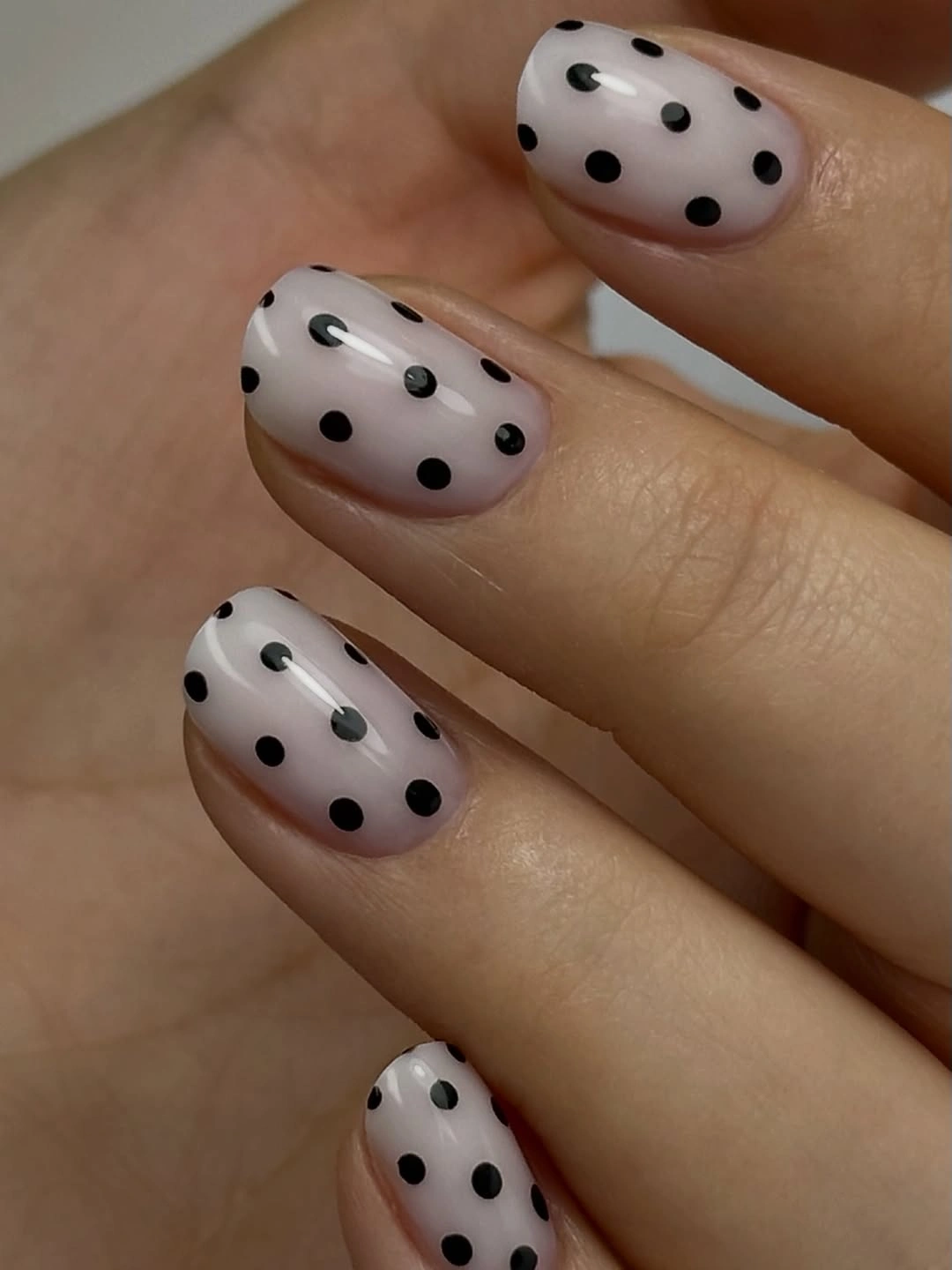
Large dots need room – that is the whole rule here. If they were packed closer together, the short nails would look busy immediately, but the white margins keep each mark distinct. A warm ivory base or deep brown dots would make the same composition feel softer while preserving the generous spacing.
The circles need consistent size because there are so few of them, and any uneven shape becomes more noticeable in such an open layout. The benefit is that a short manicure gets instant character without layers of color or art. It is graphic, direct, and much more polished than a dense all-over dot pattern would be at this length.
22. Tiny White Dots Over Cocoa Brown
Short rounded-square cocoa nails are covered with evenly scattered tiny white dots, a simple contrast that makes a deep warm solid feel lighter. The small scale keeps the pattern from overpowering the compact shape, while the glossy brown maintains a rich fall base underneath. It is a clear final reminder that dots do not need bright colors to feel lively.
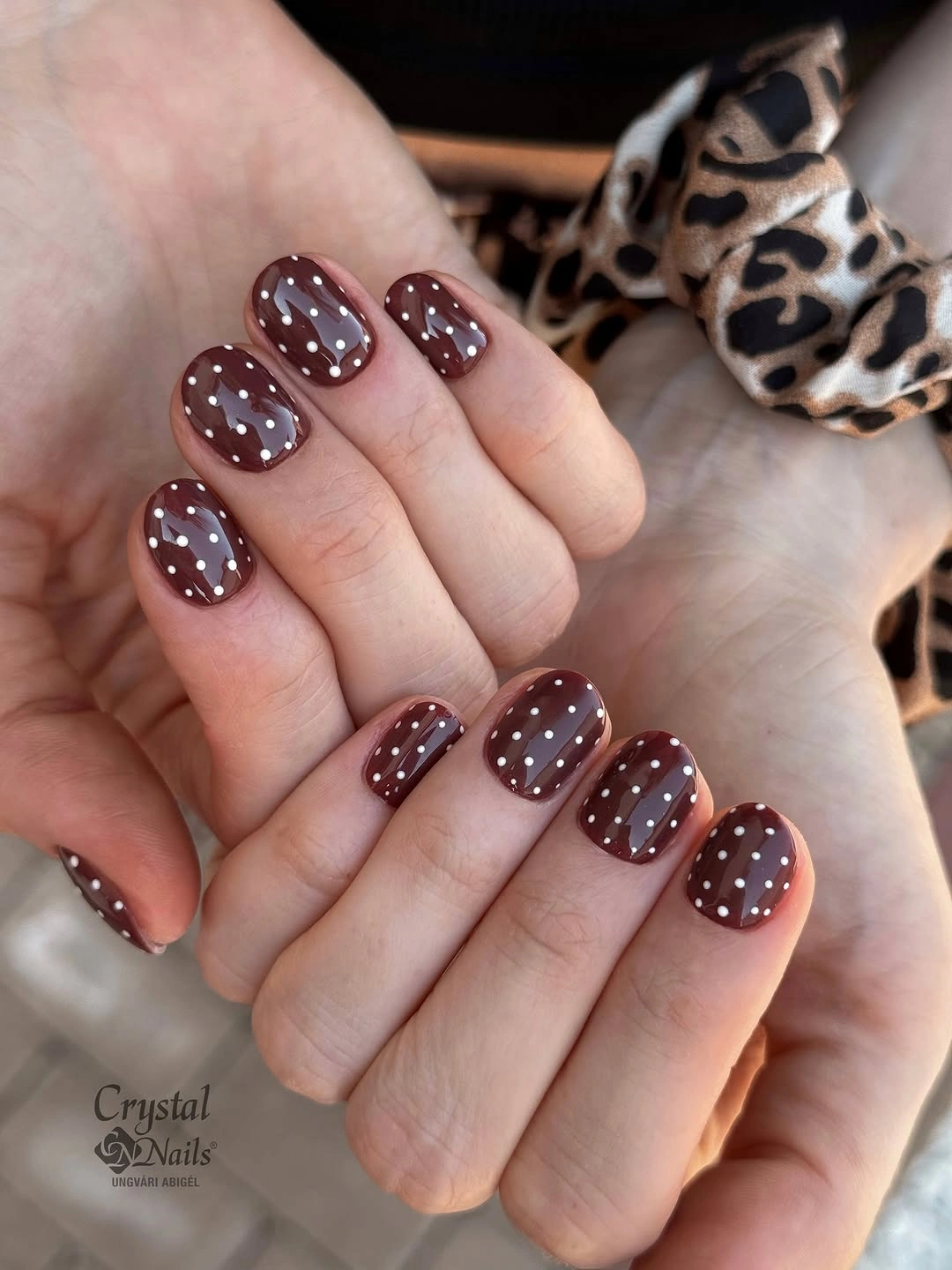
White works well against cocoa because the contrast is visible but less severe than white against black. The tiny marks can be repeated across every nail without making the set look as loud as a large-dot version would. For more warm-pattern inspiration, these fall nail art ideas show how small details can change a dark base without hiding it.
Keeping the dots small and similarly spaced is the maintenance point that matters most; one large accidental circle would pull focus immediately. The rounded-square outline makes the brown feel friendly rather than heavy, even at a dark depth. It ends with the simplest formula in the group, and perhaps the most wearable: warm color, tiny contrast, no extra noise.