A Halloween motif becomes wearable when the colors establish an order of attention before the tiny drawing asks to be noticed. Strong value contrast can make a web or silhouette clear, while a lighter, cooler, or dustier pairing changes the mood without erasing the seasonal signal. For Halloween nail art, that color hierarchy is often more useful than adding another symbol, especially when the manicure needs to work with everyday clothes.
Use palette as the first editing tool: raise or lower contrast, shift the temperature, or reserve the darkest shade for one anchor instead of spreading it everywhere. The right adjustment can change the character of a design while keeping its recognizable detail, and it gives shorter nails a cleaner route than trying to preserve every line at the same scale. A reference to fall nail design for October can stay subtle when the color relationship does most of the seasonal work.
1. Red and Black Make Spiderwebs Immediate
Long red stiletto nails with black spiders and web lines use a simple high-contrast relationship, so the theme reads instantly. Red supplies saturated warmth and carries most of the surface, while black marks divide the space into recognizable focal points. The web-patterned setting echoes the manicure, but the design remains clear because the base and the dark motif have different visual jobs.
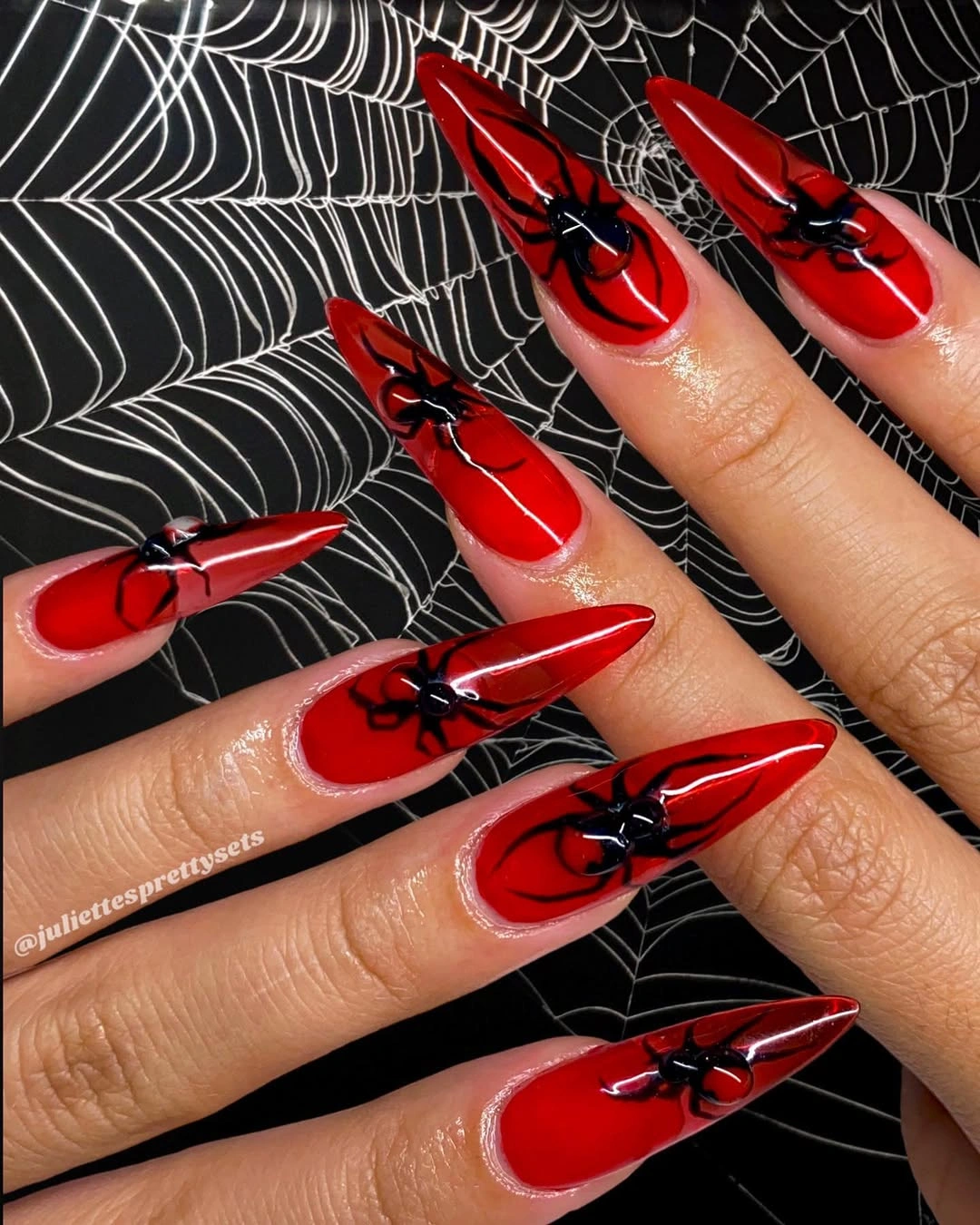
For a shorter version, keep the red base and place the strongest web on one or two accent nails, with a small black spider as the repeated symbol. The contrast will remain legible even if the point becomes an almond shape. A thin web is more useful than a dense one here because the red field needs to stay visible around it.
The tradeoff is intensity rather than complexity. Bright red against black can feel dramatic on any silhouette, but the stiletto shape adds a sharper edge to the same colors. If a softer mood is needed, shorten the point before muting the red; the temperature and value contrast are the reasons the design works.
2. Nude Space Calms Tiny Dark Symbols
Long almond nude and black nails use a pale base to lower the visual intensity of small dark marks. The nude surface supplies high-value breathing room, while the black nails act as anchors that prevent the design from becoming too faint. Tiny celestial or seasonal symbols feel more deliberate because they are surrounded by quiet color instead of competing with a full illustrated background.
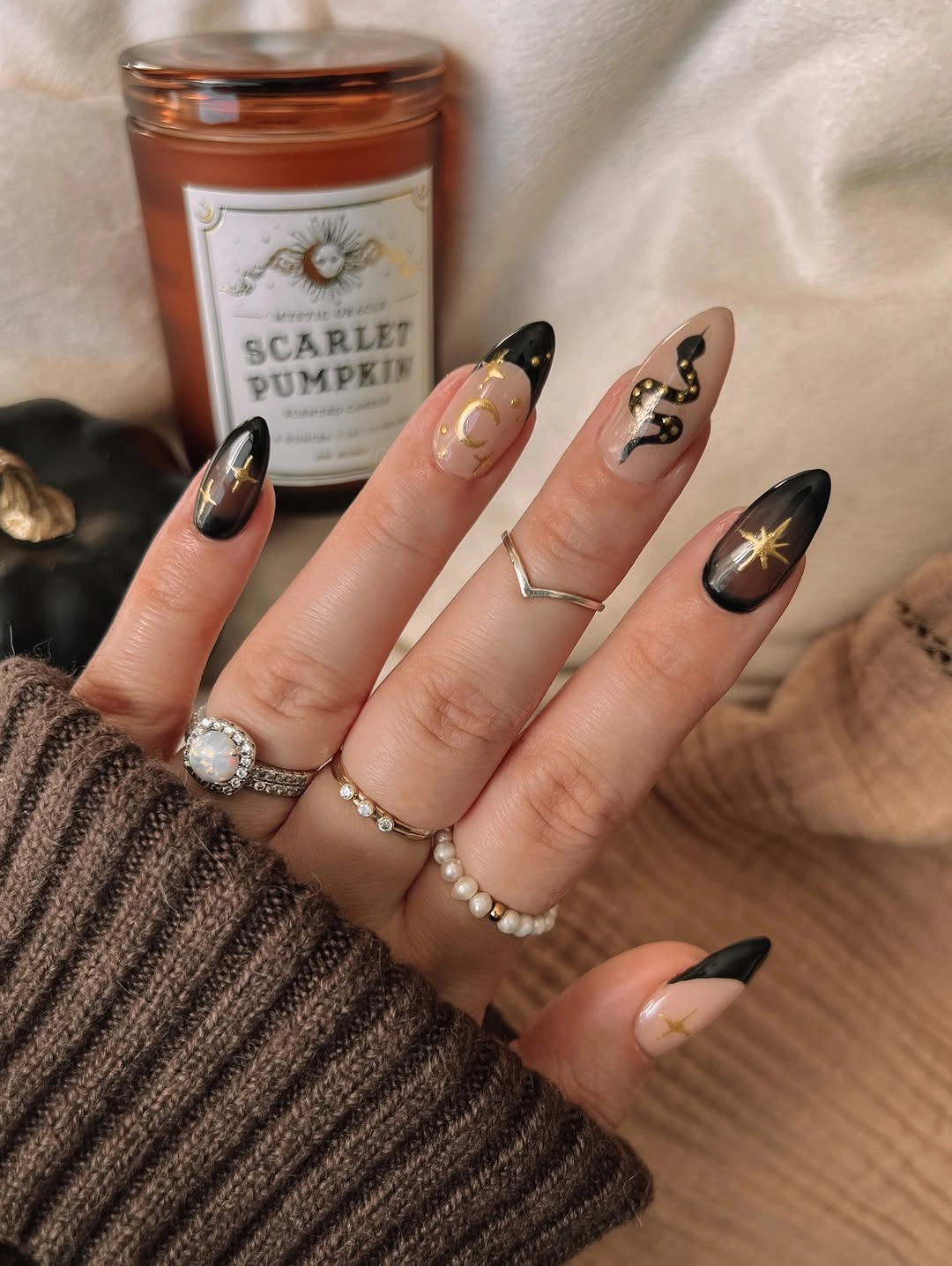
Keep the nude field dominant when adapting the design to medium or short nails, and use black on only two solid nails or one narrow accent. The small marks should stay simple because a crowded symbol loses the benefit of the open base. This restrained approach can sit beside early fall nails when the seasonal mood should remain subtle.
The color lesson is about value, not just palette. Nude is doing the work of a neutral support, so replacing it with another strong color would make the tiny marks harder to read. Preserve the light field and adjust the motif count first; the manicure will stay calm when the background remains the largest visual area.
3. Purple Tips Soften Pink Halloween Contrast
Medium almond nails combine pink, lavender, dark tips, and small bats or web-like lines, creating a pastel-gothic relationship. Pink and lavender keep the temperature soft, while the dark tips and symbols provide enough value contrast for the Halloween message to remain visible. The design feels balanced because the dark marks are placed inside a light field rather than spread across the whole surface.
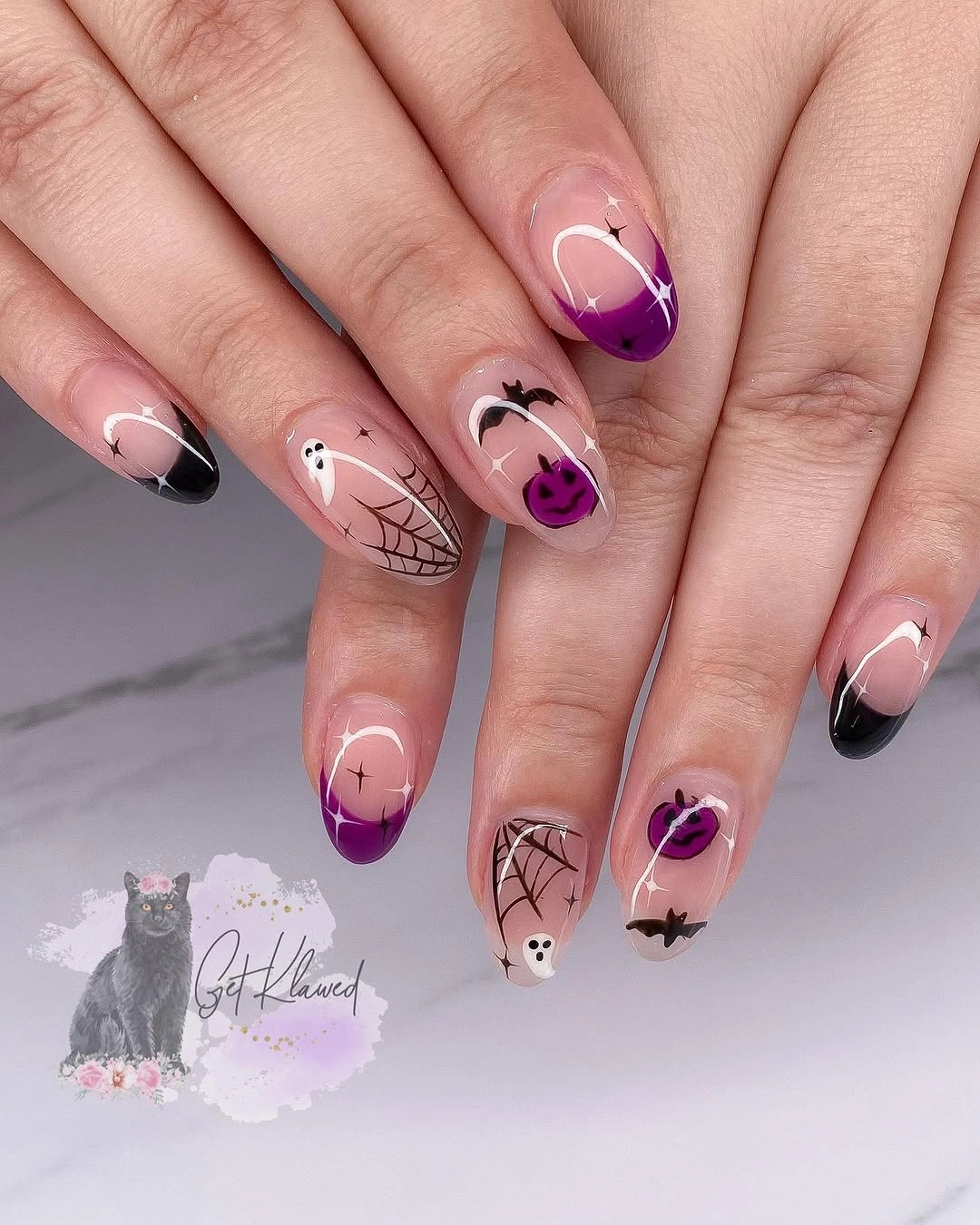
For short almond nails, keep the purple at the tip and reduce the bats or webs to one clear silhouette on each accent nail. That protects the pale pink base and prevents the small motifs from merging with the dark edge. The color can stay playful while the shape becomes easier to manage, especially for readers who like fall trendy nails with a softer seasonal direction.
Temperature is the key variable here: purple cools the pink without making it look stark, while black supplies the strongest contrast. If the purple becomes too saturated, it will compete with the small symbols; if it becomes too pale, the tip loses definition. Keep the tip darker than the base and let the motif remain the smallest dark element.
4. Bright Faces Use Saturation as the Theme
Short rounded nails with yellow, red, purple, white, and black cartoon faces use saturation to create a cheerful Halloween mood. Each nail carries a tiny character panel, but the rounded shapes keep the high-energy colors from feeling aggressive. The background is less important than the faces, so the palette succeeds through repeated brightness and a shared scale.
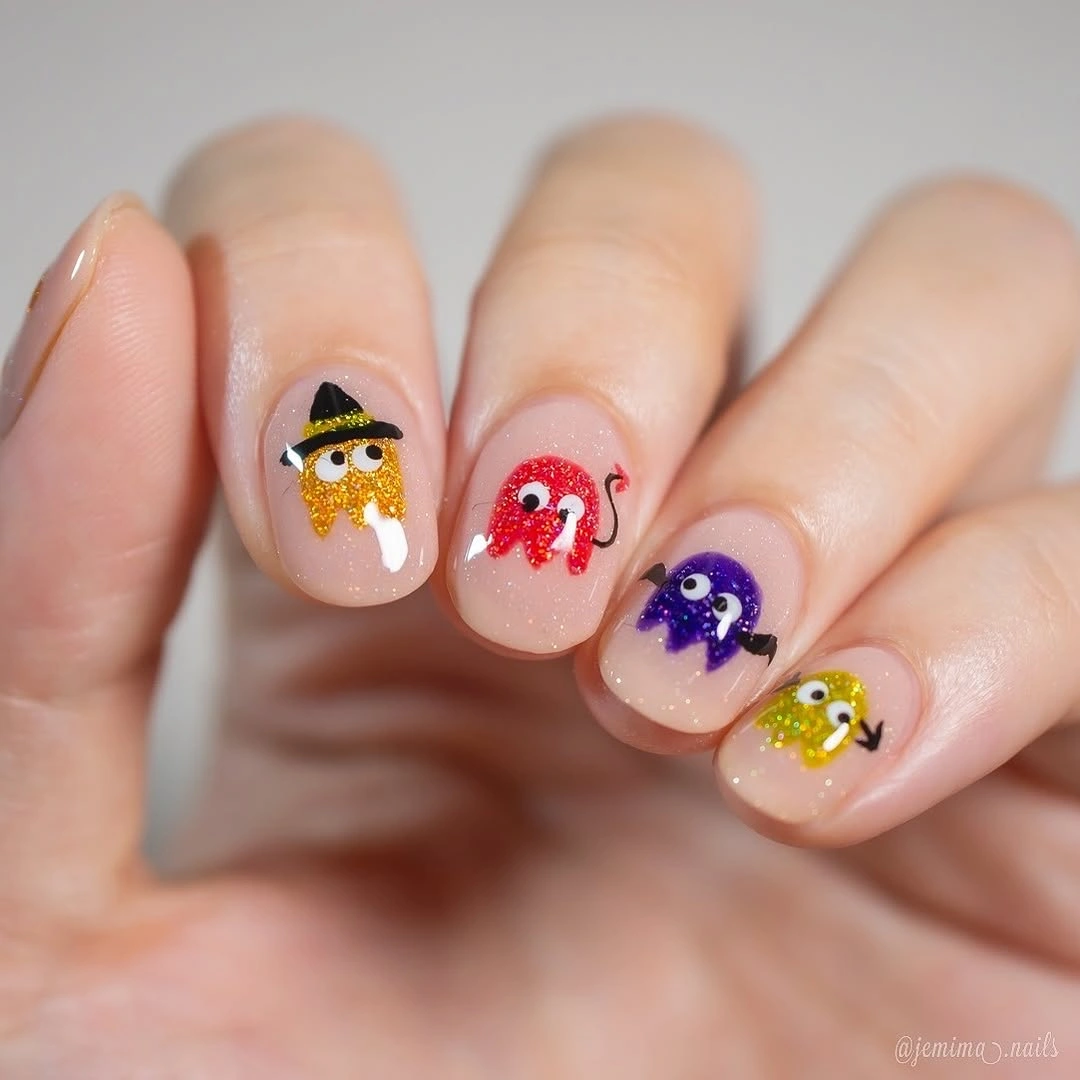
On a shorter nail, simplify each face to its clearest eyes and mouth, then allow the colors to remain bright. Reducing the number of interior lines will protect the character identity better than lowering every color into a muddy pastel. A single pale nail can act as a pause if the saturated accents begin to compete.
The honest limitation is space. Saturated color can make a small drawing feel larger, but it cannot create room for extra detail, so the motif must stay simple. Keep one character idea per nail and repeat the general scale; the manicure will feel coordinated when the brightness varies but the visual size does not.
5. Cool Blue and Black Give Eyes More Depth
Very long coffin nails use black, deep blue, silver, and white to build a cool horror palette around eye-like and web-inspired details. Blue lowers the temperature of the black base, while silver and white provide value breaks that let the repeated motifs emerge. The result feels nocturnal because the colors are deep and cool, not because the design needs a literal night scene.
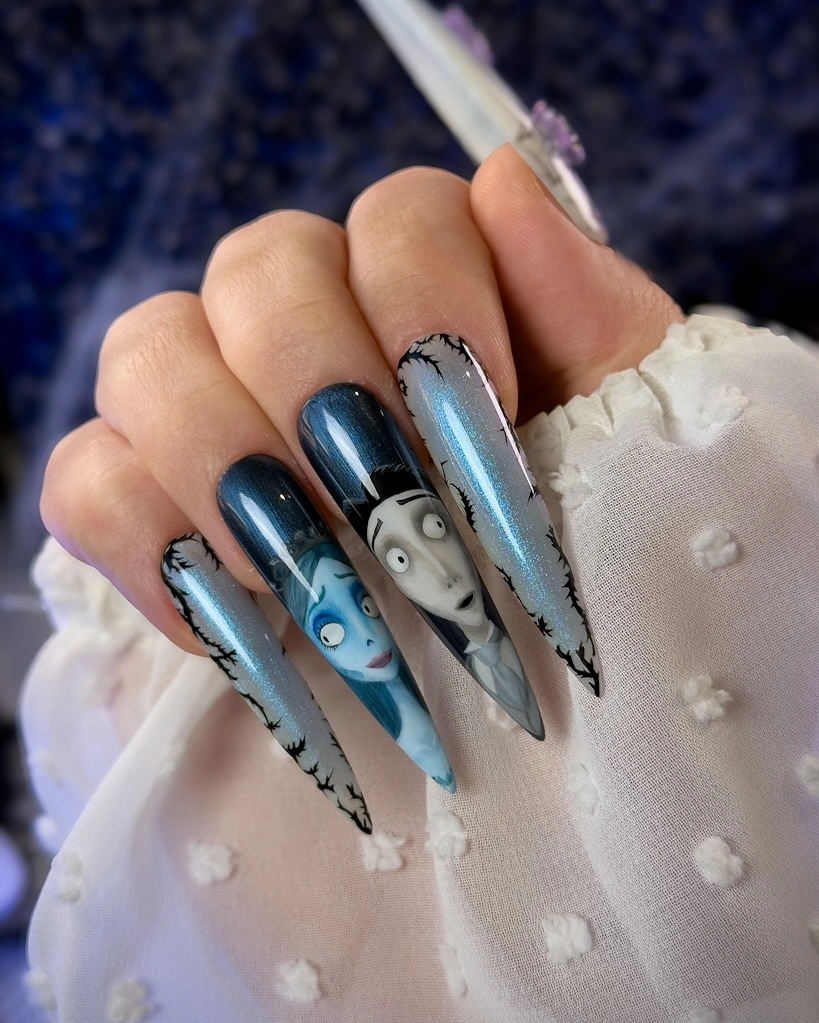
For a shorter coffin, keep the blue-black base and one eye detail on a pale or reflective accent nail. Remove extra colors before removing the contrast, because the cool relationship is what gives the design its depth. A dark base with one silver-white mark can carry the mood on medium almond nails as well.
The length allows several internal details to repeat without becoming cramped, so shortening it changes the density first. Keep the motifs larger and fewer rather than shrinking them into the same long-nail arrangement. The design remains convincingly eerie when the cool value structure is preserved, even after the surface becomes simpler.
6. Pastel Motifs Need a Shared Base
Medium nails mixing pastel ghosts, webs, moons, and warm accents show how a varied motif set can stay connected through a shared light base. Pink, orange, purple, black, and white appear together, but the soft background lowers the contrast between neighboring symbols. Repetition comes from scale and spacing rather than one repeated character, which makes the set feel varied without becoming disconnected.
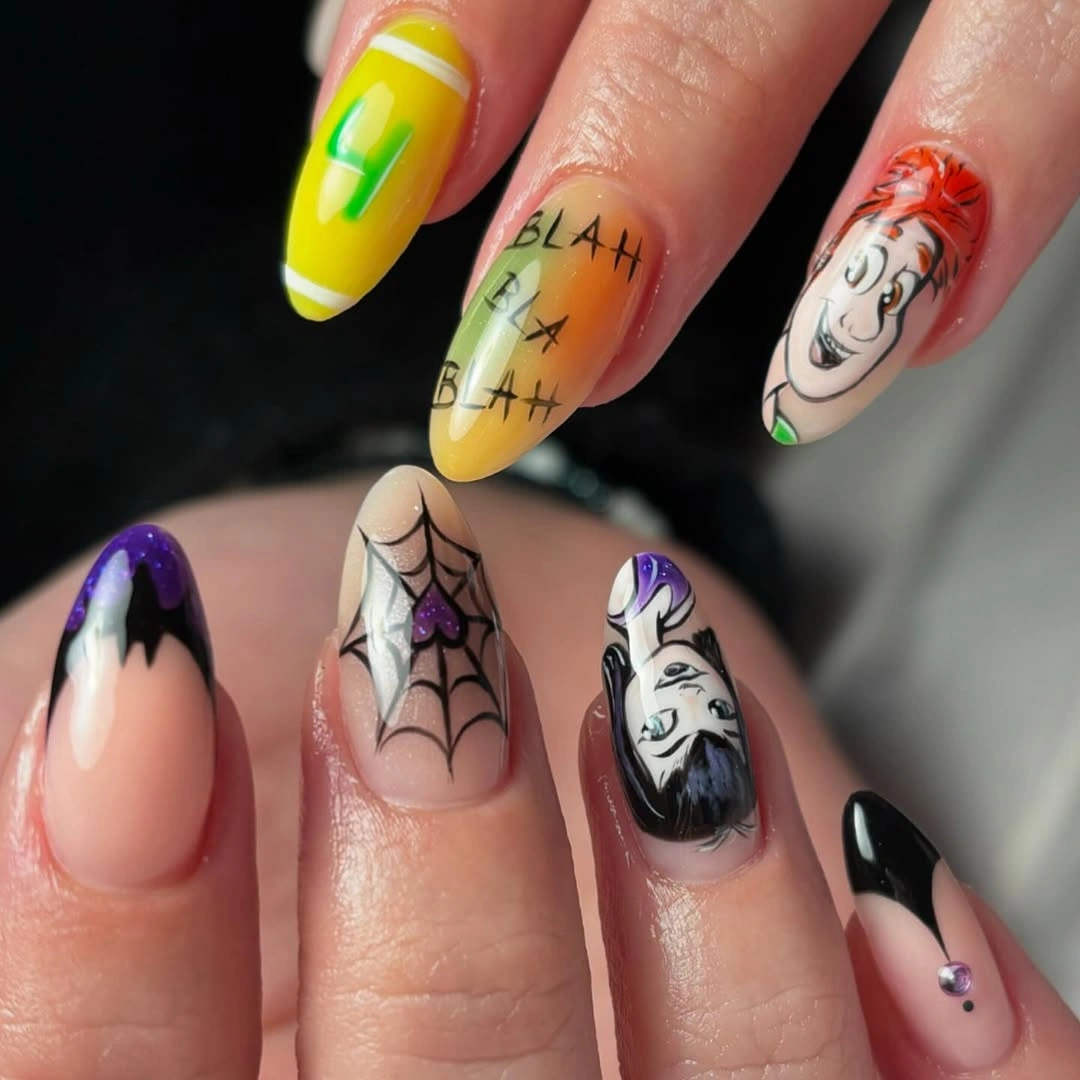
If you adapt this idea to shorter nails, limit the hand to two accent colors plus black linework, and keep the pale base visible on most fingers. That keeps the motifs from competing and makes the color relationship easier to read. A ghost with one web or moon detail can replace a more crowded illustrated panel without losing the seasonal reference.
The color lesson is neutral support. Pastel shades can coexist because the base gives them a common value level, but a dark or highly saturated background would force stronger separation between every symbol. Preserve the light field first, then choose which two accents deserve the most attention on the hand.
7. Orange Warmth Meets Cool Purple Bats
Medium almond nude and orange nails with black bats and purple star-like accents balance a warm base against cooler small details. Orange supplies seasonal heat, while purple cools the composition and prevents the design from becoming a single-color autumn set. Nude space supports both temperatures, giving the dark icons somewhere clear to sit.
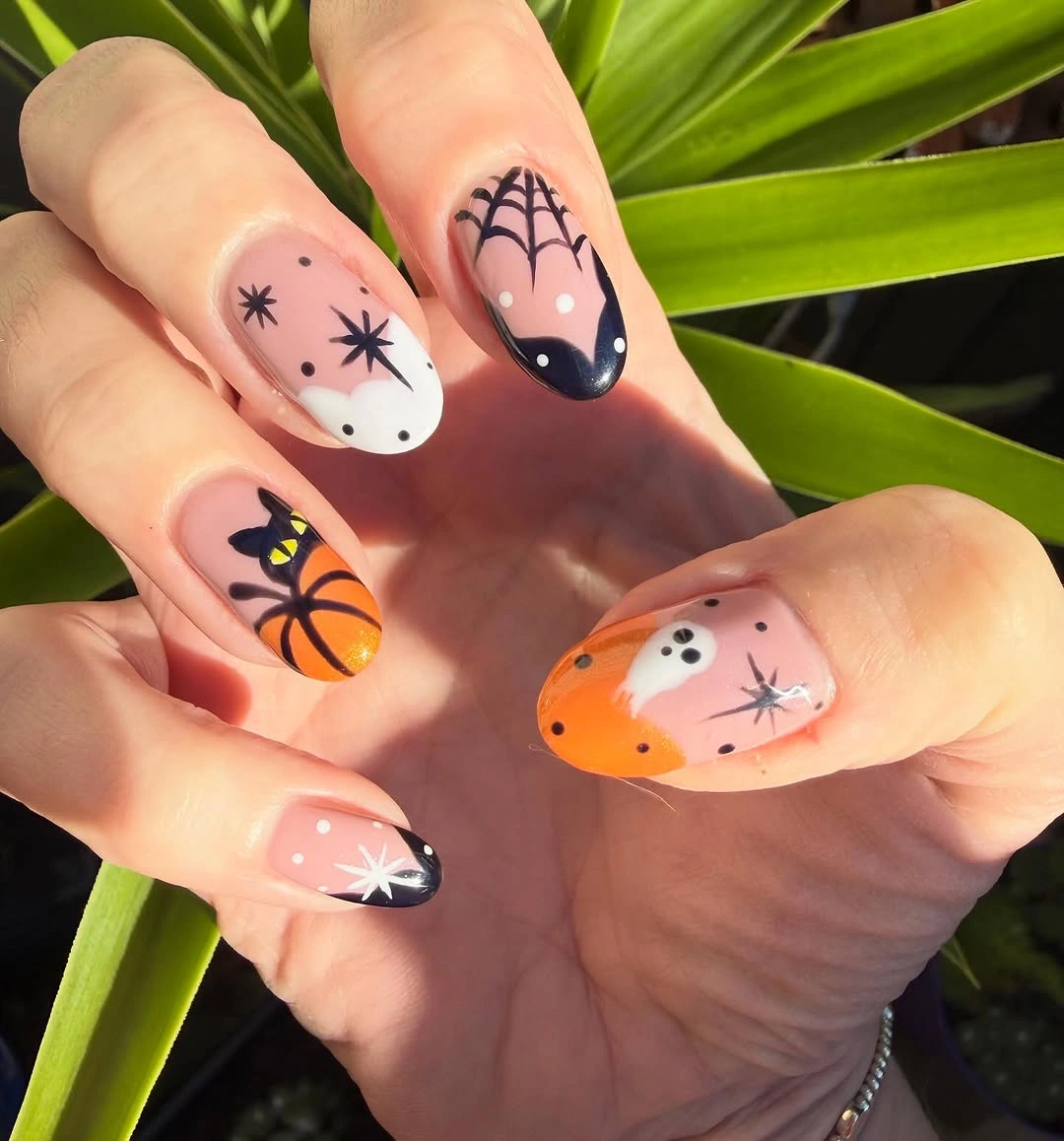
For short nails, keep orange on one or two solid or softly colored tips and use purple only for the smallest stars or curved details. The color contrast will remain visible without forcing several tiny icons into one surface. If the orange feels too bright, mute the base rather than adding another neutral over the motifs.
This design works because the warm and cool colors are not equal in area. Orange carries the base, purple adds a few cool notes, and black gives the icons their outline. Equalizing the amounts would flatten the hierarchy, so keep one temperature dominant and let the other act as a controlled counterpoint.
8. Small Black Lines Keep Pink Nails Subtle
Short almond pink nails with small black Halloween drawings use a low-saturation base and narrow dark lines to create a delicate seasonal mood. Pink supplies the light value and warm softness, while black marks give the eye a few precise places to stop. The design feels intentional because the symbols are reduced to clear outlines instead of being surrounded by extra color.
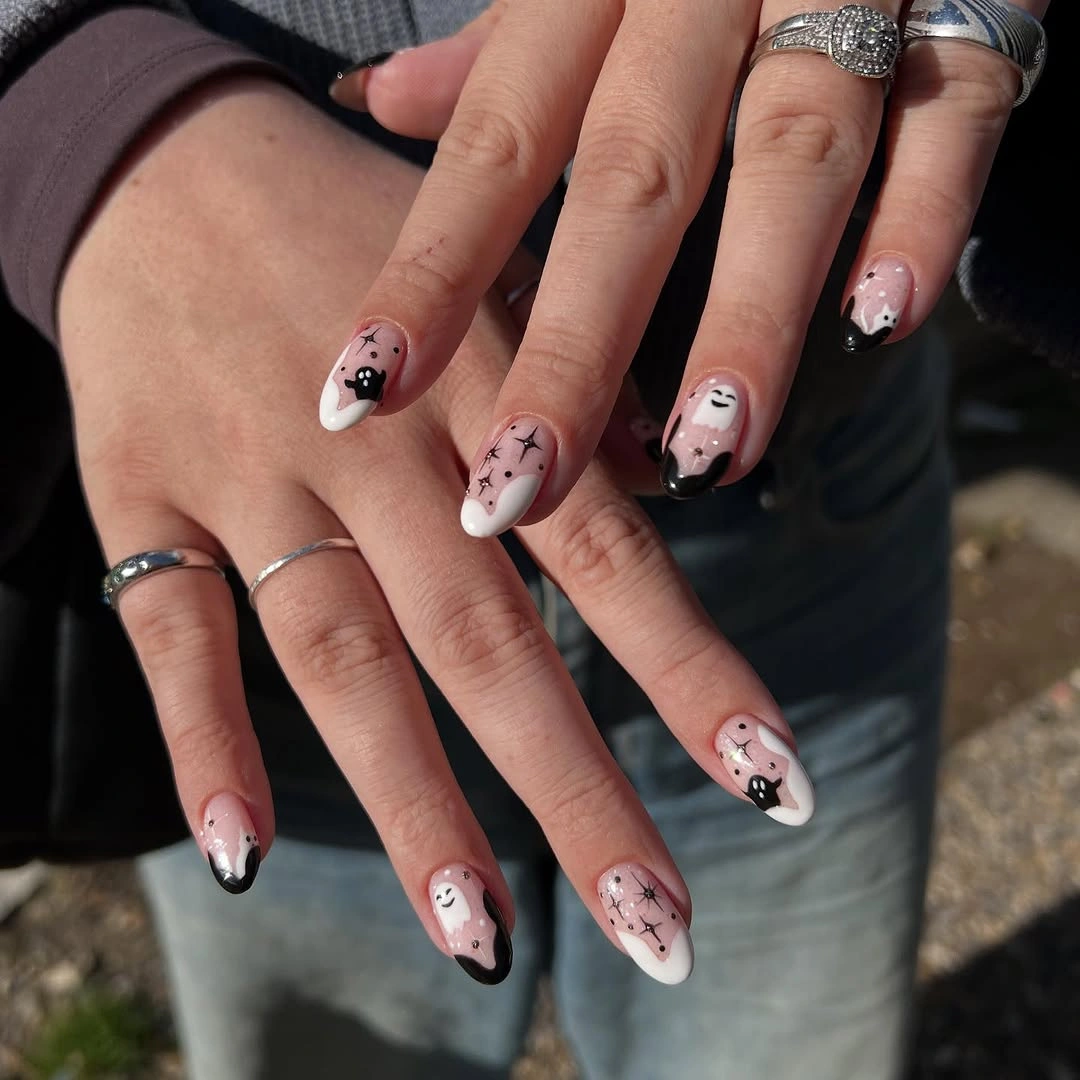
Keep the pink base on most nails and repeat one simple black symbol on two accents when adapting the look. A single bat, web, or curved mark can carry the idea better than several tiny drawings competing on a short tip. The low-saturation field will remain the main support, so do not darken it just to create more drama.
The limitation is that subtle color needs a strong enough outline to stay visible. If the black is too thin, the motif disappears into the pink; if it becomes too broad, the soft mood is lost. Change the line width carefully and keep the base light, because the balance depends on the difference between a quiet field and a precise mark.
9. Brown Plaid Connects Cozy and Spooky
Long almond nude nails with warm brown plaid and black web accents place a cool Halloween symbol inside a cozy fall color system. Brown lowers the saturation and adds visual texture, while the black web supplies a sharper contrast that keeps the manicure from becoming purely rustic. The result bridges seasons through temperature and pattern instead of relying on one literal icon.
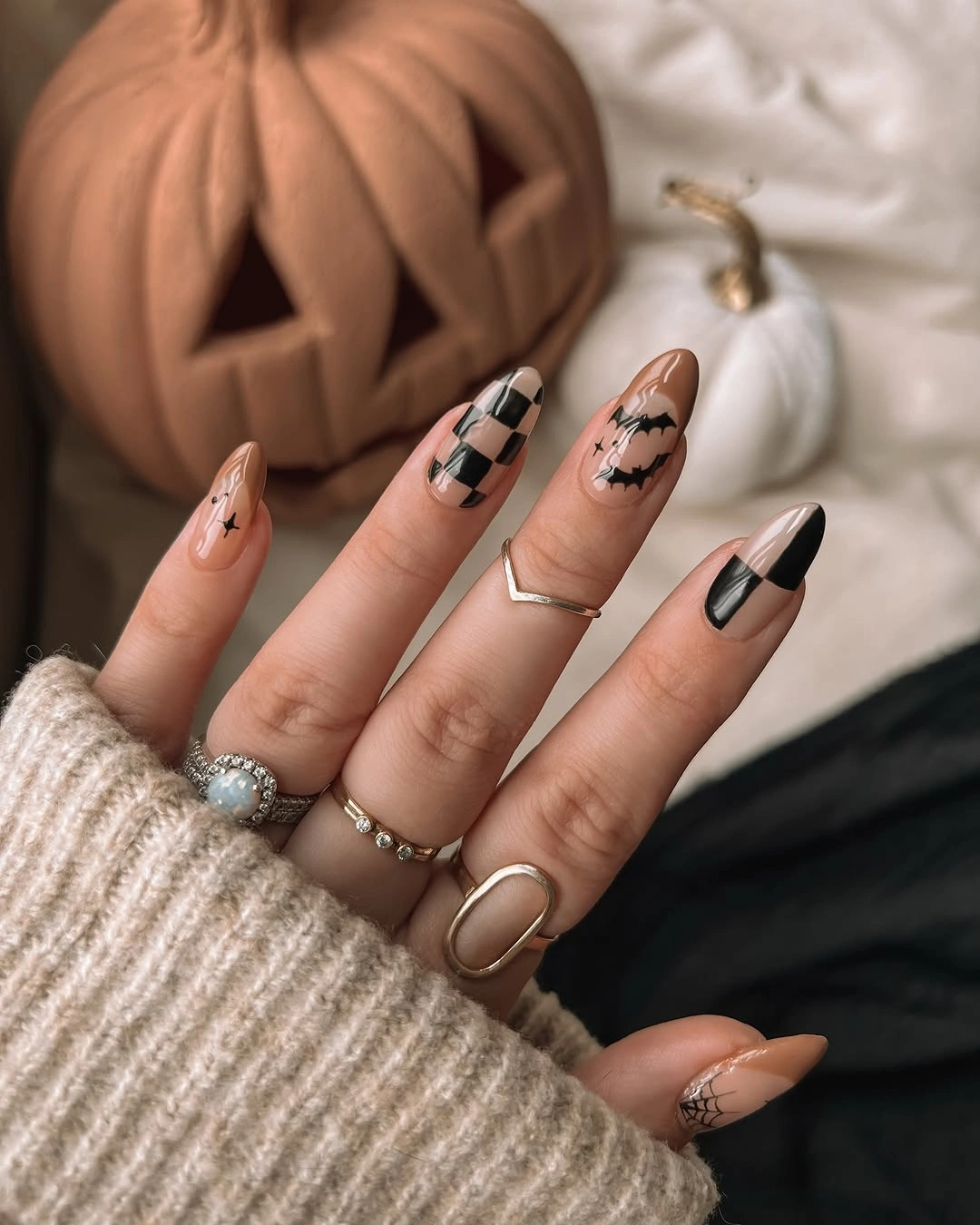
For shorter nails, keep the plaid on one accent and use a single black web on a pale neighboring nail. That preserves the warm-cool contrast without compressing two detailed patterns into the same small space. The idea pairs naturally with fall burgundy nails with design if the brown is shifted slightly deeper while the web remains black.
Pattern density is the variable to watch. Plaid already contains repeated lines, so the web should stay open and simple; adding a dense spider motif would obscure the relationship between cozy texture and sharp symbol. Let brown carry the background rhythm and black provide only the contrast needed to make the seasonal turn visible.
10. Burgundy and Nude Build a Quiet Gothic Base
Short almond burgundy and nude nails use dark solid color beside pale accent nails with fine black patterns, creating a quiet gothic mood. Burgundy is warm and saturated enough to anchor the hand, while nude raises the value and gives the linework space. The palette feels refined because the strongest color is repeated as a block rather than used inside every small detail.
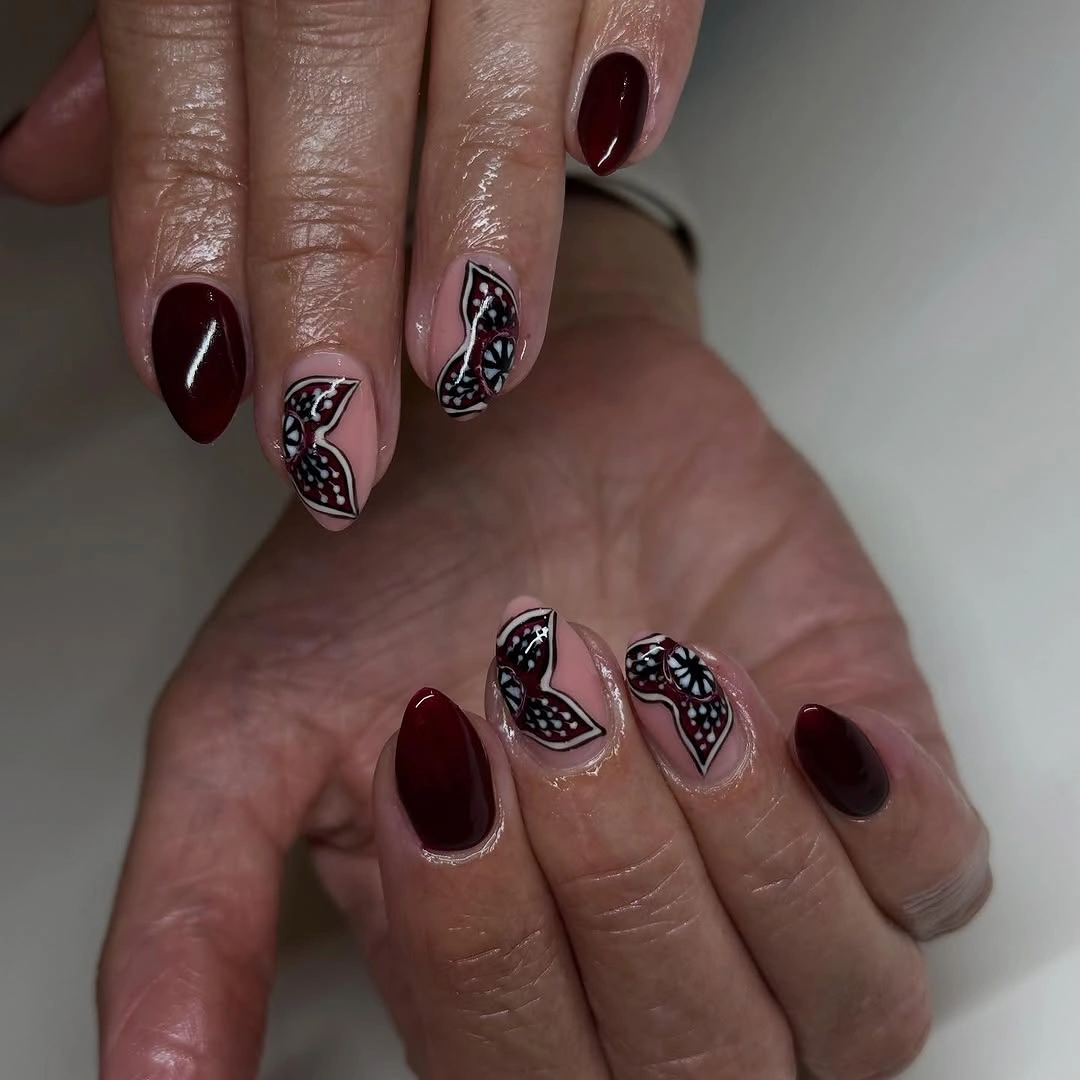
On a shorter shape, keep the burgundy on two fingers and use nude with one black web-like mark on the others. That keeps the contrast readable and makes the design easier to refresh than an all-over illustrated set. The dark base can also connect to dark fall nails while the nude accents stop it from feeling too heavy.
The color relationship depends on value more than ornament. Burgundy and nude are far enough apart to create a clear rhythm, so the black lines should remain secondary. If the linework becomes too bold, it will compete with the burgundy blocks; keep it fine and let the two base colors define the mood.
11. Yellow and Orange Give Cartoon Art Energy
Long pointed nails with yellow, orange, black, and white cartoon motifs use a warm saturated palette that turns Halloween art into a lively illustrated story. Yellow raises the brightness above the orange, while black outlines keep the symbols readable and white gives the busiest panels a pause. The colors feel coherent because they share a warm direction and repeat across different drawings.
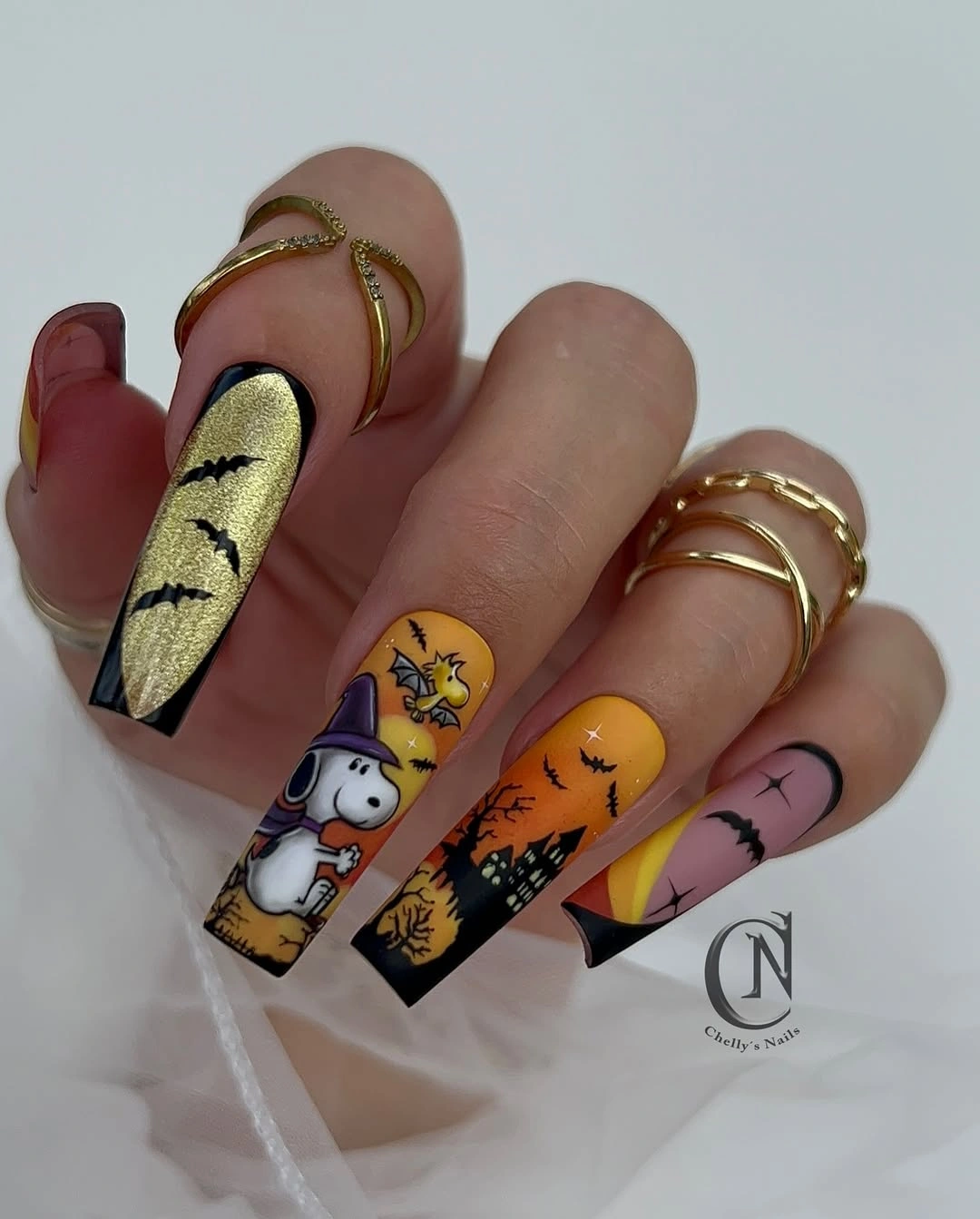
For medium almond nails, keep yellow on one accent and orange on another, then let black-and-white linework connect them. Removing extra characters will make the set more wearable without losing the high-energy color relationship. If the brightness feels too strong, soften the yellow first; the orange and black contrast can remain as the seasonal anchor.
The length and saturation together create a bold effect, so changing either variable will alter the mood. A shorter shape lowers the drama, while a muted palette makes the illustrations calmer. Decide which feature you want to keep, then edit the other one deliberately rather than reducing everything at once.
12. Many Bright Charms Need One Color Story
Very long coffin nails with colorful raised-looking charms, bows, and spooky figures use pink, green, purple, blue, gold, and white in a maximal arrangement. The palette is broad, but repeated jewel-like tones give the separate focal points a shared temperature and level of intensity. Color is acting as the glue that lets the sculptural details remain varied without looking accidental.
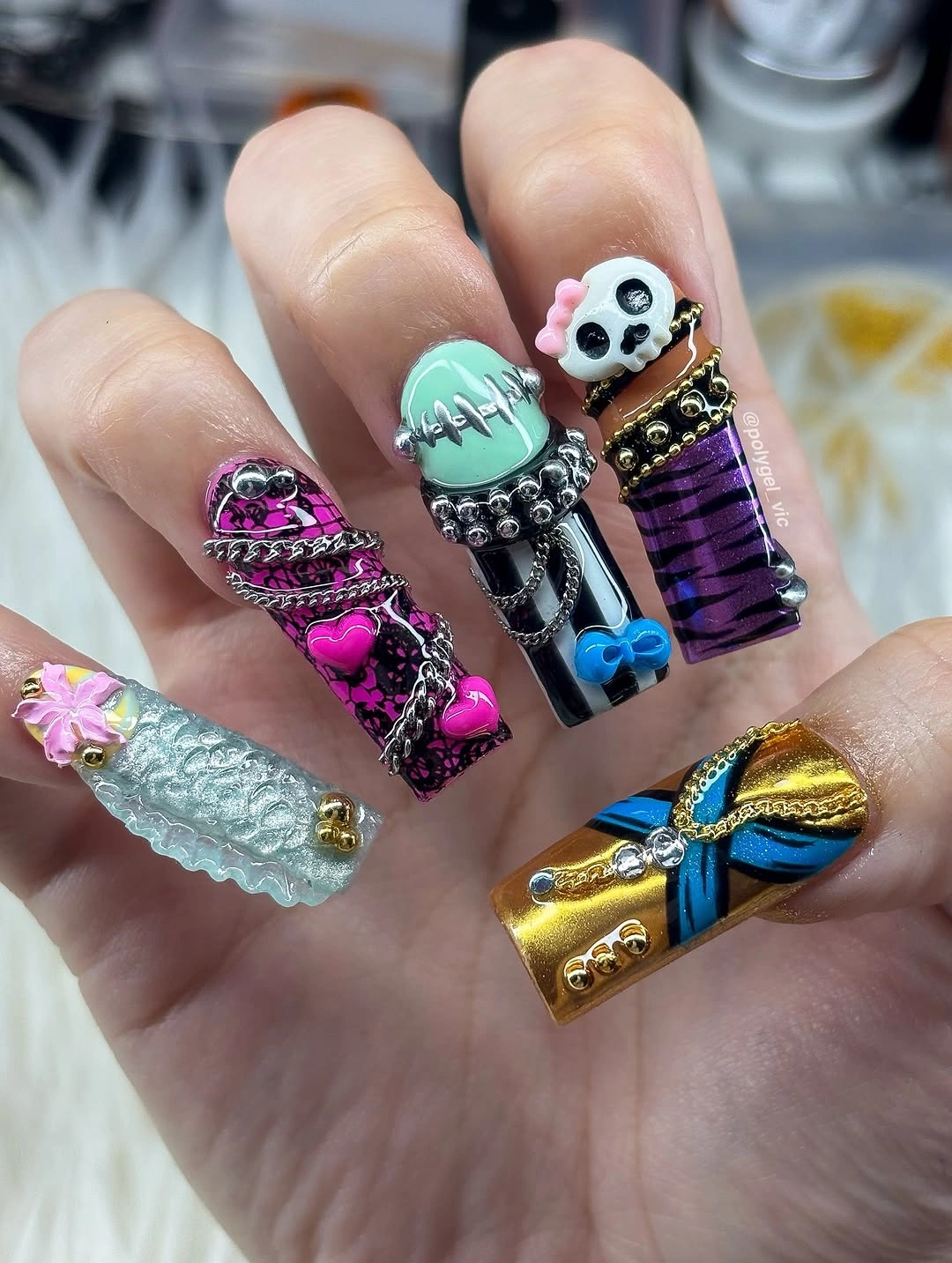
A practical version would keep one statement charm and one supporting accent color, then let the remaining nails repeat a deep base. That reduces surface density while preserving the idea of a colorful Halloween set. Keep the strongest two colors together so the shortened design still reads as one palette rather than a collection of unrelated decorations.
The main tradeoff is not only the long silhouette but also the number of color notes competing for attention. When the nail becomes shorter, remove charms and colors in pairs so the visual hierarchy stays clear. A smaller set can still feel festive if its bright accents repeat with intention and the base remains calm enough to support them.
13. Deep Red Webwork Changes the Familiar Formula
Long almond nude nails with dark red web-like lines use a warm alternative to the expected black-and-white Halloween contrast. The pale base keeps the drawing open, while deep red sits between autumn warmth and gothic darkness, giving the web a more individual mood. The color shift is small, but it changes how the familiar motif is read.
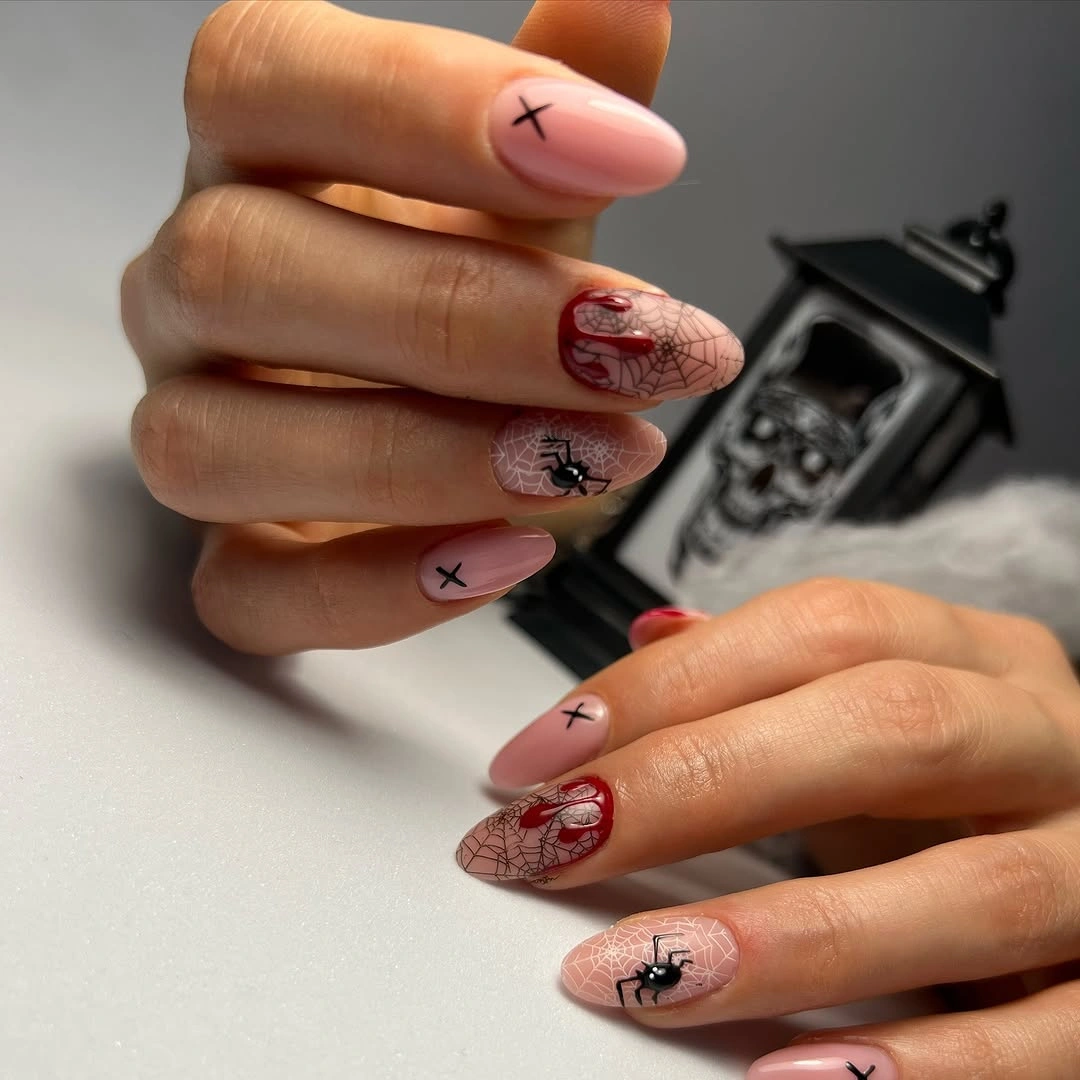
For a shorter adaptation, keep the deep red on one accent nail and repeat a small red curve on a neighboring nude nail. That preserves the warm contrast while reducing the number of thin lines that need to fit on the surface. It is a useful option for someone who wants seasonal art with less severe black, especially near fall matte nails.
The design shows how changing one variable can make a familiar idea feel new. The motif remains a web, but the temperature shifts from neutral-cool to warm and slightly muted. Keep the nude support visible and do not add a second bright color; the deep red is distinctive because it is allowed to remain the only strong accent.
14. Teal Makes Repeated Ghosts Feel Cool
Long pointed black and teal nails with repeated white ghost faces use a cool accent color to break up the dark base. The white faces create a steady rhythm, while teal adds temperature and depth without competing with the simple icon. Repetition is the organizing principle: the same small figure appears again and again, so color only needs to support its outline.
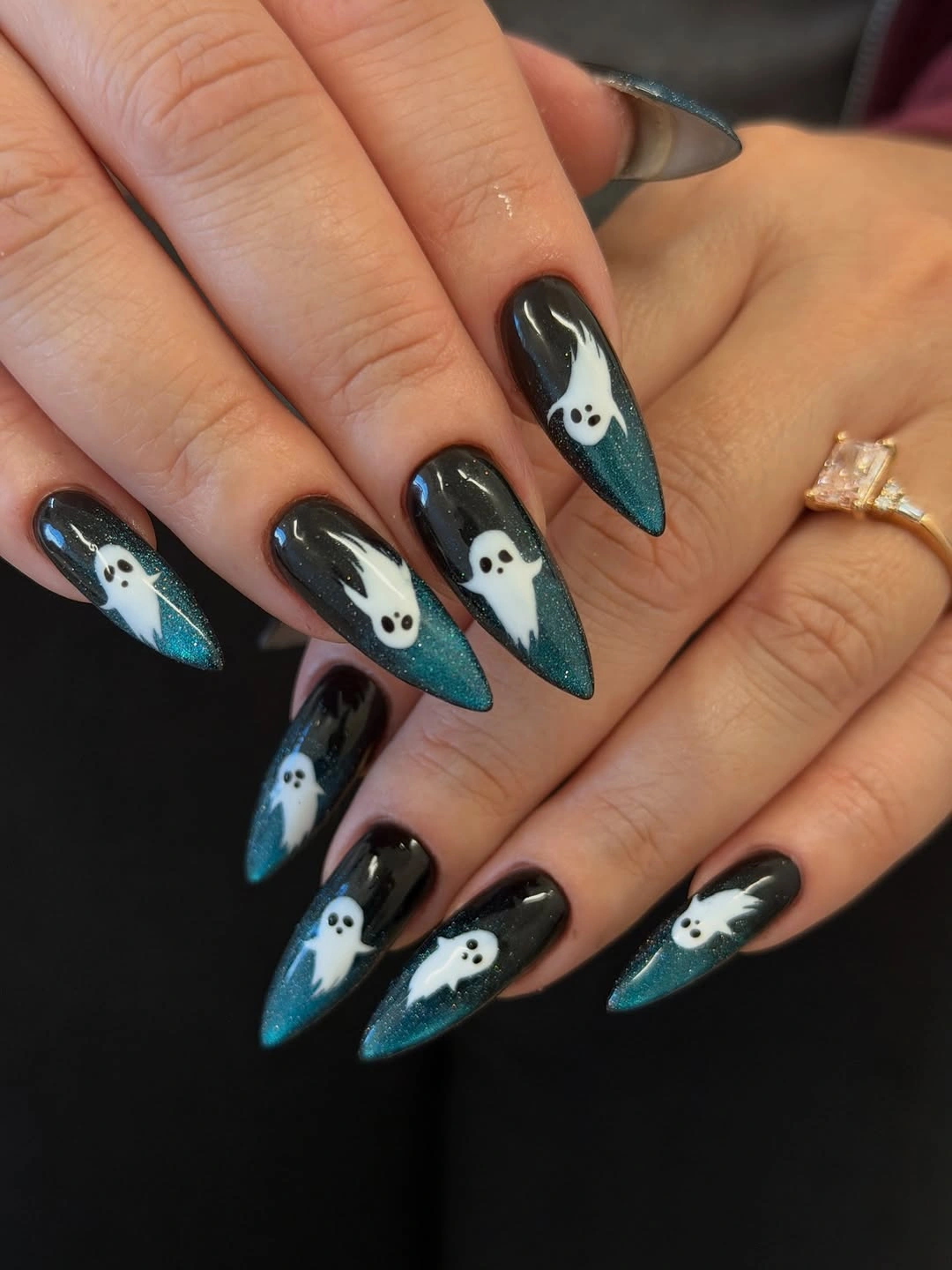
On medium almond nails, keep the black and teal blocks but reduce the ghosts to one clean face on each accent nail. The repeated icon will remain recognizable, and the shorter shape will make the composition less severe. If teal is unavailable, a muted blue can take its place, but keep the value dark enough to stay distinct from the white faces.
The color relationship is strongest when teal remains secondary to black. If teal fills too much of the hand, the ghost faces lose the dark frame that makes them pop. Keep the base dark, repeat the white symbol, and use the cool accent as a bridge rather than as a second main character or focal point.
15. Pink and White Turn Ghosts Playful
Medium almond pink and white nails with cartoon ghost and face details use a light warm base to make spooky symbols feel friendly. White raises the value around the small faces, while red and black add enough contrast for expressions and outlines to remain clear. The mood changes from eerie to playful because the palette is soft even though the motifs are unmistakably seasonal.
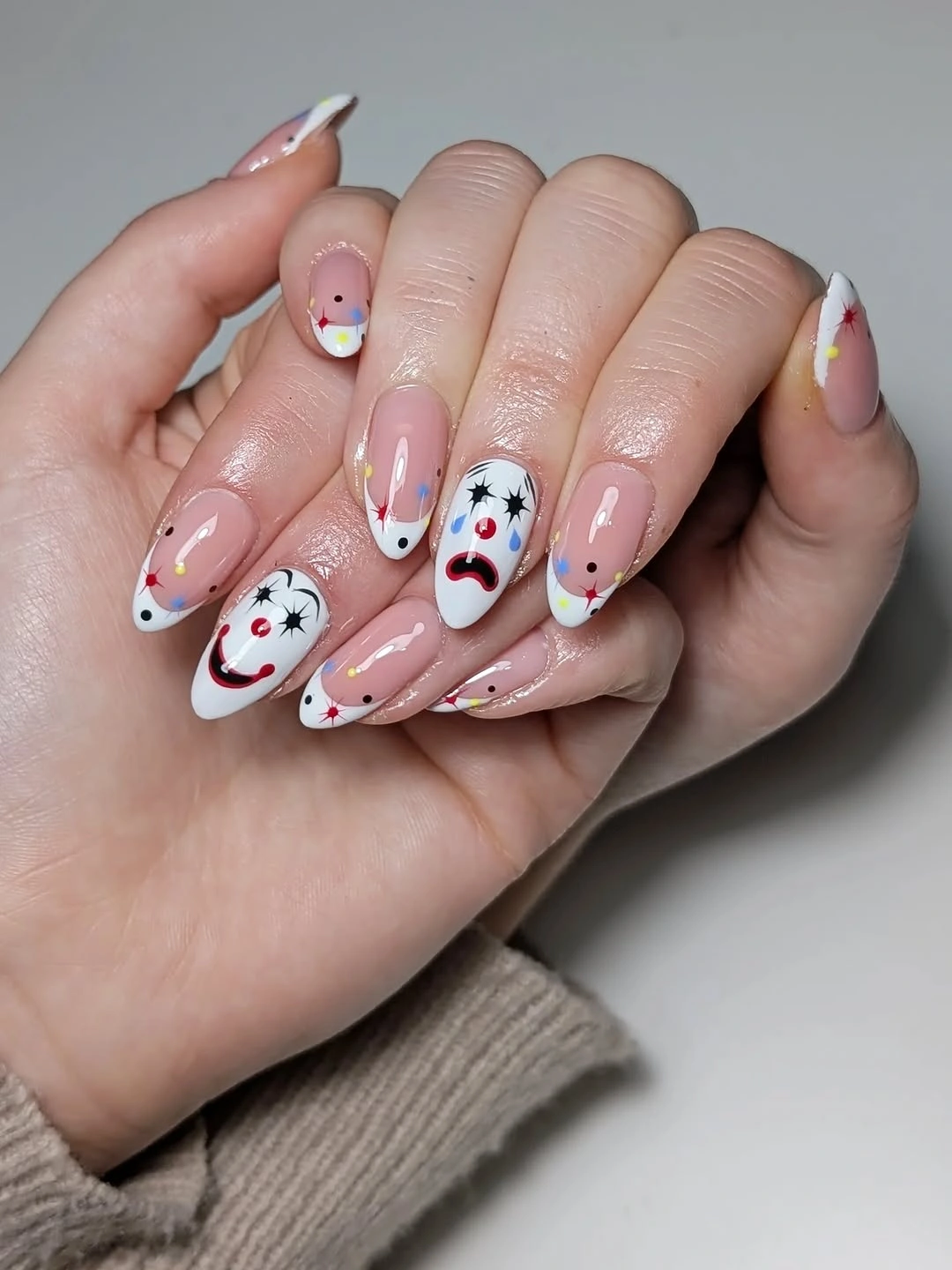
For short nails, keep the pink base and use a single white ghost face on two accent fingers, with black or red only for the clearest features. Reducing the interior marks will protect the expression better than trying to preserve every small line. This approach gives a cute Halloween option without requiring a long surface for the character art.
The useful color rule is to keep the pale tones dominant and the dark accents narrow. If black fills too much of the nail, the design will move toward a harsher cartoon contrast; if red is repeated everywhere, it may overpower the faces. Let white and pink establish the mood, then use dark marks only to clarify the icon.
16. Pastel Space Keeps Several Symbols Legible
Short pastel nails with spiderwebs, ghosts, dots, and soft color blocks rely on open value rather than strong saturation. White and pale pink leave room around the black symbols, so the small motifs remain separate even when several types appear together. The composition feels delicate because the colors are quiet and the marks are scaled to the short rounded shape.
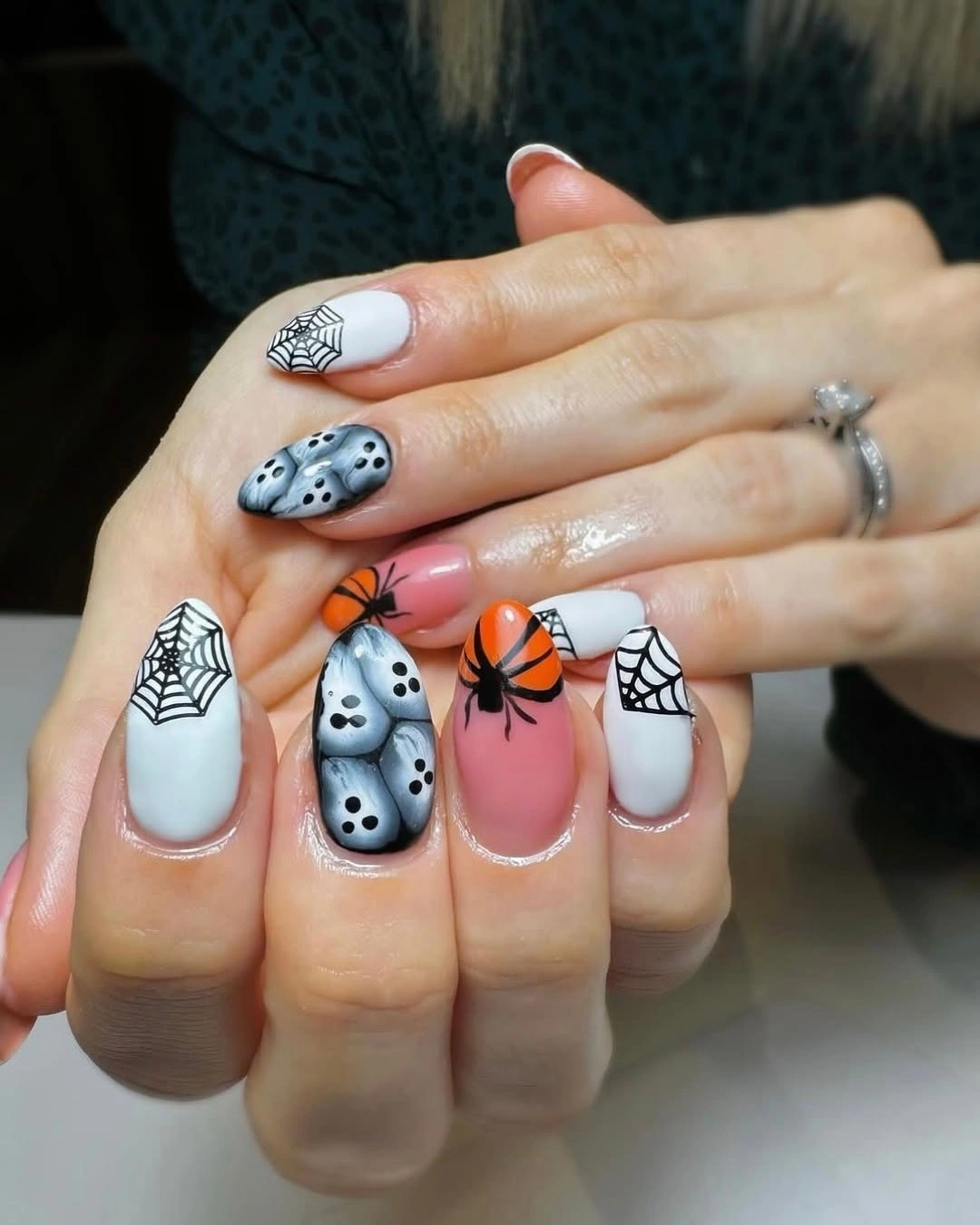
Keep the pale base on most nails when adapting the set, then choose black as the single outline color and one soft accent shade. This will make the web and ghost symbols easier to read without adding visual weight. A short nail can carry several motifs when the background remains open and the value range stays gentle.
The limitation is that pastel colors can lose definition if they are all too close in value. Keep a clear white or pale field around the darkest marks, and use one slightly deeper accent to prevent the hand from looking flat. The goal is not maximum contrast everywhere, but enough contrast at each small symbol to preserve its identity.
17. Mixed Blue and Pink Icons Need Repetition
Long coffin nails with blue, pink, black, white, and tiny Halloween icon panels use a varied palette, but repeated dark outlines and similar motif scale hold the set together. Blue cools the composition, pink warms it, and black supplies the common boundary that keeps the colors from drifting apart. The manicure reads like a collage because the colors repeat even when the icons change.
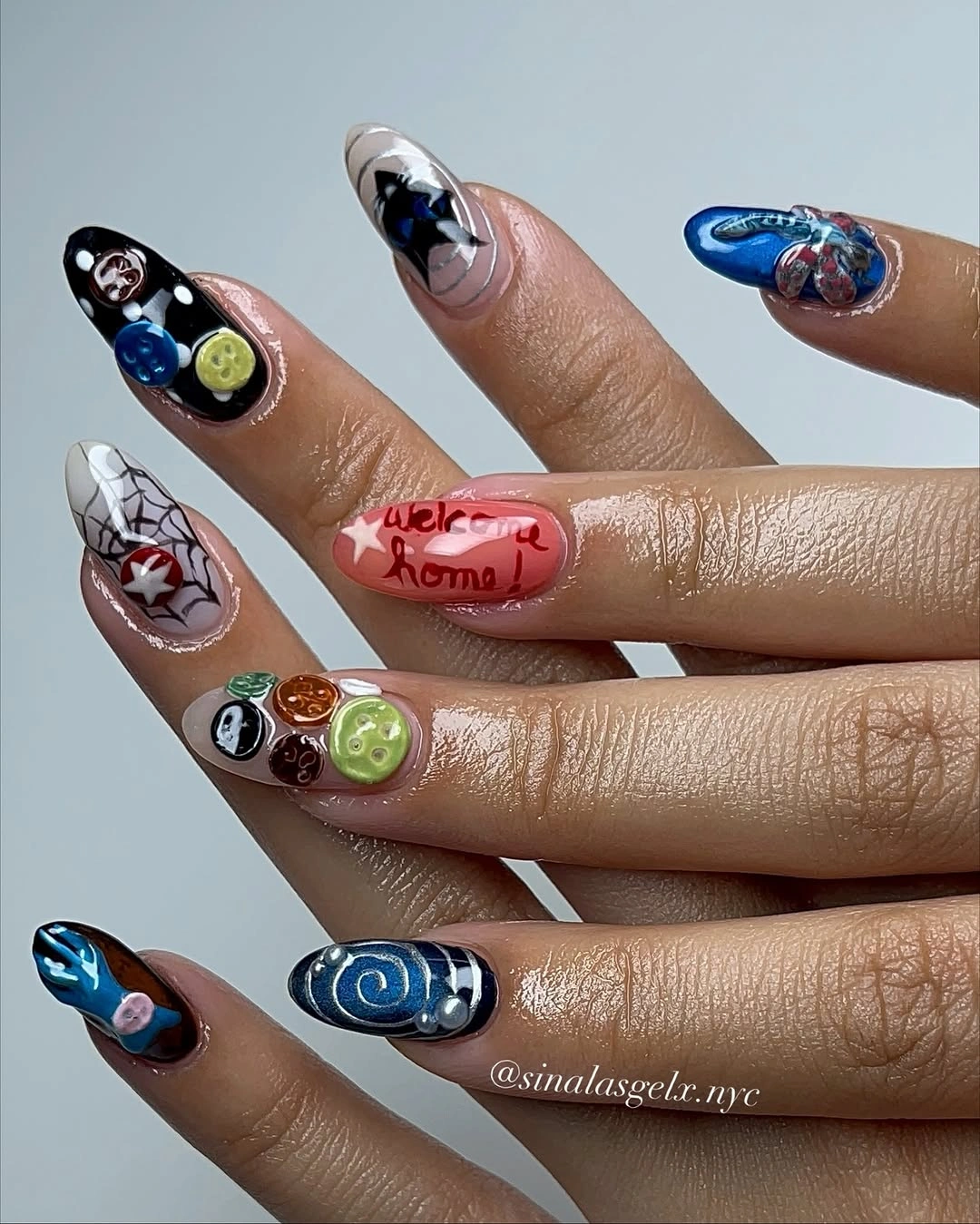
For a shorter version, keep blue and pink on separate accent nails and repeat black-and-white linework across both. Remove the smallest icon first rather than changing the entire palette, because the repeated outline is the element that creates cohesion. One blue panel and one pink panel can carry the same mixed-color idea on medium almond nails.
Color variety needs a visual rule or it starts to feel accidental. Here the rule is repeated outline style and similar icon size, so adding a new texture would require removing something else. Preserve one organizing feature when simplifying; the design can tolerate fewer motifs, but not a loss of repetition.
18. Black Holds Orange and Yellow Icons Together
Long almond nails combine black, orange, yellow, blue, and white with bats, faces, pumpkins, and other Halloween symbols. The black base acts as a visual container, giving the brighter colors a common field instead of allowing them to scatter. Orange and yellow supply warmth, while the smaller blue and white notes create cool or pale interruptions that keep the surface dimensional.
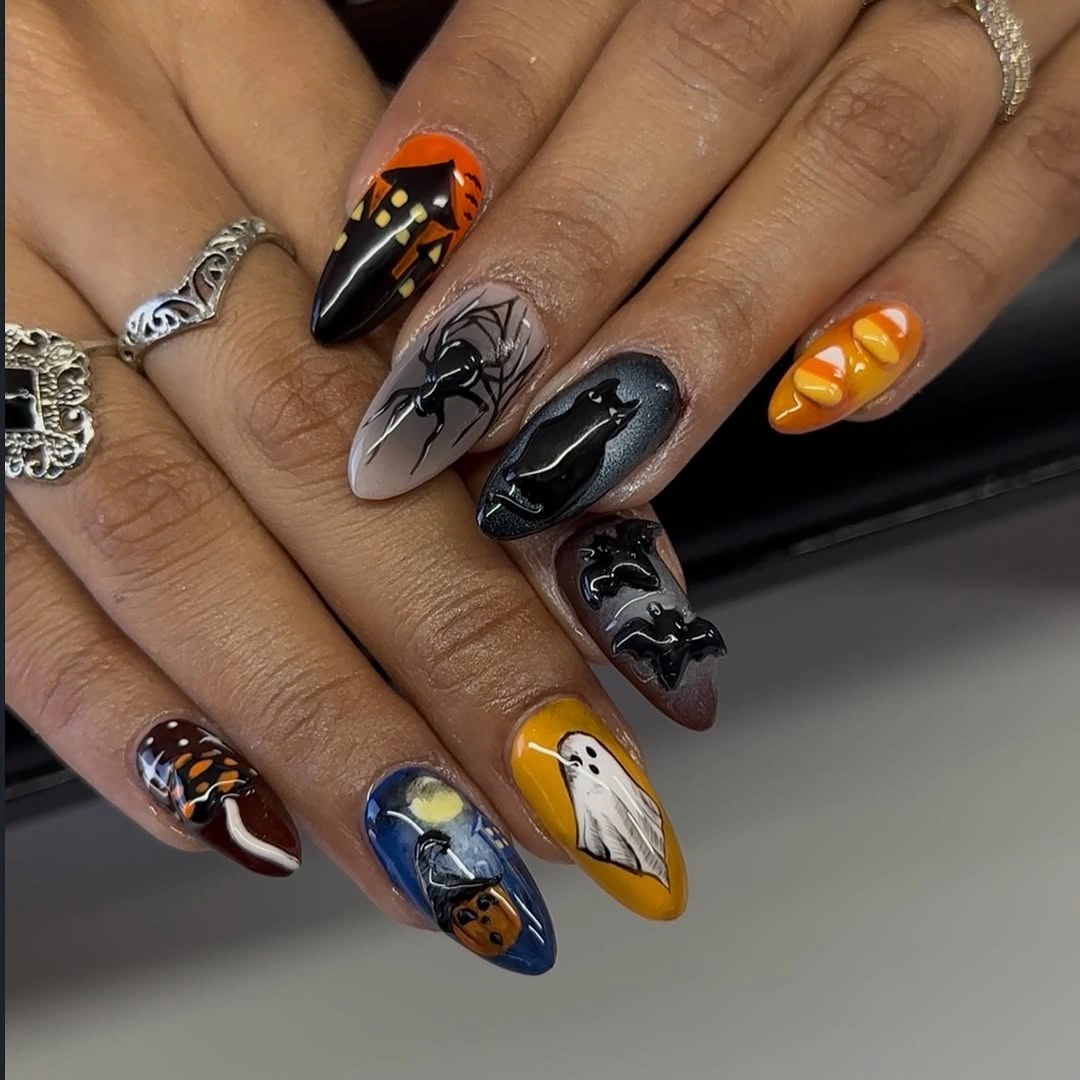
For a wearable adaptation, keep the black base and choose one warm icon family, such as pumpkins with orange details or faces with yellow accents. A shorter almond nail will benefit from fewer motifs and larger negative spaces. The palette can remain lively as long as one warm direction is dominant and the cooler notes stay secondary.
The strongest change would be reducing saturation only after the motif count is edited. Lowering every color while keeping the same number of icons may make the design muddy rather than calmer. Protect the black frame, choose the warmest accent, and let a single pale or cool mark provide the contrast needed to separate the details.
19. White Ghosts Use Shape as the Color Cue
Very long coffin nails with raised-looking white ghosts use a limited white, orange, and black palette, but the ghost silhouettes provide most of the impact. White stands forward against the dark sleeve and black accents, while orange gives the figures a small seasonal counterpoint. The color system is simple because the raised form and repeated shape are already carrying the visual story.
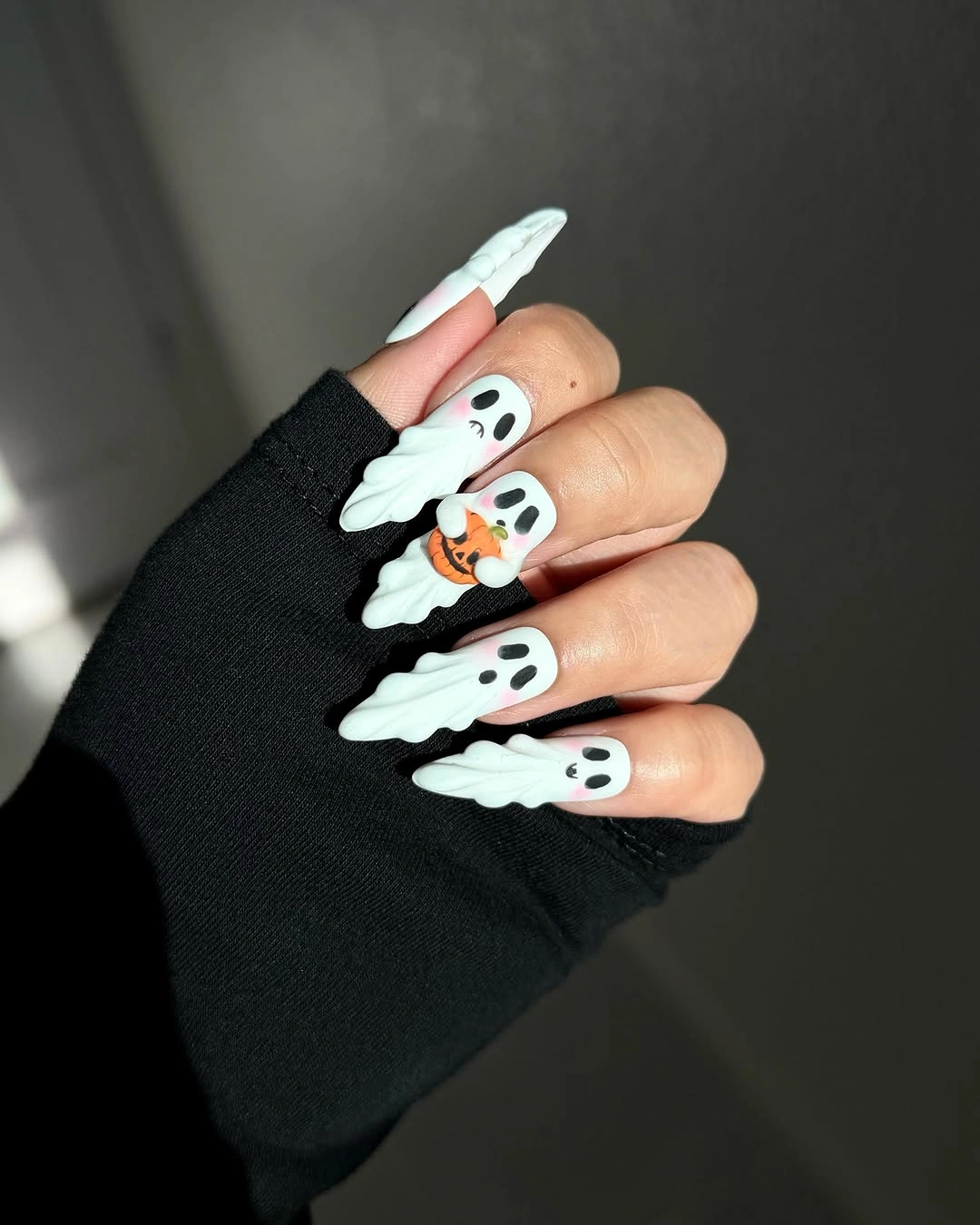
On a shorter nail, keep one white ghost as the focal accent and use a white or nude base on the neighboring nails with a small black outline. Orange can remain as one tiny warm detail rather than a repeated field. The idea will still feel Halloween-specific because the shape is recognizable even after the sculptural density is reduced.
The tradeoff is that a raised-looking white figure needs room around its silhouette to remain clear. If the nail is shortened, remove surrounding decorations before shrinking the ghost into an indistinct blob. Preserve the contrast between the white form and its dark support; that relationship is more important than matching the original number of accents.
20. Silver Texture Gives Black Nails a Metal Mood
Long pointed black and silver nails use metallic-looking panels, studs, and textured gray surfaces to create an industrial Halloween mood without literal characters. Black provides the deepest value, while silver catches light and stretches the eye along the pointed shape. The cool palette feels dimensional because the surfaces differ in reflectivity and texture even though the colors stay close.
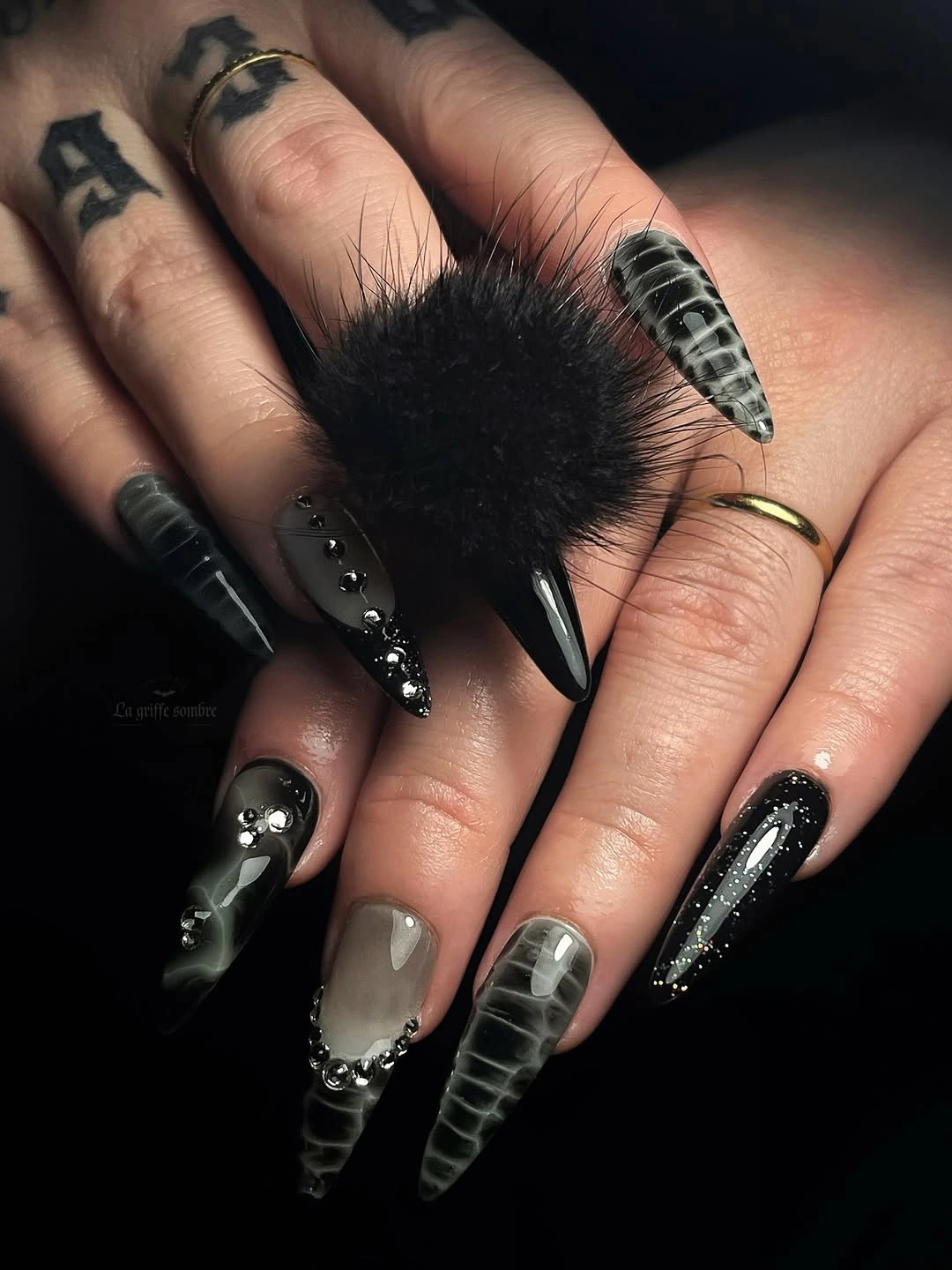
For medium almond nails, keep the black base and place silver texture on one or two accents, with studs used sparingly. That preserves the cool contrast without making the shortened surface look overloaded. A matte black field can make the metallic details clearer, but the silver should remain the brightest area so the color hierarchy stays intact.
The industrial effect depends on value and finish more than on extra decoration. Adding another bright color would pull the design away from its controlled metal mood, while removing every textured detail would make the black feel flat. Keep one reflective or raised-looking accent and allow the surrounding black to remain visually quiet.
21. Red Solids Make Simple Ghosts Read Clearly
Short rounded nails alternate glossy red with nude and pale accent nails carrying simple white ghost faces. Red supplies a warm saturated anchor, while the white faces create the highest-value focal points and the nude base keeps the hand from becoming too dark. The repeated icon is easy to understand because the palette is limited and the shapes are not crowded by extra linework.
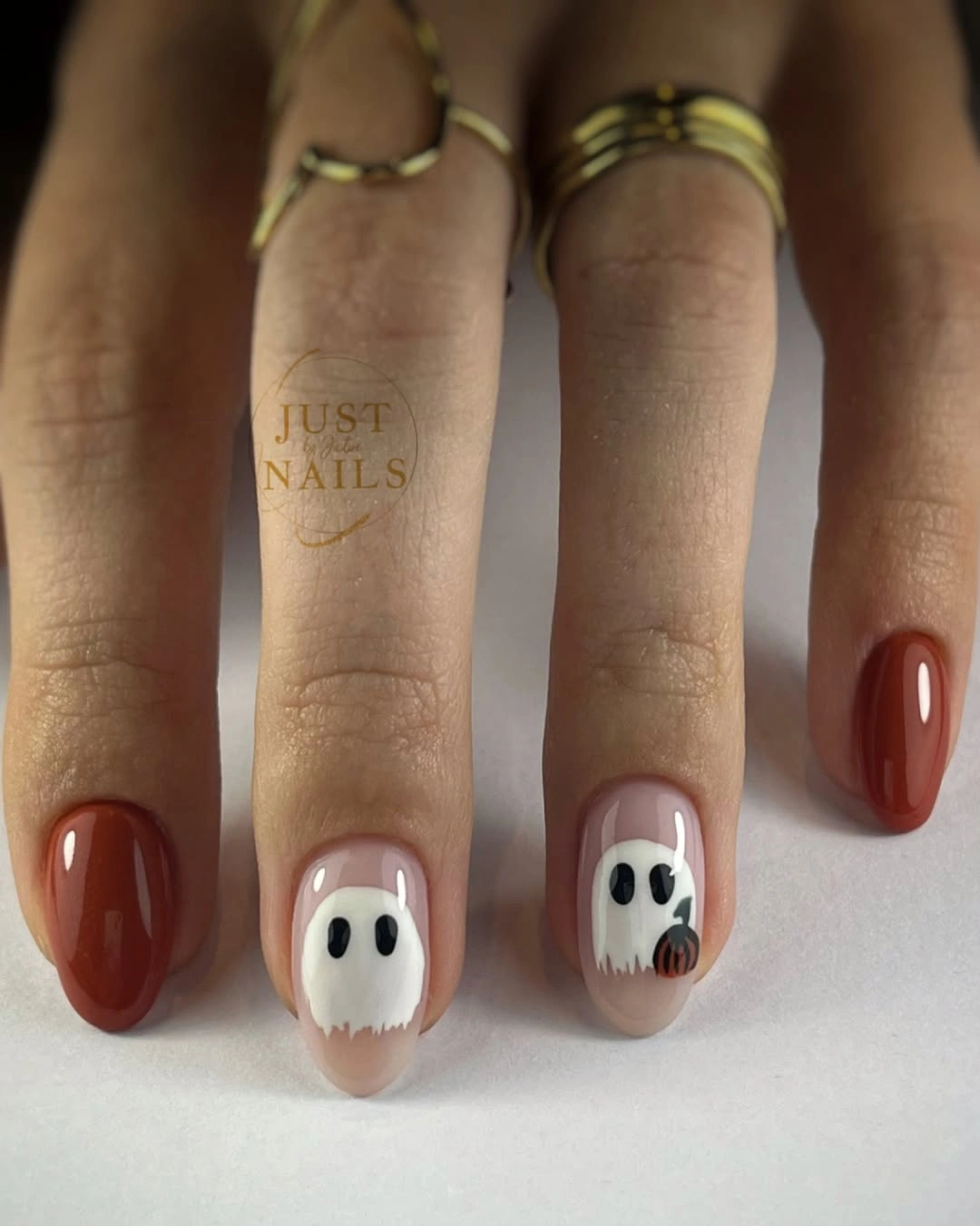
Keep the red on two nails and repeat the white ghost face on one or two pale accents when adapting the design. The short shape already supports the simple scale, so there is no need to add webs, stars, or extra colors. This makes a clear closing option for someone who wants fall burgundy nails with design but prefers a brighter red-and-white contrast.
The final color relationship is the easiest to preserve: warm red, pale support, and one repeated white icon. If the red becomes too dark, the manicure will move toward burgundy and the ghost faces may lose their cheerful contrast. Keep the solids glossy or clear in value, and let the white shape remain the detail the eye remembers.